
Do Glue Traps Work on Scorpions? What They Tell You and What They Never Fix
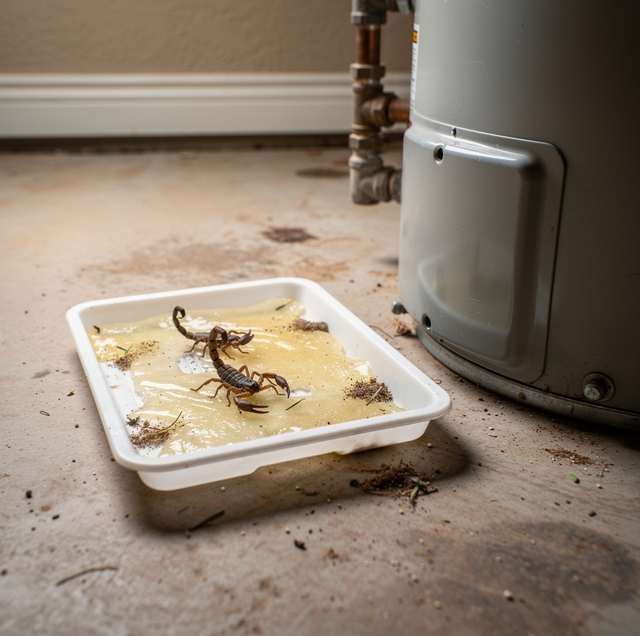
You checked behind the water heater on a whim, and there they are: two scorpions stuck to a glue board you put down two weeks ago. That reads like progress, and it's tempting to treat a full trap as proof the problem is shrinking. But a glue board can't tell the difference between catching the last scorpion on the property and catching the third of forty still working their way through the walls. It only reports what walked across it that week, on that stretch of floor, and nowhere else. Knowing what that report actually means, and where it stops meaning anything, is what separates a trap that earns its place in your monitoring routine from one that just gives you something to check on.
What a Glue Trap Actually Does
A scorpion glue trap is a flat sheet coated in a thick, tacky adhesive, usually paired with cardboard or a plastic tray that holds its shape on a hard floor. It has no active ingredient or bait, unlike a rodent trap, which uses cheese or peanut butter, though some versions add a scent lure. The mechanism is purely physical: a scorpion crossing the surface gets its legs and underside anchored in the adhesive, and the more it struggles, the more of its body contacts the glue and the harder escape becomes. A trap works the same way on a cricket, a roach, or a scorpion, which is exactly why pest control technicians use glue boards as a monitoring tool for all of those pests, not just this one.
That word, monitoring, is the whole point of the device sitting in your garage or laundry room. A glue board doesn't seek out scorpions, doesn't treat a structure, and doesn't reduce a population by removing breeding adults faster than they reproduce. It works less like a treatment and more like a smoke detector: it tells you something is happening, and roughly where, but pulling it off the wall and resetting it doesn't put out whatever set it off. Reading a full trap as a body count of a shrinking problem gives it credit for something it was never built to do.
Why One Scorpion off the Floor Doesn't Change the Population
Removing an individual scorpion from a floor path is not the same as reducing what's actually producing scorpions on your property, for three mechanical reasons that have nothing to do with how many traps you put down.
The first is reproduction. A female Arizona bark scorpion gives birth to live young rather than laying eggs, and a single litter can run roughly two to three dozen nymphs that ride on her back until their first molt, usually one to three weeks. That entire nursery stays inside a wall void, a woodpile, or a gap under a slab, never touching an open floor, until the young disperse on their own. A trap catches whatever wanders across open ground you've covered. It has no way to reach a brood still riding on a mother's back a few inches inside a block wall.
The second is that bark scorpions are strong climbers, unlike most ground-dwelling scorpion species. They move up stucco, across ceilings, and along the tops of baseboards as comfortably as they cross a floor, which means a meaningful share of the scorpions active on your property in a given week never cross a floor-level trap at all. A trap tells you about the population that happens to travel the ground plane where you set it down. It has nothing to say about the ones climbing the wall six inches above the trap's edge.
The third reason is food supply. A scorpion's presence on a property tracks the crickets, roaches, and other small insects it hunts, and a structure that keeps producing prey keeps drawing scorpions in to feed on it, regardless of how many wanderers got caught the week before. Trapping a few individuals off a busy path doesn't change how much prey is available around the foundation or in the landscaping, so new scorpions tend to move into a spot that keeps offering food long after the ones you caught are gone. Population size in a given area is set by how much shelter and prey it can support; the number of traps checking that area doesn't change what draws scorpions there.
A scorpion stuck in a glue trap can still sting. The tail and stinger are unaffected by the adhesive, so pick up trays by the edges only, and keep them well out of reach of curious pets and small children.
What the Catches Are Actually Telling You
None of that makes a trap useless. It just means the useful information lives in the pattern of catches rather than the raw count.
Where scorpions turn up matters more than how many do. A run of traps along one wall of a garage that keeps catching, while the rest of the house stays empty, points to an access route or harborage near that specific wall, not a house-wide problem. Trap catches that hold steady or climb over several weeks tell you activity in that spot isn't slowing down on its own, whatever else has changed. Size matters too: catching a mix of large adults and small juveniles in the same area points to a breeding population settled in nearby rather than an occasional adult wandering through. An adult-only pattern reads very differently than one that includes several sizes at once.
Put those three signals together- location, trend, and size mix- and a handful of traps you check weekly over a month can tell you far more about where the real problem sits than any single sighting could on its own.
What a Trap Can Never Show You
A trap can't identify the specific gap, crack, or weep hole a scorpion used to get inside, only the general area where activity clusters. It can't confirm a treatment worked, because a drop in floor-level catches could mean fewer scorpions are active, or it could mean the ones still around have shifted to climbing routes a floor trap was never going to intercept in the first place. And it can't reach the scorpions that matter most for actually shrinking a population: the ones still inside a wall cavity, under a slab, or in a woodpile, which are the ones producing next month's wanderers.
Dust and debris on a trap's surface reduce how well the adhesive holds, too, which is a separate, more mundane limit worth knowing about. A trap sitting in a garage corner collecting dust for months can let a larger or stronger scorpion drag itself partway free, leaving a smear behind instead of a clean catch. A trap that's been down since spring isn't giving you the same read as one you set out last week.
Cross-Checking Trap Data With a Black-Light Walkthrough
Because a floor trap misses anything traveling above ground level, a black-light walkthrough at night fills in a different part of the picture. Arizona bark scorpions fluoresce a distinctive blue-green under ultraviolet light, bright enough to spot from several feet away on a wall, a fence line, or a ceiling corner a trap could never reach. Walking the perimeter and interior walls with a UV flashlight after dark shows you scorpions actively out and moving in real time, including the climbers a floor-level trap will never intercept.
Used together, the two methods cover each other's blind spots. Trap counts build a record over days and weeks without you having to be present; a black-light walkthrough gives you a single-night snapshot of where scorpions are currently active on vertical surfaces. A property with heavy trap catches on the floor, but almost nothing showing up under UV on the walls, points toward a ground-level access issue. The reverse pattern, light trap catches, but scorpions glowing all along one exterior wall after dark, points toward a climbing route the traps were never positioned to see.
Getting a Useful Read From a Trap
A single trap in the middle of a room tells you almost nothing, because scorpions travel along edges far more reliably than across open floor. Traps earn their keep placed along baseboards, in corners, behind and under appliances, and near doors, since those are the paths a scorpion actually walks. Checking traps on a fixed schedule matters more than checking them constantly; once a week works for most homes, since a pattern only shows up once you have several evenly spaced data points to compare. Traps placed in more than one room also give you a location comparison a single trap can't: without a second reference point, there's no way to know whether a busy trap in the garage means the garage has a problem or the whole house does.
Turning Trap Data Into an Actual Plan
A month of trap data is a map, not a fix. It points to which wall, which room, or which side of the structure to look at closely, and whether the activity you're seeing is a couple of wanderers passing through or a breeding population that's settled in close by. What it can't do is close the gap they're using to get in, treat the harborage where next month's litter is riding on its mother's back, or reach a scorpion working its way through a wall cavity a floor-level trap was never built to intercept. That part of the work starts with knowing where to look, and a few weeks of trap data hands you exactly that: not a finished answer, but a set of coordinates worth acting on.
Frequently Asked Questions
One trap tells you almost nothing beyond whether scorpions are present at all. Three to six traps spread across likely rooms, the garage, the laundry room, and any room with a slab-to-exterior wall give you enough location data to see whether activity clusters in a specific area or spreads evenly through the house.
There's no evidence scorpions learn to avoid a trap from watching another one get caught; they don't have the social behavior or visual range that would make that kind of avoidance possible. A trap that stops catching usually just means the travel path shifted; there's no indication scorpions are steering around it on purpose.
It's possible but uncommon, since a female typically only carries her brood on her back for one to three weeks before the young disperse to hunt on their own. Catching her during that narrow window would remove the litter along with her, but most catches happen well outside that timeframe.
Scent lures marketed for insects and rodents aren't built around what draws a scorpion, so an unscented trap performs about the same for this purpose. Placement along a scorpion's actual travel path matters far more than any lure added to the glue.
Ongoing catches usually mean the entry point or harborage feeding that area is still active. A trap that keeps producing new catches month after month is telling you the source hasn't been addressed; the trap itself is doing exactly what it's supposed to.
The most common approach is to seal the whole trap in a bag and dispose of it, since prying a live scorpion off the adhesive risks a sting without accomplishing much. Some homeowners freeze the trap first to stop movement before disposal, which also makes handling it safer.
Reading a glue trap for what it can actually show you- activity level, general location, and whether a breeding population has moved in- turns a handful of scorpions on a board into a useful starting point. Getting from that starting point to a structure that doesn't keep producing scorpions in the first place means finding and closing the routes they're using to get in and treating the harborage behind them, work that happens off the floor and inside the places a trap was never able to reach.
Schedule a scorpion control inspection — turn a few weeks of trap data into a plan that finds the entry points and harborage behind them and closes the routes for good. Russell Pest Control serves the Phoenix Valley. Call (623) 469-7583.
