
Ants After Bee Removal: What's Still Drawing Them In
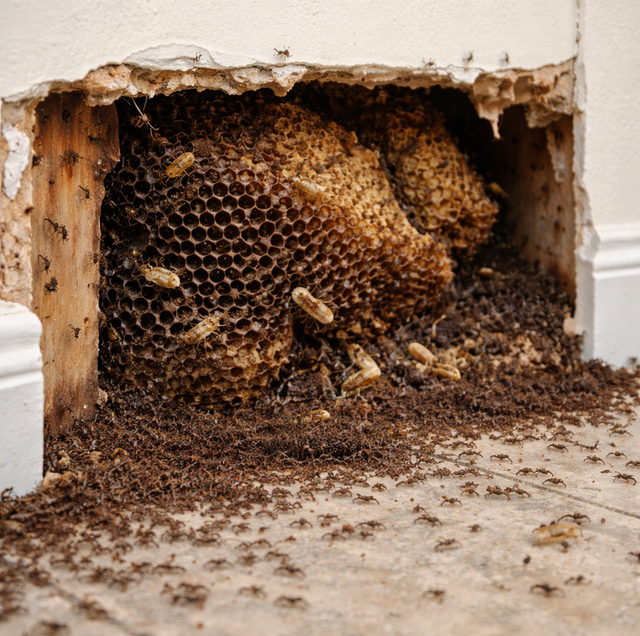
A line of ants is crossing your baseboard in the exact corner where a bee colony used to come and go. There is no hum this time. No cluster of bees hanging outside the entrance in the afternoon. Just ants, moving in a steady column toward a gap that used to belong to something else entirely.
That gap, and whatever is still behind it, is the real subject here. Bee removal solves the bee problem; what stays in the cavity afterward can start a second one.
What Can Still Be Sitting in the Cavity
A cavity ends up holding comb for more than one reason, and most of them aren't anyone's fault. A colony can die out or move on with nobody ever called. Someone can spray the opening, which may end the visible traffic without reaching the colony in the void. Comb can run deeper into a bay than the entrance suggests, into a space nobody could reach without opening a finish.
What stays behind is the same either way: capped and uncapped honey, brood at every stage, and the wax holding both. Beyond the thin residue any removal leaves in porous material, that behaves as a resource rather than a trace. A crumb on a counter dries out or gets swept up within a day. Pounds of honey and brood sealed in a closed void retain moisture, break down in place, and continue to give off a sugar-and-protein scent for weeks.
Ants Are Usually the First Ones You See
Ants forage individually before they forage as a group. A scout crossing a baseboard or a slab edge on routine patrol is what finds a fermenting honey source; a colony does not arrive all at once. Once she does, she lays a scent trail back to the nest and nestmates follow it out within hours. The column at the corner is that recruitment is already well underway.
Sweet-feeding ants already working baseboards and countertops for smaller food usually reach a leftover comb cavity first. Sometimes the trail turns out to be carpenter ants instead. They are heavy sugar feeders too, with honeydew as their staple outdoors, so a fermenting cavity reads to them much the way it does to the smaller species, and it is still an ant control matter handled on ant terms. Ant control itself is bait-first, built around tracing the trail back to the colony rather than treating the workers you can see.
Wax Moths Go Straight for the Comb
Nothing else in the house eats what wax moth larvae eat: old brood comb, the cocoon silk left in it, cast skins, and pollen residue. That narrow diet is why they are often the quickest thing to colonize abandoned comb rather than a late arrival. Larvae start tunneling through wax as soon as they hatch, so a cavity can be feeding moths while a scouting ant is still deciding whether the trail is worth running.
Webbing and grainy debris inside a wall cavity point at the comb behind them. That is a signal rather than a job of its own, and treating the larvae would leave the material that drew them. The response is the same as for everything else here: take the comb out.
Cockroaches Settle In When the Cavity Suits Them
Which of the rest turns up, and in what order, depends on what is already active around the structure. A property with steady roach pressure gets roaches; one with an established rodent population may get a mouse before it ever sees a roach, and plenty of cavities draw nothing but ants. The constant is the cavity, not the queue.
Roaches are looking for two things at once, and a leftover bee cavity offers both: a warm, humid void, and protein in the decomposing brood alongside the fermenting honey. They don't need to keep running a trail back and forth. A roach that finds a cavity like this can settle into it, feeding at night and retreating into cracks and seams by day.
That settling-in takes longer to show than the ants do, sometimes weeks, because a population is establishing rather than following a scent to a snack. The first sign indoors is usually where the cavity meets the living space: an outlet plate, a baseboard, a cabinet toe-kick.
A cavity doesn't need a wide opening to keep feeding insects. A quarter-inch gap around a pipe collar or under baseboard trim is enough for scouting ants or roaches to reach the comb sealed behind the drywall.
Rodents Take Longer to Commit
Rodents come for a different combination: fat and sugar in the honey and brood, plus soft material for nesting. Old wax comb and the insulation around it serve that second purpose, which is why a cavity that has already drawn insects can draw a mouse or roof rat too.
Rodents tend to be more cautious than either insect, often investigating on repeat visits before committing. When they do settle, gnawing at the edges to widen the original opening is common, since a bee-sized gap isn't rodent-sized. Chewed material and droppings near a former bee entry point are usually the first evidence, well before anything is heard inside a wall.
How Each One Reaches the Living Space
None of these pests need the same opening the bees used. Ants and roaches travel through wiring holes, plumbing chases, gaps at a top plate, or the joint where a baseboard meets the slab, whether or not that sits near the bees' original entry. A rodent does have to widen something, but it will use whatever penetration is already closest to the food rather than start a new one.
Where it shows up inside, tracks that logic: baseboards and outlet plates nearest the old entry, cabinet toe-kicks, attic access if the cavity sits in the roofline, or the edge of a kitchen wall the cavity backs onto. The activity is rarely centered on where the bees were seen; it follows whichever interior seam sits closest to the food.
What a Complete Cleanout Removes From the Chain
A full cleanout takes the comb, the capped and uncapped honey, and the brood out in one pass, and the entry point gets sealed afterward along with any sibling gaps found during the work. Every pest here loses its reason to be there at once: ants and roaches lose the food that started the trail, rodents lose the food and the nesting material both, and wax moths lose their host entirely.
Ant control still has work to do after that, and the order is what makes it stick. The trail through the kitchen doesn't stop because the cavity behind the drywall is empty, so the colony feeding it still gets traced and treated on its own terms. Doing that alongside the cleanout, rather than instead of it, is the difference between treating once and treating again in a month.
Frequently Asked Questions
Rarely, and not successfully. Guard bees defend a working entrance and will drive off or kill scouting ants that get close. A colony under active guard is not a food source ants can reach. Only once the guards are gone, whether the colony was relocated, removed, or died out on its own, does the same cavity become reachable.
A trail feeding on a fixed, sealed source holds a fairly constant route and width day after day, since the supply isn't moving or shrinking the way loose crumbs do. It also keeps running through a kitchen that has already been cleaned, because nothing you wipe down changes what sits behind the wall. A crumb trail shifts path between days and thins out once the debris is gone.
Not necessarily right away. Residue from a short-lived cluster, or comb already dried out in a low-humidity void, may not hold enough scent to register with foragers for months. The risk increases with the amount of comb and brood left and the enclosure of the cavity.
Bait works by being the best food on offer: workers carry it back and pass it through the colony by mouth-to-mouth feeding, which is what reaches the nest rather than the trail. A cavity holding fermenting honey a few feet away is richer, closer, and effectively unlimited, so acceptance drops and the colony keeps working the comb. Bait placed once the cavity is empty competes with nothing, which is why sequence matters as much as the product does.
Yes. A block or masonry wall with only one or two real penetrations slows insects down, since there is less connection to the living space. Continuous stud bays in a wood-framed wall give ants and roaches several routes across the same distance, and let a trail surface in a room that doesn't share a wall with the old entry at all.
Not necessarily the colony itself, but the comb has been undisturbed for a while. Greater and lesser wax moths both work old comb, and their eggs hatch in roughly three to five days in warm conditions, with the larvae tunneling straight into the wax. Visible webbing points to material that has been sitting for a couple of weeks rather than a couple of days. Treat it as a rough floor on the timeline, not a date.
The Ants Are the Early Reading
Of everything that can move into a cavity like this, ants are the one that shows up soonest and in the open, on a floor or a countertop where somebody notices. Roaches take weeks to build to anything visible, a rodent usually announces itself from inside a wall by the time the material has fed it for a season, and wax moths work entirely out of sight. A column of ants at a corner where bees used to come and go isn't only a nuisance; it's the cheapest reading the house will ever give of what's still behind the drywall, and it's worth acting on while ants are all it is.
Get the ant problem solved at the source — ant control paired with a full comb cleanout, so the trail has nothing left to come back to. Russell Pest Control serves the Phoenix Valley. Call (623) 469-7583.
