
Commercial Bee Removal: Why Height Changes the Whole Job
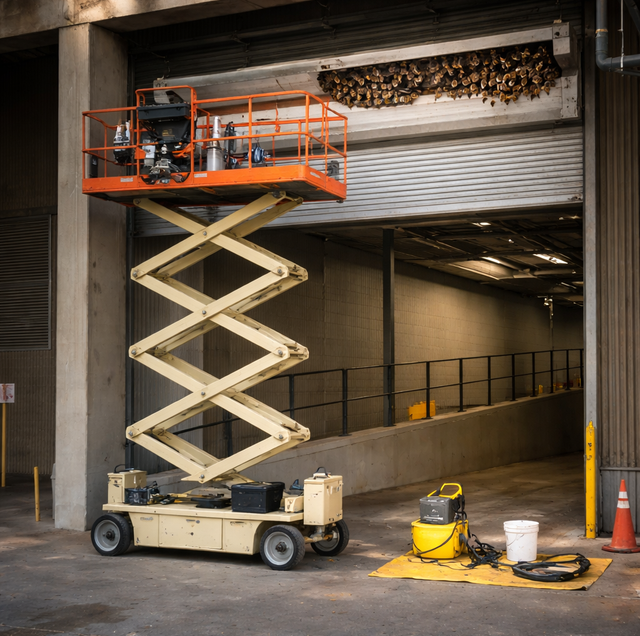
On a commercial bee call, the first few minutes on-site are spent looking up. Bees are working a seam somewhere overhead, and what shapes the whole visit is how anyone puts a pair of hands within arm's reach of them. A roll-up door header sits directly above the door opening, eight to sixteen feet up on most dock and drive-in doors, with the coil and its hood mounted just above that. A skylight curb can sit thirty feet above the floor. A mezzanine void hides behind a deck nobody walks under. None of that is stepladder work, so the first arrangements are about a scissor lift or a boom lift, a stretch of floor cleared underneath it, and a slot in the day when the machine and the aisle are both free. A removal a crew could start on the spot at a house wall gets scheduled here instead.
Roll-Up Door Headers and the Framing Above Them
A roll-up door carries a deep steel header across the top of its opening, and the framing transition where that header meets the wall and roof line runs the full width of the door with almost nothing inside to interrupt a colony's spread. A gap at a corner trim piece, a seam in metal panel siding, or a joint where the header meets the roof deck is all it takes for scouts to get in. The door hood adds a second sheltered pocket a few feet higher, dry and shaded on every side.
The loading door is also where staff spend the most time, so a rise in bee traffic near that doorway is usually the first thing anyone reports. What matters is which part of that traffic holds steady: bees drifting through a wide-open dock door on a warm afternoon are passing through, while a line running both directions through one fixed seam above the door, hour after hour, is a working entrance.
Clerestory Windows, Skylight Curbs and Roof Penetrations
High windows and skylights multiply the penetrations a house has a handful of: flashing runs, curb assemblies, and the gap where a curb meets the roof deck, repeated dozens of times across one roof. Rooftop equipment curbs, conduit runs, and vent stacks add more of the same, and most are reachable only from the roof, never from inside a finished ceiling. A clerestory band carries a transition of its own, where the clerestory wall meets the lower roof below it: base flashing and counterflashing run the full length of that band, and the cavity behind the run continues for as far as the windows do.
A steel roof deck in direct sun turns a shallow curb cavity into an oven by midafternoon, so a colony rarely settles right against that surface. It tends to hold in the cooler, steadier recess where a curb meets a shaded purlin or a run of insulation, the way anyone picks shade in the heat and a sheltered corner in the cold.
Mezzanine Decks, Drop Ceilings and the Voids Beneath Them
A mezzanine platform creates a void between its underside and whatever ceiling sits below it. A rack-supported mezzanine does the same thing: a decked walking level with an enclosed run underneath, and where the racking itself carries the wall panels, the closure strip at the top of the wall can run unbroken from one end of the building to the other. A suspended ceiling creates a plenum above the tile grid, which runs bay after bay with nothing boxing it in. These spaces are large and open, without the stud bays and fire blocking that box a colony in inside a typical house wall.
That difference in scale is why a colony in a building like this can grow well past what anyone expects before it gets noticed. An established colony in a house cavity is usually a several-dozen-pound job. The largest one this crew has ever opened ran far past that: comb in a commercial drop ceiling about four feet wide and six feet long, eleven layers deep, over three hundred pounds of comb and honey together. It sat above an exterior overhang, and the bees had been coming and going where a four-inch pipe entered the ceiling. That job is the outlier of three decades of work, not the shape of a typical commercial call, and it was possible because nothing inside that ceiling ever gave the colony a reason to stop. The comb came down in sections onto a tarp on the patio below, cut loose with flat shovels.
Clear the floor beneath the work area before the lift goes up. A comb section can drop without warning once removal starts, and forklift or foot traffic doesn't belong under that footprint while a crew is working overhead.
Where that void sits above a picking aisle or a storage area, the comb inside it hangs directly over whatever product or equipment lives underneath. As comb softens or ages, wax and honey residue can drip or flake onto packaging, pallets, or machinery below, which is a cleanup and product-contact problem in its own right, separate from the stinging risk that usually gets the attention.
Why Height Turns a Simple Locate Into a Planned Operation
At ground level, a crew can walk up, confirm the entry, and often start the same visit. At height, locating the colony and reaching it are two problems solved in sequence. The general area gets narrowed by sound and traffic first, and then the access method has to fit the space. A scissor lift travels straight up, so it wants a flat floor path and an aisle directly under the work. A boom lift can reach out over racking from a parked position, but its turret rotates with a counterweight behind it, and that tail swing needs clearance on the back side of the machine as well as room in front.
Height also removes the option every ground-level job has by default, which is simply stepping back. A crew standing on concrete has an open path in every direction if a colony turns defensive. A crew on a raised platform has a railing, a controlled descent, and not much else, so the work gets planned around that limit before the platform goes up.
Fitting the Work Into a Running Facility
A facility does not stop running because a colony needs attention. Positioning a lift means choosing an aisle wide enough for a straight vertical approach, which may require shifting product or pausing forklift traffic there for the duration of the visit. A loading door near the work area may need to stay closed for a stretch, with foot traffic routed around it.
None of that has to happen on short notice. A conversation with whoever runs the floor, ahead of the visit, about which aisle can close, which door can stay shut, and which stretch of a shift carries the least traffic turns a disruptive stop into a window the operation can absorb.
Frequently Asked Questions
On a commercial building, the closure is often roof work. A seam at a skylight curb, a panel joint, or the collar around a pipe penetration sits on the exterior face of the assembly, so the gap is closed from the roof or the outside wall, even when the comb itself comes out through the ceiling below it. That makes access a two-sided question worth settling before the visit: an interior route for the cleanout, a roof route for the closure. The gap and its siblings get closed once the cavity is confirmed clear, so roof access arranged in advance keeps the closure off a separate trip.
Ladder work holds up while a technician can keep both hands on the task and stay square to it. Past roughly a one-story reach, the working angle makes it hard to run a vacuum hose, hold a container, and keep position at once, and a veil narrows peripheral vision enough that leaning out sideways is no longer reasonable. A platform provides level footing at the void, which makes a slow, complete cleanout possible at height.
Often, yes, since a lift arriving at a void is not a quiet event. The useful part is what a crew does with that. Many park the platform at working height for a few minutes before opening anything, partly to let the first surge settle and partly to watch where bees emerge under disturbance, which is often a cleaner read of the true entry than calm traffic observed from the floor. If two separate openings produce bees at once, the void runs wider than the entry suggested, and the cutting plan changes before anything gets cut.
Sometimes, and how much it can do depends on what the surface is made of. A thermal camera reads the temperature of the surface it is aimed at, so it shows an active cluster as a warm patch on drywall or a suspended ceiling tile, which hold heat unevenly enough to keep that patch in place. Bare metal decking behaves the opposite way: steel conducts, so it smears a local warm spot across the panel, and a bright, low-emissivity surface reports the temperature of whatever it reflects more than its own. On a stable, non-reflective surface a scan carries real weight; on an exposed metal deck the image is a hint at best. Contrast is also strongest before the sun loads the building, so the scan happens early where the schedule allows.
The covering has to outlast the visit. Cut comb and the residue left on the deck above keep shedding wax flakes and debris for a few days after the bees are gone, so anything porous underneath stays covered until the void has been cleaned out and wiped down, not just emptied of bees. On a job that runs to a second pass, the aisle underneath is committed for longer than the lift is actually parked in it.
Often, though volume decides it. A void that has held a colony for years can carry more comb and honey than a crew can cut, bag, and bring down in one platform session, and honey has to come out in containers that can ride a lift, so the work paces to the machine as much as to the bees. A second pass, where one is needed, is comb-and-cleanup work; the gap and its siblings are closed as part of the job once the cavity is confirmed clear.
Reading the Building Before the Bees
Almost nothing about how the colony itself is handled changes with the building's size. What changes is the ratio. On a house wall, nearly the whole visit goes to the comb. In a building like this, a real share of it goes to standing in front of the comb at all: the aisle, the machine, the door that has to stay shut, the roof hatch someone has to open up. That share is not fixed, and the building's own people are the ones who move it. A seam above a loading door flagged the week the traffic changes is a smaller job in every direction than the same seam found a season later, because the void behind it is still small enough to reach through one opening.
Request a commercial bee removal assessment — a site visit maps the access, timing, and equipment your facility will need before any work begins. Russell Pest Control serves the Phoenix Valley. Call (623) 469-7583.
