
Bees Behind Stucco: Why the Entry Hole Isn’t the Hive
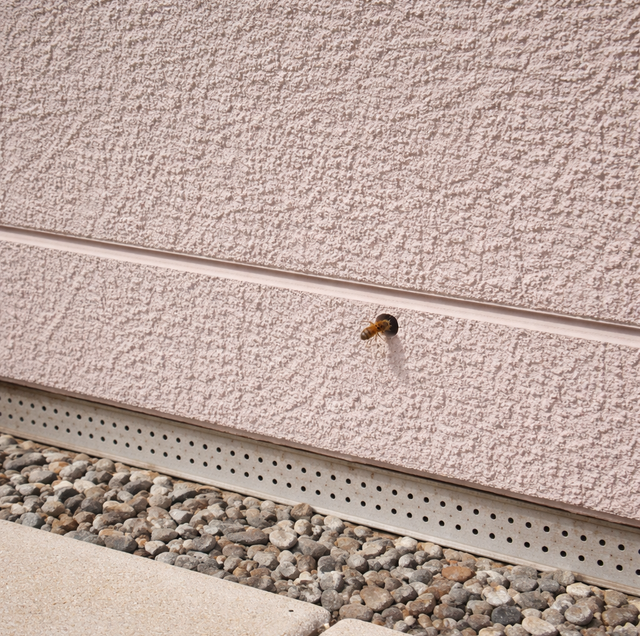
A stucco wall is not a single skin. Standard three-coat stucco starts with a scratch coat pressed into galvanized metal lath, a brown coat that builds the wall's shape, and a thin color coat on top. Behind the lath sits a layer of building paper or a synthetic weather-resistive barrier, and behind that sits the sheathing that carries the wall's structural load. In a foam-based system, a board of rigid insulation replaces the lath, with a thin base coat and mesh troweled directly over the foam before the finish goes on, and a weather-resistive barrier usually still sits behind the board.
None of these layers is solid the way a brick or block wall is solid, and every coat, board, and fastening leaves a gap somewhere that connects to the next. The space behind a stucco skin behaves less like a sealed room and more like a chimney flue running the height of the wall, broken only where a header, a fire block, or a slab edge interrupts it. That continuous cavity is why the hole a colony uses to get inside is so often nowhere near where the comb ends up.
Where the Openings Actually Sit in a Stucco Wall
A finished stucco wall looks solid from the sidewalk, but it is built with deliberate gaps, and it accumulates accidental ones. Four kinds account for most bee entries.
Control joints: Long, straight seams that break a large wall panel into smaller sections so the stucco can expand and contract without cracking randomly. A plastic or zinc strip sits under a bead of sealant, but the reveal behind it is not filled solid, and it runs for feet in an unbroken line, an easy path once a scout finds either end.
Weep screed: The perforated metal flashing along the base of a stucco wall has openings by design, allowing moisture to drain out of the wall assembly. Slots are spaced around the entire perimeter of the house, and because there are dozens of them on an average home, sealing one does nothing about the rest.
Penetrations and cracks: Hose bibs, vents, electrical conduit, and cable lines pass through the stucco skin, and the caulk sealing them shrinks and hairline-cracks well before the stucco itself shows wear. Settling cracks do the same at corners and window returns, particularly where a foam trim band meets the flat field of the wall.
Pop-outs, parapets, and eave returns: decorative foam trim, pop-out bands, and keystones are adhered to the wall rather than mechanically fastened as the base coat is, so their edges are usually the first to separate as the adhesive ages. Parapet walls on a flat roofline have their own hollow cavity behind the stucco cap, and the seam where a coping cap meets the wall face is a common gap. Eave returns mix wood trim and stucco at a joint rarely sealed as tightly as either material on its own.
How Far a Colony Can Build From Its Entry
Scouts inspect a cavity on its own merits before a swarm commits, not for its convenience to the entrance. Once a swarm commits, comb construction starts near the highest point of whatever void the workers can reach, and they get there by traveling through the connected cavity behind the stucco skin. In a stud-bay wall that might mean climbing a few feet up an open bay; in a foam system or a wide control-joint reveal, the connected space can run much farther before it narrows enough to stop them.
There is no biological limit on that travel distance. What stops it is framing: a header over a window, a run of solid fire blocking, a slab edge, or a line of blocking between studs. Where those interruptions are absent, common in an open parapet cavity or a long, unbroken foam layer, a colony can end up building several feet from the gap it used to get inside, horizontally along a wall or vertically toward a parapet cap. The entry gap and the comb are two separate facts about the same wall, and only one is visible from the ground.
What That Means for Locating the Hive
Because the entry point and the comb are not reliably in the same cavity, a locate has to establish where the comb actually sits before anyone opens the wall. A listening or tapping test at the visible gap works well enough on some interior walls, but it is far less reliable once a stucco skin and everything behind it are involved.
Thermal imaging is another tool commonly used, and how much it provides varies with the wall and the conditions on the day. A working colony keeps its nest core warmer than the structure around it, but whether that difference reaches the outside face depends on what sits in between: a thin skin over an open bay can carry it, while a foam layer or a face still holding the afternoon's heat can flatten it to nothing. A warm patch marks a place to look rather than proof of comb. Combined with a physical read of the assembly (where the control joints run, where the weep screed sits, whether the wall has a foam layer or an open stud bay behind it), a locate narrows the cutting zone before a tool touches the stucco. Cutting at the entry gap instead is a guess, and in a continuous cavity a guess is as likely to miss the comb as hit it.
Cutting stucco directly at the entry gap can break into open comb without warning, provoking defensive stinging from a colony that had no reason to leave the wall alone. A locate should always precede any cut.
Why Patching the Visible Hole Is the Worst Available Move
Sealing the gap a colony is using looks like a fix because the bees become invisible, and it is usually the worst option available. A live colony and its brood are on the other side of that patch, and a colony sealed inside a cavity does not relocate on its own: it dies in place. In a climate where a wall bakes all afternoon, the temperature inside a foam cavity can push well past what open comb tolerates, so a trapped colony is under stress from both directions at once.
Do not patch or caulk a gap bees are still using. Sealed in, a colony works toward whatever opening it can find, which on an exterior wall is often an outlet box or a baseboard gap on the room side.
A patched entrance does not close off the wall's other openings. The same building method that lets a colony in through one control joint reveal or one weep screed slot almost always has several more nearby, feeding the same connected cavity. Sealing the one gap you can see does not touch the ones you cannot, and a wall that still has old comb and wax inside it is no less attractive to a future swarm just because the visible gap is patched. What looks like a solved problem is very often the same cavity, occupied again, with a fresh patch to remove before the real work can even start.
Frequently Asked Questions
Not from the stucco side; the reason is the assembly, not the technique. What a technician adds instead is access from the inside: a small borescope hole is drilled between studs on the interior face, giving a direct look into the cavity without opening the exterior wall at all, and it closes afterward with a plug rather than a stucco patch. That is why the interior side is often investigated first, even when every bee enters from the outside.
Yes, in most cases. A rigid foam layer holds heat directly against the back of the stucco skin, with almost no airflow to release it, while an open stud bay usually has small gaps at outlet boxes and top plates that allow some air to move through. That difference in ventilation, not just the material itself, is why a foam-backed cavity tends to run hotter for longer after the sun moves off the wall.
It happens, and the reason is worth knowing before anyone reseals a joint. Control-joint sealant fails where the joint moves most, which is usually near a corner, a window return, or the end of a run rather than at its middle. A joint resealed end-to-end holds; a joint patched only at the point where bees were seen fails again at whichever end was already moving. The material matters as much: a joint filled with a rigid patching compound rather than a flexible sealant cracks open the next time the wall moves.
It reads a temperature contrast rather than the bees, and that sets its limits as much as its uses. A scan works best when the wall and the cavity are furthest apart in temperature, so early morning, before the sun has loaded the stucco face, or after dark, once the face has shed that heat, gives a far cleaner signature than mid-afternoon does. A foam layer flattens the contrast, since stopping heat from moving through the assembly is exactly what the foam is there to do, which is why a foam-system wall is usually scanned at the coldest part of the day.
Yes, particularly if wax and comb are still inside the cavity rather than physically removed. The scent scout bees use to evaluate a cavity comes largely from the wax itself, which is why a locate-and-removal approach that actually takes the comb out reduces that draw far more than sealing the entrance ever does.
Often, yes, for a different reason than most people assume. Many pop-out bands are added during a later remodel rather than during the original stucco job, and a retrofit trim piece is rarely tied into the weather-resistive barrier as the original assembly was. That mismatch, more than the material itself, is what tends to open a gap at the edge over time.
One Wall, Several Possible Doors
Two homes built from the same plans and the same stucco system stop being identical once enough time passes. One might have had a satellite dish added later, a hose bib moved during a remodel, or a control joint run a little differently by a different crew. Those small, ordinary changes are what end up mattering when a colony picks a way in, which is why a locate reads the actual wall in front of it rather than assuming every stucco wall behaves the same.
Schedule a locate before any cutting starts — a technician traces the cavity behind your stucco to find where the colony actually built, not just where it got in. Russell Pest Control serves the Phoenix Valley. Call (623) 469-7583.
