
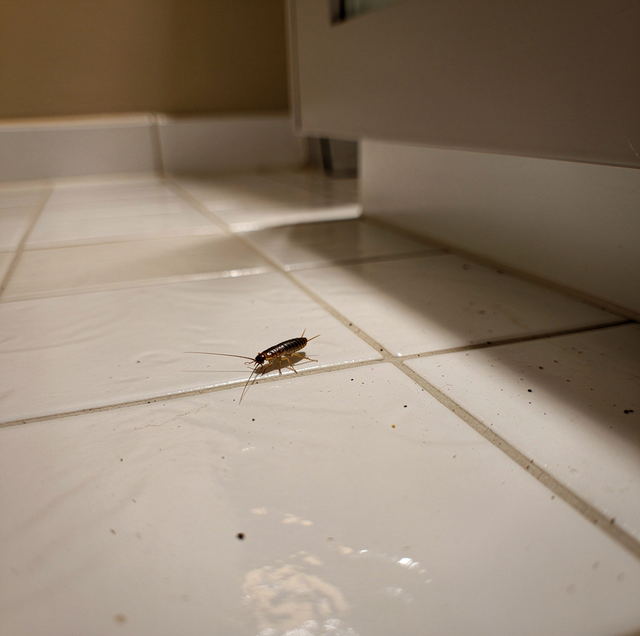
Something small and fast crosses the bathroom floor at night, and by the time your hand reaches the light switch it has gone under the vanity. Your first question is not what to spray. It is which insect you just saw, because the two that turn up on your bathroom tile want different things from your house.
A silverfish and an earwig are both harmless to you, both drawn to damp, and both about half an inch long. What separates them sits at the rear of the body, and once you have seen it you can name your insect from the doorway, aim your search at the damp spot that suits it, and hand your technician a list you have already narrowed down for yourself.
Two Pincers or Three Filaments: The Rear End Test
Both insects carry their identification at the back of the abdomen, and nothing else on either body is as consistent. Entomology guidance describes earwigs as elongate, flattened insects, light red-brown to black, easily recognized by the forceps-like appendages, called cerci, on the end of the abdomen. The same guidance describes a silverfish from the same angle: an elongate body that tapers from head to tail, with two long antennae protruding from the head and three long filaments protruding from the rear. Two stiff pincers, or three soft trailing bristles. From the bathroom doorway, that pair of shapes is your whole diagnosis.
The contrast holds because both descriptions depict the adult insect as a homeowner would meet it. An earwig's cerci are hard and curved, and their size and shape vary between species and between males and females, so a wider or narrower set is still a set of two. A silverfish's three filaments trail straight back and move with the body, while the two long antennae at the front can give the impression of a fourth and a fifth. Counting appendages at the tail takes about a second, and it works whether the insect is standing still or already moving toward the gap under your cabinet.
Color and Size Will Fool You; the Tail Will Not
Color is the axis most people reach for first, and it fails on both insects. Entomology guidance describes adult earwigs as ranging from light red-brown to black, and young earwigs, which are wingless, as ranging from white to olive-green. A pale young earwig on white tile can read as silver from three feet away. The same guidance calls the silverfish gray and carrot-shaped. Two insects whose color ranges overlap in the middle cannot be told apart by color, and the light you have at night will not close the gap for you.
Size fails the same way. The European earwig runs about half to three-quarters of an inch, the ringlegged earwig about half to three-fifths of an inch, and the silverfish about half an inch. Every one of those figures starts at the same half inch, which is the size a homeowner reports seeing on a bathroom floor. Wings are no better: an earwig may be winged or wingless. The test that survives a dim room is the count at the tail rather than the shade of the body you saw.
Why Is a Bathroom the Room Both of Them Choose?
Moisture, and nothing more complicated than that. Silverfish live outdoors too, but they thrive in indoor areas with high humidity, the condition entomology guidance puts behind an established indoor population. Earwigs require moist, cool places, and the same guidance lists damp crawl spaces and basements first among the places they are usually found.
A bathroom combines both of those conditions in one room: lingering humidity after a shower, a cabinet under the sink that stays cool and dark all day, and plumbing penetrations that open into the wall. The room is not attracting a particular insect. It is offering the one thing both of them need from your house.
Movement, Antennae and the Sink and Tub Clue
Behavior separates them almost as fast. Entomology guidance describes silverfish scurrying around the bathroom or other rooms of the house, and reports that in homes with significant infestations it is common to find these insects trapped in the sink or bath tub. So a bug circling the bottom of a dry tub in the morning is worth a second look before you rinse it away.
Earwigs move differently. The same guidance notes that they rarely fly, are active at night, and that they hitchhike indoors in laundry baskets, cut flowers, newspapers, and cardboard boxes. One that rides in inside a box of stored paper and one that walks in under a door sweep reach the same damp room, but only one came in on something you carried.
The Damp Spots Worth Checking Under a Bathroom Sink
The useful search is short and stays within reach. Under a bathroom sink, the supply stops, and the trap arm passes through holes in the cabinet floor or the back panel, and the gap around them usually opens to the wall cavity; a slow weep at a compression nut keeps the particleboard beneath it dark and swollen long after the drip stops. The tub surround gives up the same information at the caulk line, where a split seam lets shower water behind the tile and holds it. A hose bib on the far side of that wall, a laundry standpipe and a water heater pan finish the list.
Standing water and unstable footing make a crawl space dangerous, so a licensed technician takes that inspection and any suspected slab leak instead of the property owner.
What every item on that list has in common is that it is visible, reachable, and dry to the touch when nothing is wrong, which is why the homeowner can check it without tools.
Anything behind those points changes the job for you. A stain spreading across drywall, a floor that stays damp with the water off, or a meter that keeps moving overnight is a plumbing question first and an insect question second, and the order matters, because treating the harborage while the source runs only resets your clock.
The Damage Each One Leaves on Paper and Fabric
The two insects do not damage the same things. Entomology guidance notes that silverfish damage book bindings, stored papers, photographs, cotton fabrics, and similar products, and that it becomes significant when items are stored for long periods in moist, humid areas such as basements or attics; silverfish will also occasionally feed on cotton, linen, or silk clothing. Earwigs feed on mosses, lichens, algae, fungi, insects, spiders and mites, both dead and alive, and some are predators on aphids, so the earwig in your bathroom is not working through the closet.
So the pincers change what happens next. A silverfish in the tub sends the search toward stored paper and the damp air holding it there. An earwig sends it toward entry points at floor level, the moisture sitting behind them, and whatever came indoors in a box. One count at the tail, not a can of spray off the shelf, points your first move, and it points the technician's second one.
Frequently Asked Questions
No. The name you know comes from a European superstition that these insects enter the ears of a sleeping person and bore into the brain, and entomology guidance answers that plainly: earwigs inhabit soil, rotting logs, and moist organic matter. Your ear is no part of their biology, and the cerci carry no venom that can hurt you.
Damage alone will not name the insect that made it. Entomology guidance puts the earwig diet on mosses, lichens, algae, fungi, insects, spiders, and mites, none of which is the paper stored on your shelf. Counting the three filaments at the tail of a live one confirms that it's a silverfish for you.
Often, though not always. Entomology guidance notes that silverfish undergo no metamorphosis: immatures resemble adults, and adults continue to grow and molt after they become sexually mature, so a small one in your tub is the same species you would find behind the baseboard at a younger age.
Yes. Entomology guidance puts good moisture management, sanitation, and exclusion first, and names bug-proof containers for important documents, so sealed bins instead of cardboard, storage lifted off a damp floor, and less clutter do more for your books than a spray you can buy.
Yes. Earwigs and silverfish both sit inside the recurring general pest plan, which runs monthly, bi-monthly or quarterly with a fifteen-day re-treat warranty, so a single visit can cover the moisture hunt under your sink, the cabinet voids behind it, and the harborage treatment your technician plans from it.
Because the moisture is no longer outside. Entomology guidance states that earwigs are strongly attracted to and require moisture around homes, particularly when the weather turns hot and dry, and that during such dry, hot weather, earwigs sometimes migrate indoors. The mulch and wood pile that held them no longer hold water; the damp cabinet under your bathroom sink does not. The same guidance puts gutters carrying water away from the foundation, a dry gravel border, and caulking around your doors and windows on your list.
Booking a moisture inspection puts a technician under the sink and behind the tub surround before the stored paper in your closet takes any more damage — recurring plans keep silverfish and earwigs both covered on the same visit. Russell Pest Control serves the Phoenix Valley. Call (623) 469-7583.
