
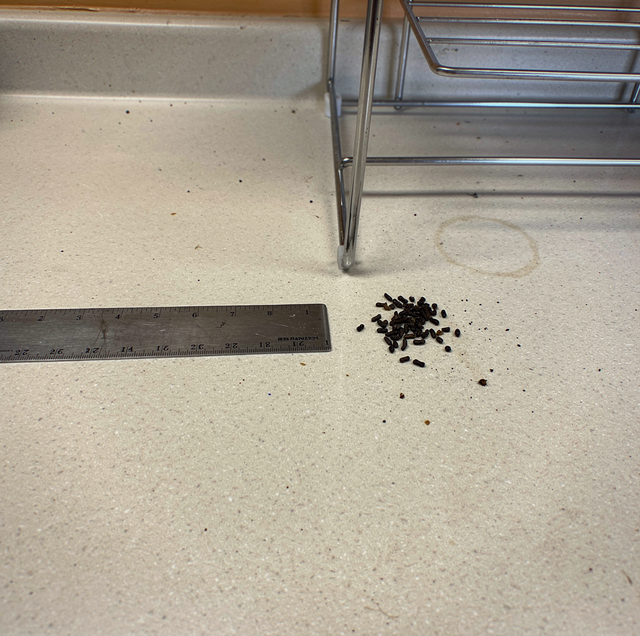
Small dark pellets on a pantry shelf, or scattered along an attic beam, raise one question before any other: how bad is this? The droppings hold part of the answer if you know how to read them. Size narrows down which rodent left them. Texture hints at how recently it was there. Count and placement suggest the scale of the problem: one animal passing through, or a group that has settled in. None of that is proof on its own, but when stacked together, it tells you how urgently you need to get the problem looked at.
Size and Shape by Rodent Type
Hold a ruler near a dropping without touching it. Droppings of about 1/8 to 1/4 inch fit a house mouse or a young rat, and droppings near 1/2 inch fit a rat, which an inspection narrows to either a roof rat or a packrat. The size difference reflects the animal's size, with one catch: a young rat leaves droppings in the mouse range, so a mix of sizes in one spot can mean mice and rats together or a rat family with young.
Size also says nothing about timing or spread. A cluster of half-inch droppings tells you a rat has been there, but not whether it was there last night or last season, or whether it was one animal or a nest of them. Those answers come from texture, count, and placement.
Fresh Versus Old Droppings
Look closely without touching. A fresh dropping is dark and slightly glossy; as droppings age, they dry out, the surface turns matte and dusty, and the color fades toward gray. Pressing one to test it raises the same dust the cleanup steps below are built to avoid.
Dark, glossy droppings in one spot mean an animal used that spot recently. Dry air complicates the reading, since it draws moisture out of a dropping and can leave a recent one looking dull and gray, so one look at texture can make recent activity seem older than it is.
A second visit answers the timing question for that spot. Clean the spot with the damp method in the cleanup section, then check it again after a few days. Fresh droppings in a cleared spot mean something is still using that route, whatever the first batch looked like. A spot that stays clean across several checks suggests that route has gone quiet, though it says nothing about the rest of the house.
How Many, and Where They Cluster
A single dropping near a garage door or a vent can come from an animal that passed through without settling. A scattered handful along one beam or behind one appliance fits a small presence, possibly a recent one. A heavy, repeated concentration in the same corner, drawer, or patch of attic insulation marks a spot the animal returns to again and again, which fits feeding, resting, or nesting nearby.
Placement within the structure adds another layer. Droppings clustered near food, inside a cabinet, along a pantry shelf, or behind the stove, mark feeding, and sometimes a nest close by; a rodent that has found food keeps returning to it. Droppings scattered along a beam, on top of stored boxes, or pressed into insulation mark travel or nesting, unless the boxes hold food or something the animal chews.
Trails That Mark Travel Routes and Nests
Rodents travel the same paths from one night to the next, so the droppings along a route fall in a line. A steady line along the top of a joist, a pipe run, or the base of a wall marks an established route, and each end of that line is worth following with a flashlight.
A line of droppings that thins out toward a gap at the roofline, a vent, or a soffit shows where the animal gets in. A dense pile tucked into a corner of insulation, especially one mixed with shredded paper or fabric, marks a nest. In the attic, that reading depends on which rodent is present. Roof rats eat citrus and make their nests up in attic insulation, so a dense attic pile of half-inch droppings with shredded nesting material fits roof rats living overhead, though a packrat nest can look similar. On a property with no roof rats around, that attic-nesting habit drops out of the reading, and the same pile belongs to another animal: mice if the droppings fall within the smaller size range, or a larger rodent such as a packrat if they run near half an inch. A nest with fresh droppings around it means residence, and a resident population grows until something interrupts it.
Cleaning Up Safely
Once you've read what the droppings tell you, the next instinct is to clean them up, and this is the step where people unintentionally make the situation worse for themselves. Both the droppings and the urine can spread disease through contact with food and surfaces and through the dust dried droppings give off when they are disturbed. A broom or vacuum on a dry pile lifts that dust into the room you're standing in.
The safer sequence starts before you touch anything. Ventilate the space first, opening a window or running a fan if it's a closed area like an attic or a cabinet. Put on gloves and a mask before you get close. Then spray the droppings and the surrounding surface with a disinfectant and let it sit for several minutes so the moisture holds the dust down. Only then, wipe up the area with paper towels or a disposable cloth, working from the outside of the pile toward the center, and seal everything in a bag before it goes in the trash. Spray the gloves with disinfectant before you peel them off, and wash your hands thoroughly once you're done, even though you wore gloves. Rags, sponges, or fabric that sat under the pile go in the same sealed bag, and washable items with droppings go through a hot wash cycle on their own.
Attic droppings sit in insulation soiled with urine and nesting debris, and walking or digging through it raises dust throughout the space. Leave heavy attic contamination to a pest professional, who removes the soiled material with protective gear.
What a Professional Inspection Adds Beyond What You Can See
Reading droppings gets you a long way, but it has real limits. You're working from what's visible in the spots you happened to check, and rodents nest in places nobody looks: behind insulation, in a wall cavity, beneath a slab. A technician brings tools and a systematic search pattern that go past a visual scan, checking entry points from the outside in along with the droppings visible inside, so the picture includes how the animal is getting in and not just where it has already been.
An inspection also settles the question that droppings can leave open: whether a single animal wandered in and has already left, or an established population. That distinction changes the plan. A visitor that has gone calls for sealing the gap it used and watching for new signs, while an established population calls for trapping, exclusion, and follow-up visits.
Keep notes before that visit: where each group of droppings sat, what they looked like, and whether a cleared spot filled again. Those notes give the technician a starting point, and the re-check results in particular show which routes are still in use today.
Frequently Asked Questions
Yes. Roof rats can nest outdoors, in a dense palm skirt, a citrus canopy or a woodpile, and come inside only to travel or feed, so an attic trail with no nest at its end can belong to animals living outside the house.
It can. A musky, ammonia-like odor in a closed cabinet or crawlspace often comes from rodent urine, which collects where the animals rest and travel, including spots out of sight inside a wall void or under insulation. An odor with no visible droppings is a reason to open that area up and look closely with a flashlight.
Not everything. Treat sealed containers as fine once wiped with disinfectant, but anything in cardboard, thin plastic, or an open container near the droppings should be thrown out, since rodents can carry contamination on their feet and fur even without chewing into a package directly. The risk isn't limited to items with visible gnaw marks.
Not by itself, since the droppings may mark a single route. The concern is the air: a forced-air system's blower can draw dust from droppings into the ductwork and carry it through the vents to other rooms. Droppings near a return vent or inside visible ductwork call for a look at the entire duct system, not just a wipe-down of the vent cover.
Watch for prints. Lightly dust a small patch of floor near the cluster with plain flour or talc, without touching the droppings themselves, and check back after a night or two for fresh prints crossing it. Each rodent's front feet print smaller than its hind feet, so compare the hind-foot prints: two clearly different hind-foot sizes point to more than one animal.
Yes. Rodent urine and droppings can carry bacteria that make pets sick, including the one behind leptospirosis in dogs, and a pet that catches and eats a rodent can pick up roundworm larvae from it. Keeping pets out of an attic, garage, or cabinet where you've found droppings until the area is cleaned and cleared is worth the inconvenience.
Send a photo of what you found — a technician reads the droppings and sets up a rodent inspection that finds where the animals nest and get in. Russell Pest Control serves the Phoenix Valley. Call (623) 469-7583.