
German vs American Cockroach: Which Is in Your Kitchen?
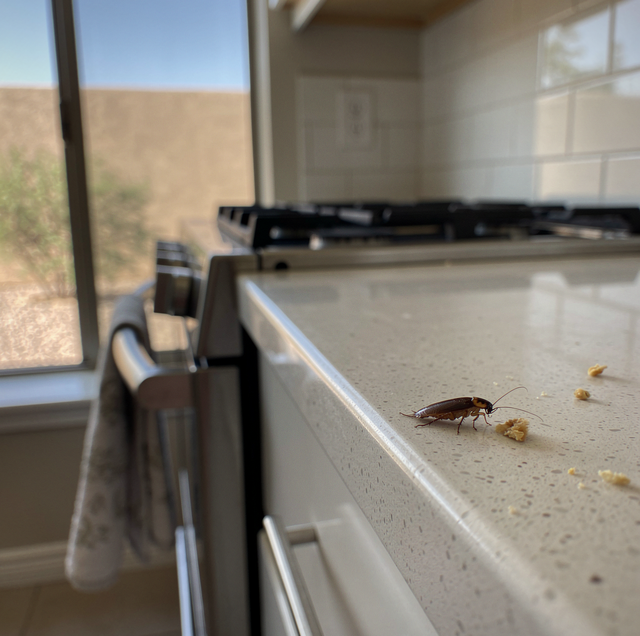
The two cockroaches that most often show up in home kitchens lead very different lives. One spends its entire existence inside the building, wedged into a warm, damp crevice a short walk from food and water, and it breeds there. The other lives in drains, crawlspaces, and damp ground cover outside the wall, and comes indoors episodically along a route it found in the dark. Naming which one crossed your floor decides what the work has to reach: an indoor population already producing egg cases, or an opening between outside harborage and your kitchen.
Quick Answer: Size and markings sort them. A German cockroach is about half an inch, tan, with two dark stripes behind the head. An American cockroach runs an inch and a half or more, reddish brown, with a pale ring around that shield.
The Size Gap Is the First Thing to Check
An adult German cockroach measures roughly half an inch to five-eighths of an inch. It is light brown to tan, flattened, and fast on a smooth surface.
An adult American cockroach belongs to a different size class: commonly around an inch and a half, with large individuals reaching two inches. The color is deeper, a reddish brown that reads almost mahogany under kitchen light.
At adulthood, those ranges do not overlap, which makes size the fastest sort available to you. The complication is age: both species hatch small, and a growing American passes straight through the size range an adult German occupies. Size gets you most of the way, and the markings finish the job.
Markings Behind the Head and the Wing Line
The shield just behind the roach's head, the pronotum, carries the clearest mark either species offers, and you can read it from above without getting close.
The German cockroach wears two dark, roughly parallel stripes running front to back down that shield, standing out against the tan background and running its full length. Nothing else about the insect is as reliable at a glance.
The American cockroach has a pale yellowish band around the edge of that shield, framing a darker center. Depending on the individual, it reads as a rough figure-eight, a horseshoe, or a halo. There are no stripes.
Wings give you a second reading. On an adult German, the wings lie over the abdomen and end at about the tip of the abdomen. In adult Americans, the wings are longer: in males they extend past the end of the abdomen, and in females they reach roughly to it. Wing tips that stick out beyond the body outline are a large-species tell.
When a Roach Takes Flight
"It flew at me" is worth more than it sounds. Both species have full wings as adults, but only one of them uses them. German cockroaches run; sustained flight is not part of their behavior, and a startled one heads for the nearest crack at speed. American cockroaches will launch or glide, most readily in warm air, often downward from a wall or the top of a cabinet toward a light or an open door.
That makes flight a strong species signal, and it beats a size estimate for reliability, because people badly misjudge the size of a fast insect in a startle but rarely invent the memory of one in the air. It also says something about the route: this is a species comfortable in open air, which fits an insect arriving from a garage, a patio door, or a wall void with an outside opening.
Where Each Species Lives and Why It Stays
German cockroach. The whole life cycle happens indoors. What it needs is warmth, steady moisture, and a tight crevice within a short trip of food, and it will accept remarkably little space: the motor housing of a dishwasher or refrigerator, the void under a sink, the hollow of a cabinet hinge, the seam where a countertop overhangs, the gap behind a stove. They press into gaps snug enough to touch their backs and bellies at once, and they stay close to the room that supplies them. Outdoors they fare poorly, which is why the arrival story is nearly always a carried one: a grocery carton, a secondhand appliance, or a shared wall with a unit that already has them.
American cockroach. This one is at home outside and below. Sewer lines and storm drains, floor drains that see little use, meter and irrigation boxes, crawlspaces, mulch beds, leaf litter, damp block walls. It feeds on decaying organic matter and does not depend on your kitchen for anything. Indoors, it turns up episodically, along a specific route: a drain whose trap seal has evaporated, the gap under an exterior door, a utility penetration, an open crawlspace hatch. Heavy irrigation, a storm that saturates the ground, or heat driving them out of a dried-out harborage moves several at once.
A Daytime Sighting Reads Differently for Each
Both species are night-active, so daytime activity carries information in either direction. What it points to differs.
A German cockroach in the open at midday is a population signal. They hold to crevices during daylight hours, so daytime foraging generally means the harborage behind the panel has more occupants than it can comfortably hold. A daylight sighting is the point at which a quiet problem stops being quiet.
A single American cockroach crossing a floor at noon carries much less weight. It is a large insect that got displaced: a drain flushed, a mulch bed turned, a door propped open on a hot afternoon. Being caught in the light is ordinary for a wanderer with no nearby crevice to reach. One daytime sighting of the large species does not imply an indoor population. Several sightings over consecutive days suggest a route that has remained open.
Egg Cases, and Who Carries Them, How Long
Both species package their eggs in a hard capsule called an ootheca, and the two look different enough to tell apart at a glance. German capsules are pale to medium brown, about a quarter inch long, purse-shaped, with fine ridges along the seam. American capsules are darker, reddish brown to nearly black, closer to three-eighths of an inch, and blunter.
The count inside differs too. A German capsule commonly holds around 30 to 40 eggs. An American capsule holds roughly 14 to 16.
What each female does with the capsule matters more than either number. The German female carries hers attached to the tip of her abdomen through nearly the whole of its development, releasing it only shortly before it hatches. She takes it into the crevice with her, so the capsule spends its vulnerable weeks in the same protected pocket she occupies, and, as a clutch nears full, the eggs hatch inside the structure.
The American female glues hers to a sheltered surface within a day or so of forming it, sometimes camouflaging it with debris, then leaves. From that moment the capsule is on its own, exposed to drying, predation and disturbance, and it is often outdoors or around a drain to begin with.
Same structure, two very different survival odds. That is much of the reason the indoor German population builds the way it does, while sightings of the large species can remain occasional for months.
Do not pick up or crush an egg case to see what is inside. A capsule found loose on a floor has often already released its nymphs, and a photograph of where it sat is worth more than a destroyed one.
Why the Identification Changes the Plan
Naming the species tells you where the work has to happen.
If it is the German cockroach, the population is inside the building, and most of it sits where you cannot see it: appliance housings, cabinet voids, hinge recesses, the underside of a counter. Attention aimed at open floor and counter surfaces reaches the small share out foraging while the rest of the population stays behind a panel. The plan has to reach interior harborage, and keep reaching it long enough for the generation still sealed inside egg cases to emerge, because a capsule already formed will hatch on its own schedule regardless of what happens to the surfaces around it. An established indoor population is also a reason to act promptly rather than wait a few weeks: cockroach allergens in household dust are a well-established indoor concern, and a breeding population is their source.
If it is the American cockroach, the center of gravity is outside. The indoor sightings are the symptom of an opening: the dry drain trap, the door sweep, the pipe penetration, the crawlspace vent, the damp ground cover against the foundation where the outdoor population actually sits. Work confined to the kitchen leaves both the source and the route untouched, and the sightings resume with the next storm or the next irrigation cycle.
The observations that make the call are ones you already have: the size, the markings if you got a look, whether anything flew, the time of day, how many, which rooms, and whether a capsule turned up and where. That set turns a sighting into a plan matched to the insect actually in the house.
Frequently Asked Questions
They might be. Nymphs of both species are wingless until the final molt, so the wing test fails for them, and size alone is misleading because a half-grown American sits squarely within the adult German size range. The shield settles it. German nymphs carry those two dark stripes from the first instar onward, so a small striped roach is a German at any age. American nymphs are a fairly uniform reddish to grayish-brown, and the pale border around the pronotum gradually fills in as they mature, so on a young one it can be faint.
Yes, and it happens more often than people expect in homes with an attached garage or an older drainage system. The two arrived by different means, so finding one does not account for the other: the German population was carried in on something, while the large species walked or flew in through an opening. A mixed catch means two lines of inquiry: one inside the kitchen and one covering the exterior and the drains; closing only one leaves half the problem running.
Usually. The pronotum is the stiffest part of the insect and tends to survive damage that flattens everything else, so the stripes or the pale border are often still visible. Wing tips relative to the end of the abdomen hold up better than you would guess. Two cautions: photograph it where it lies, since there is no need to pick it up, and remember that a specimen dead and drying for a while fades, so its color reads lighter than it did in life.
Several species do. The oriental cockroach is dark, almost black, and glossy; the female's wings are short pads that leave most of the abdomen bare, and neither sex flies well, so a dark roach that clearly cannot get airborne is a good candidate for this one. The smoky brown cockroach is a uniform dark mahogany with no pale pronotal pattern and wings running well past the abdomen, and it gets called a young American constantly. Turkestan cockroaches, common around irrigation boxes in warm regions, are also reported in America; the males are slimmer, with yellowish wing edges.
The gap is large. Under warm indoor conditions, a German cockroach can go from egg case to breeding adult in roughly two months, and adults live a matter of months after that, so an indoor population turns over and rebuilds quickly. The American develops far more slowly: its nymphal stage commonly runs from several months to more than a year depending on temperature and food supply, and adults are comparatively long-lived. A full-size American on your floor has usually been growing for the better part of a year somewhere outside the kitchen.
They can, where a space stays permanently warm, wet, and undisturbed. Utility rooms with a floor drain, sump pits, sub-slab voids, water heater closets, and shared sewer laterals in larger buildings all qualify, which is why commercial kitchens and apartment buildings see resident populations more often than single-family homes. The evidence is size classes: several different body sizes over a few weeks suggests reproduction on site, while a run of full-grown adults alone still points to an outdoor source and an open route.
Name the species before anything gets treated — an inspection identifies which roach you have and where its harborage sits, so the work matches the insect. Russell Pest Control serves the Phoenix Valley. Call (623) 469-7583.
