
Restaurant Bee Removal: Keep the Patio Open for Service
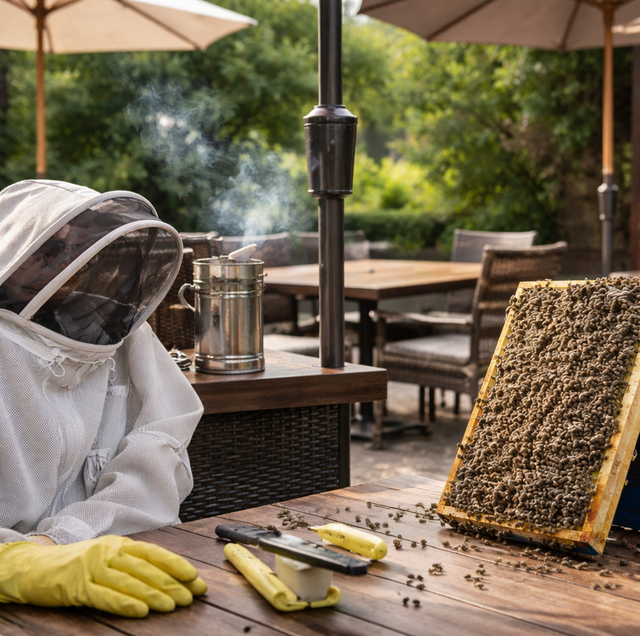
Doors open in twenty minutes and six tables on the terrace are already roped off, because the opening server found bees working the drink rail an hour ago and nobody wants to seat a four-top under it. The host is rebuilding the floor plan on the fly and the kitchen is asking how long the patio is out. None of that is a pest question yet. It is a seating question, and it stays one until somebody figures out what is actually on that patio.
That read is the whole job, and it is yours to make before anyone touches the section. Your patio draws two kinds of bee traffic: a handful of foragers pulled in by an open sugar source, gone once the source is gone, or a colony that has moved into the structure and treats your patio as its front porch. They call for opposite responses, and reading one as the other either burns a shift you did not need to lose or leaves a real problem sitting behind a wall for another week.
The Patio or Terrace Itself During Service
Foragers work in a pattern you can watch from the host stand without leaving it. A bee lands, feeds, and leaves on roughly the same line it arrived on, and a few minutes later another one does the same thing. Their numbers drop off once whatever is drawing them is gone, though returning traffic to that exact spot tails off over the following days rather than stopping the same afternoon. What you have is a supply problem rather than a colony problem, and it clears once you find the draw and cover it.
A colony reads differently. Bees hold position at one fixed gap: a hollow umbrella post, the void under a built-in bench, a soffit corner, or the hole where a patio heater line or a string-light run passes through the wall. Traffic runs both ways at that gap steadily, not in bursts tied to a spill or a tray of citrus. Watch that one spot rather than the whole patio. An entrance in use for a while often darkens where repeated traffic contacts the surface, though a gap occupied recently shows nothing of the kind, so the mark confirms a colony when you find it and rules out nothing when you do not. A cluster hanging in the open on an umbrella rib or a beam, with nothing going in or out of anything, is neither case and gets triaged separately.
Time the watch. Stand where one gap is in view and count two minutes on your phone. A handful of arrivals with nothing going back in means you are watching a feed rather than a front door.
Once you have read it as a colony, the decision is not whether the section closes but when. Comb-and-honey work, sealing the entry, and checking for a second gap a few feet away all take real time, none of it compatible with a four-top seated ten feet off. A planned closure of one section between services costs you covers you would rather keep, and that trade is worth naming honestly. An unplanned closure mid-shift, with a table already seated and your host improvising, costs more covers and takes goodwill with it. Book the window you want rather than the one the bees pick: the slow stretch between lunch and dinner, or the hour before doors. Tell the reservation desk early enough that the section comes off the book instead of coming off with a stack of chairs.
Waste and Recycling Areas and What Draws Foragers There
Your dumpster corral and recycling bins pull foragers for one reason: sugar. Syrup residue in soda and juice bottles that went into the bin unrinsed, sticky liner bags from the bar, and fruit rinds from prep sitting in open or loosely lidded containers in full sun turn that corner into a standing buffet on a schedule your kitchen never intended to keep.
Nobody watches that corner during service the way they watch the dining room, so a pattern out there can run for days before it reaches you. Rinsing sugary containers before they go in the bin and keeping lids closed between drop-offs removes the draw without touching your pickup schedule. If bees are holding at a fixed point on the enclosure itself rather than working the bins, run the same read you would run on the patio: one spot, two-way traffic, the gap rather than the garbage.
Sugar Sources on a Service Line, from Soda Guns to Fruit and Cut Flowers
Most of the open sugar in your building sits on the service line, and almost none of it is put there deliberately. The drip tray under a soda gun holds sweet residue that never fully dries between orders. A garnish caddy of cut citrus and cherries left uncovered between rushes reads to a forager the way a flower bed does. Bus tubs staged near a patio entrance concentrate half-finished sugary drinks and fruit scraps into a single open container at foot-traffic level. Cut flowers on the tables draw as well, more slowly and more steadily than a spill does.
None of that needs a deep clean to fix. A lidded caddy between rushes, a faster clear-out cycle on the bus tubs, and a wipe of the gun tray at a slow moment cut the draw off at the source instead of chasing what it produces.
What Staff Should and Should Not Do While Waiting
Between the call and the response, what your team does matters as much as what the crew does on arrival. Walk these at pre-shift rather than in the moment.
- Do not swat at bees near the entrance itself. Defensiveness tracks how close something gets to the nest, and a hand waving at an occupied gap reads as precisely that, while doing nothing to the colony behind the wall. A single forager on a table is a different proposition and leaves when you remove what it feeds on.
- Do not spray anything at a gap or entrance. An aerosol drifting across a service line near open food and a lit burner is its own hazard, and it does not reach a colony sitting behind a wall or inside a post.
- Do not let anyone knock a cluster loose from an umbrella rib, a string-light fixture, or an overhead beam. A cluster that comes down scatters into the nearest seating instead of holding still.
- Clear the whole section, not just the tables nearest the gap. Bees working a fixed entrance do not respect a two-table buffer.
A colony inside a hollow umbrella post or a bench void sits inside furniture your staff moves. Pull that piece from the rotation and mark it, or someone will fold, drag, or stack it without knowing what is inside.
Frequently Asked Questions
Usually yes, as long as you find the actual draw and cover it rather than wiping it down once. Bees that found a reliable spill or an uncovered garnish tray return to that spot out of habit for a day or more after the mess is gone. Reopen from the far end of the section and hold the two tables nearest the old draw back until last. If arrivals keep landing where there is now nothing to land on, you are watching habit rather than a source you missed.
No, and the length of the closure is not what decides it. Access is. A colony reachable from one open face can be worked in a single window, while one behind a finished surface adds opening, cleaning, and closing to the same visit, and a second entry found during the work extends it again. The usual way this goes wrong is a section blocked out for a set date that then needs a second window, so hold it as unavailable until it is released rather than until a day on the calendar.
Not for this problem. A zapper is a UV device built for night-flying insects, while foraging honey bees fly in daylight and home in on a specific sugar source largely by scent, so the two barely overlap in operating hours. Citronella works on the same broad principle and does nothing about the spilled soda under table nine, which pulls bees back to that exact spot for the rest of the shift.
Rarely. The bigger indoor risk is usually an opening you created for service: a patio door wedged during a rush, or a pass-through window propped for expo. Either one hands foragers already working the outdoor line a direct route in. Managing those openings and moving the bus station away from the door being held open matter more than closing seating that's nowhere near the activity.
Give whatever comes off the line a covered destination, not just a covered origin. A lid that gets flipped open every ninety seconds through a rush is an open caddy, so move the garnish off the line and portion it out of the cooler instead. Flowers pulled from the section go into cold storage rather than the bus station, since a bin of stems and vase water at ambient temperature keeps producing the draw the vases did. The common failure is a lidded caddy sitting beside an uncovered tub of the trim that came off it.
In two predictable ways on a working patio. A colony that arrived recently has not worn or stained anything yet, so a clean gap with steady two-way traffic is still a colony, and the absence of a mark proves nothing. In the other direction, a soda-gun drip line or a wet seam on the trash enclosure can hold a dozen foragers in one place for twenty minutes and look exactly like an entrance until you notice that nothing ever goes in. If you cannot settle it from the host stand, watch the gap before open, when the sugar on your own floor is not yet live and competing for the same bees.
When the Section Comes Back Into Service
The patio you reopen is the same patio. The features that made it a candidate are furniture and fixtures rather than accidents: tube frames open at the ends, umbrella bases hollow underneath, the ring of space where a heater line or a light run passes through the wall. None of that changes because a colony came out of one of them. Which is worth knowing at the moment you are least likely to be thinking about bees, when a table set or a heater comes up for replacement on the ordinary cycle. Capped ends and a closed base are a specification choice rather than a project, and they take the option away from the next scout that comes through. A bee call reads as an incident while it is happening. It is more useful afterward as a note on what you buy next.
Get a patio or terrace bee situation read correctly before it costs another service — Russell Pest Control serves the Phoenix Valley. Call (623) 469-7583.
