
Black Widow vs Other House Spiders: The Danger Is Underneath
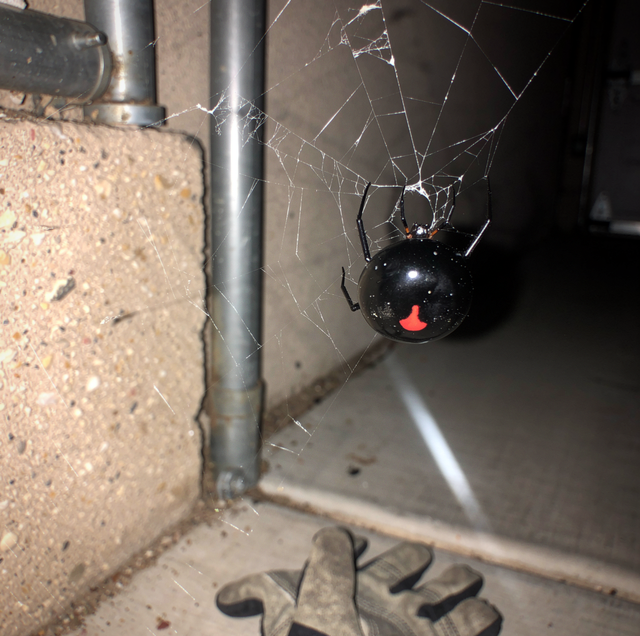
The web in the corner behind the stacked patio cushions does not look like it was built. Drawn through it, a gloved finger tears the silk with a faint, audible rip rather than quietly stretching it aside, which is a property of the silk rather than of the corner. The jaws of most spiders are too small to break your skin.
One spider that builds this kind of tangle is the exception, and she is the reason it is worth telling one from another. A mature female western black widow carries a set of features that no amount of squinting at a dark shape on a garage wall will resolve, because the marking that identifies her is on her belly.
A Body That Is Black Down to the Last Leg Segment
Start with gloss, across the whole animal. The mature female western black widow is shiny jet black over her body and her legs alike, with a rounded abdomen and a body length of about half an inch. Give the legs the same look you give the abdomen. A dark spider with tan, banded, or hairy legs is not her, however black the abdomen looks. The one exception is a brownish or plum tinge on a female so well fed the abdomen has stretched the black pigment thin.
Shape carries almost as much as color. Her abdomen is round and high, and her legs are slender and carry no spines, the build of a spider that waits in silk rather than one that hunts on the ground. All of this describes the mature female. Where a bite has already happened, that is a medical question and a separate one, and it is not answered here. At a suspect corner, what you are settling is whether the animal in front of you fits that description or one of the four look-alikes that share the same places.
The Red Mark Sits on the Underside
The mark you are looking for is on the ventral surface of the abdomen, the side a spider normally keeps toward the ground. It runs red or orange, and in a perfect specimen it takes the shape of an hourglass. That position is why a spider found away from its web is hard to call, and why the web is the place to look at her.
The shape itself is not reliable. Forms run from two perfect triangles meeting at their points down to, on rare occasions, no red at all. A missing hourglass does not clear the spider in front of you. A clear one on a glossy black body settles it.
Red on top of the abdomen is a different marking and carries less weight. Some mature females keep one or two indented white lines across the front face of the abdomen. The brown widow, the genus's other look-alike, is mottled tan to brown, never the shiny black you are checking for, and carries a mark underneath that runs orange to yellow.
The Belly-Up Posture Turns the Marking Toward You
The posture solves the problem the position creates. This family almost always hangs upside down by its claws in the web, with the spider sitting in the middle of her own web at night, underside facing upward, waiting. The surface that identifies her is the surface she presents.
So where you find her changes what you can check. A widow hanging in her own web has the hourglass turned upward and in plain view from several feet away, with nothing touched and nothing moved. The same spider walking along a wall or crossing a floor is the right way up, its belly against the surface, and the one mark that would settle it is out of sight.
Take that look before anything disturbs the web. A disturbance larger than a prey item sends her toward the safety of her retreat, so the window in which the belly is visible closes the moment a broom or a hand shifts the silk. Once she is in the crevice, you have a tangle and no animal, and you are back to guessing.
Where the Web Sits and When She Leaves It
The web runs back to a retreat: a hole between bricks or a space around a pipe penetration, with a tangle of silk extending out of it. The retreat sits near the ground in most cases, with the working web usually within three feet of it. There is an alternative: a female may take a retreat well above ground level, in an eave, then drop ten feet or more before she builds. In a garage, the webs sit by doors and near vents, where insects already pass.
The hour you look changes what is there to see. Widow spiders come out at dusk, repair the web, and take their position for the night, which means that a daytime inspection of a suspect corner turns up silk and nothing living, leaving you where you started. To find the animal itself, you look after dark with a light, from a distance, at web height and from a few feet back. It is also the hour a technician walks a property, for the same reason.
A widow moves toward her retreat when the web is disturbed. She bites when a hand arrives in the retreat with her, pushed into the gap behind boxes or under a patio chair, where she is pressed against skin. Wear gloves.
The Other Spiders Sharing Those Corners
Four spiders share these corners, in the order she drops out of the picture: the first shares her family and her corner, the last only the hour it hunts. First, the common house spider: the female runs five to six millimeters, with a yellowish-brown carapace, a dirty-white abdomen with gray chevrons, and yellow legs ringed darker at each segment end.
Second, the cellar spider, which also hangs inverted in a loose mesh. The female runs seven to eight millimeters, with an abdomen three times as long as wide, and forelegs near fifty. Threatened, she vibrates in a circular path until she blurs.
Third, the grass spider, a funnel weaver. Females run ten to twenty millimeters, the hind spinnerets project visibly past the rear of the abdomen, and the legs band darker at the segment ends. They move indoors as autumn temperatures fall.
Fourth, the wolf spider, which builds no capture web and hunts on the ground after dark. The larger species run eighteen to thirty-five millimeters, and there is a test you can run from the doorway: their eyes reflect green in a flashlight beam.
The mark is on her belly, and she shows it only while hanging inverted in her own web. Photograph her there rather than on a wall, with the flash on, from far enough back that nothing you do shifts the silk.
The Egg Sac and Its Tough Yellow Covering
The sac in your torch beam, wedged into the back of a retreat, is yellowish rather than white and about half an inch long and half an inch across. Its outline sits between a ball and a teardrop, since accounts of the shape disagree. The covering is tough to tear apart, and its margin, a single unbroken line, is the feature that distinguishes it from sacs whose edges cannot be located at all. The common house spider's sac is also tough and papery, but brown and smaller, six to nine millimeters across.
Finding one when the spider has moved off gets you something the animal leaves out on its own. A western black widow sac holds about 300 eggs, and a female stores sperm from a single mating and can produce more than ten sacs from it without the clutch size falling. An adult female lives over a year. So the sacs in one gap measure how long it has been in use, in a way a single night's sighting cannot.
Frequently Asked Questions
Only the mature female is jet black with the hourglass you looked up. Spiderlings leave the sac with tan legs, a tan cephalothorax, and a mostly white abdomen with black spots. The background then darkens to olive-gray or tan, with a white stripe down the top and diagonal stripes on the flanks. The male keeps that pattern and stops feeding once mature, so his abdomen shrinks. Yours is probably an immature.
Maturity takes four to six months for females, with males reaching it sooner, and both vary with temperature and with how much prey the spider in front of you catches. The change is gradual. At each molt, the white stripes narrow, the tan darkens toward black, and the pale shield where the hourglass will sit turns from white-yellow through orange to red as its middle tapers.
Almost certainly the false black widow, Steatoda grossa. It runs slightly smaller than a mature widow, at three-eighths of an inch, is chocolate brown, and never carries red on its belly. It sits in the same family and builds the same tangle, and it thrives in heated buildings, which is why you meet it indoors. Its egg sac is loose and fibrous, with margins you cannot locate.
They turn up indoors, but they typically nest outside it, in holes and crevices around the structure and within clutter, since your living space does not hold enough insects to feed one. A garage sits in between, and yours is where you should look first. Insects pass through it, and the spiders make webs where that traffic runs.
For that web, yes. An occupied web is kept clean because dirt on the silk deters prey, so silk carrying a visible layer of dust is old and no longer worked. Take that narrowly. The dusty tangle in front of you says nothing about the crevice behind it, where a live spider spends the day.
Architecture, and the family behind it. A widow belongs among the cobweb weavers, family Theridiidae, and the web you are standing at is a three-dimensional snarl anchored at several points, with taut lines run down to the floor, sticky at the bottom, catching whatever walks underneath. Those verticals are gumfoot lines. An orb weaver hangs a flat wheel of spokes in open air; a grass spider lays a horizontal sheet with a funnel to one side.
Book an after-dark inspection — it finds the retreats actually in use and the stage of the spiders holding them, which a photo of one spider on a wall cannot show. Russell Pest Control serves the Phoenix Valley. Call (623) 469-7583.
