
Rodent Control in Tempe, AZ — Built Around the Irrigation Calendar
Tempe is one of the few cities left that still runs its own flood-irrigation utility, and on an irrigated lot, the yard runs on a schedule set by somebody else. That schedule feeds a canopy roof rats live in, and it stops for two months in November and December. When it stops, the animals go looking, and the warm building with a citrus tree touching the fascia is the obvious place to look. We work the removal first and close the house behind it.

What Rodent Work in Tempe Actually Covers
+ RODENT_DEF + Sealing reduces how much gets in, which is what makes a treatment program hold. It doesn't replace treatment, and a quote implying otherwise is selling you something. Where a property needs both, we price them separately so you can see what you're buying.
On an irrigated lot, the harborage question is really a canopy question. Flood irrigation is what keeps forty-year-old citrus, olive, and ash alive in a desert city, and a roof rat lives above the ground and travels along branches. Where the canopy is continuous, the animal never has to come down, which is why a trap line on the patio slab catches nothing while the attic keeps filling.
One safety note before anyone clears anything. Maricopa County publishes the protocol for rodent droppings, and it matters. Rubber gloves on. Ventilate the area the night before you clean by opening doors and windows, and don't shortcut that step to the few minutes before you start. Never sweep or vacuum droppings dry. Spray the droppings, the nests, and the area around them with a ten percent bleach solution, one part bleach to nine parts water, and give it at least fifteen minutes of contact time before you remove anything. Wipe up with paper towels or a mop, double-bag it, and wash your gloved hands in disinfectant before the gloves come off, then wash your hands with soap and water once they are off. The county puts the onset window for illness at one to five weeks. If a flu-like illness shows up in the weeks after a clean-up, the standing public-health advice is to see a physician promptly, to mention the rodent exposure, and to treat difficulty breathing as urgent, because early diagnosis is what changes the outcome.
What Tempe Households Call Us About
The calls
- Running overhead in the ceiling after dark, loudest in the first cold weeks of the year
- Citrus stripped on the tree, with the rind left hanging and the flesh gone
- Droppings on a garage shelf or along the top plate of a block wall
- Chewed irrigation drip line and gnawed low-voltage landscape wire
- An open valve box or standpipe surround with a burrow beside it
- A neighbor who has already trapped, with the traffic simply moving next door
Where they get in
- Fascia and tile edge at the point a branch is in contact, which on an irrigated lot is usually the one
- Gable and soffit vents where the screen has torn or pulled away
- The joint where a patio roof or a shade structure meets the wall
- Vent stacks and any roof penetration with a cracked or lifted boot
- The gap under a roll-up door, and irrigation and valve boxes at ground level
The harborage that feeds it
Stored material, woodpiles, dense oleander and undisturbed ground cover, plus the fruit on the tree and the fruit already down. Fallen fruit matters more than people expect, because it's a food supply that renews itself with no help from anybody. Gloves and closed shoes, and never reach into a pile you can't see into. The same harborage holds bark scorpions, and near open ground it holds snakes. If something has sat undisturbed for months, don't move it by hand. For a snake, that's a call to a licensed wildlife removal service or Arizona Game and Fish, and a bite is a 911 call. For anything else, leave it for us.
The City Owns the Water Calendar
The water comes from a City utility
Tempe delivers flood irrigation to roughly 850 homes through tens of miles of City-owned mains and around 1,000 valves. It's a municipal utility on a published rotation, with the City deciding when each block takes its turn, so the yard is wet on a rhythm nobody on the property chose.
Deliveries start late at night
A delivery run opens late on a Sunday evening and works through the following days, so depending where your block falls in the rotation, the water may arrive overnight. Those are a roof rat's active hours. Where your block sits in the schedule is worth knowing, because a trap line placed for daytime observation is placed for the wrong animal at the wrong hour.
The valve is not yours to touch
City staff operate the valves, and customers are asked to keep clear access and leave the operation to the utility. So there's a piece of infrastructure in many Tempe front yards that the homeowner is told to stay out of and keep uncovered, which is exactly the kind of quiet, permanently open void a rodent will investigate. We work around it, and we don't open it.
And then it stops for two months
There's no delivery in November or December because the upstream canal system undergoes its annual dry-up. Two months of no yard water lands at the same time as the first cold nights and the citrus harvest. For an animal that's spent the year drinking outdoors, the building solves two problems at once, and that's why the ceiling calls cluster where it does.
What that means for the schedule
September and October are the useful months, ahead of the move indoors. Work started in January is remedial: the animals are already in, so removal comes first, and sealing follows it.
Removal First, Then the Roofline
Read the lot before the house
Where the canopy touches the roof, where it touches a neighbor's canopy, where the fruit is, and where the water sits after a delivery. On an irrigated lot, the route into the attic is usually a branch, and that's a smaller job than anything we could sell you.
Find the roofline entries
Tile edges, gable and soffit gaps, vent screens, the point where a patio roof meets the wall. Every one gets photographed and written down, whether or not you have us close it.
Trap where they already travel
Traps are set above ground level on the runs the animal is already using, and they are checked. Bait alone in an attic gives you an animal dying somewhere you can't reach, which is a smell problem in place of a rodent problem.
Take the food supply down
Fallen fruit cleared and kept cleared, pet food off the patio overnight, bird seed contained. Fruit still on the tree is a judgment call, and we'll tell you how much difference stripping it makes on your lot.
Open the canopy
Branches cut back off the roof and off the neighboring canopy. On an irrigated lot, nothing else you spend money on moves the number as far, and it's usually not our work to do. We'll mark what needs cutting, and you can have anyone do it.
Close the building
Only once the animals are out. Sealing a house with rats in it traps the problem where you live. Rodent exclusion works to a wider threshold than scorpion sealing does, and a scope should tell you which one applies where.
Leave the list behind
What was found, what was trapped, what was closed and what's still open, in writing. The walk and the written list are free either way, whoever ends up doing the work. Where the building is the problem, sealing gets scoped and priced as its own job, separate from a service visit, so you can see exactly what it covers.
Why Tempe Homeowners Stay With Us
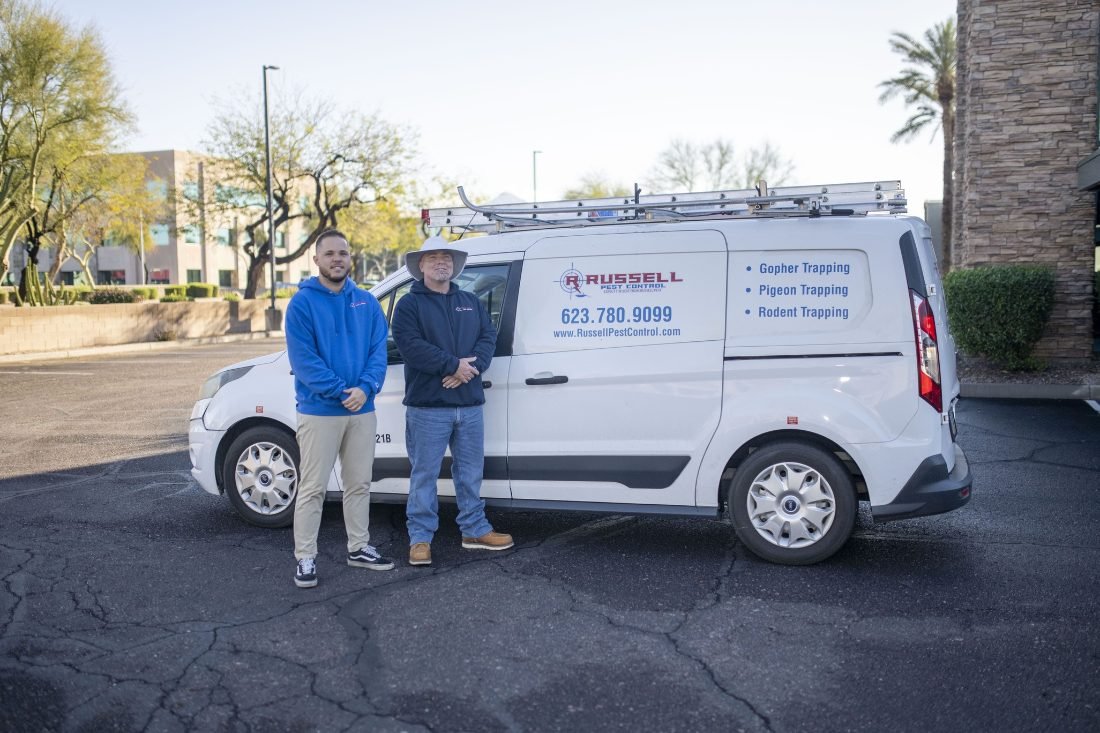
Thirty years of Arizona desert work, with a second generation on the routes. One call gets Steve, Steven Jr., or the office. Never a call center.
We schedule exclusion against the irrigation calendar, so a house gets closed ahead of the November dry-up while it's still a quiet job.
No contracts and no initial fees on residential service, and a 15-day re-treat warranty if something comes back inside the window.
We say when the fix is a tree-trimming job, and we say it before you have paid us for a program that a pruning saw would have shortened.
Arizona OPM License #I5321B, and a family company that's been answering its own phone in the Valley since 1996.
What Tempe Homeowners Ask Us
Is the irrigation itself causing this?
Not directly. What the water does is keep a big mature canopy alive, and the canopy is the highway. A dry lot on the same street with nothing overhanging the roof has a much quieter attic.
Should I stop taking my irrigation turn?
We wouldn't tell you to. It's your water right, and it's what keeps your trees alive. The tree work and the roofline work get you the same result without giving up the yard.
Something is burrowing next to my valve box. Can you handle it?
We'll treat and trap around it. We won't open the valve or work inside it, because operating those is the City's job and the access has to stay clear for the utility. If the structure itself is damaged, that's a call to the City.
Why is it always worse in December?
Two things land together. The yard water stops for the dry-up, and the nights get cold. An animal that's been living outside all year suddenly has a reason to be indoors, and your attic is warmer than the canopy.
Can you just seal the house and skip the trapping?
No, and we'd turn that job down. Sealing a building with animals in it leaves them inside, and what follows is chewing, then odor. Removal comes first every time.
My neighbor trapped and now they're at my place.
That happens on a connected canopy, and it's the clearest sign you're dealing with a block-level population. It doesn't mean your neighbor did anything wrong. It means the animals moved along a route running through both yards.
Do you use poison in the attic?
We lead with trapping in occupied structures. There are exterior situations where a tamper-resistant station is the right tool, and the technician will explain what he's placing and where before he places it.
How long does the whole thing take?
Removal is usually a few weeks of checked traps. Exclusion is a separate scoped job with its own warranty, and you'll see both numbers before either starts.
Is Home Seal worth it on an older Tempe house?
Often, and the walk tells you. Older stock around here has more roofline entries, and if the list runs long, you'll get it as a scope with a price on it before any work happens.
Do I need to be home for the walk?
For the exterior and the roofline, no. For anything in the attic or the garage, yes, and it helps if somebody can point at where the noise is loudest at night.
Can you do same-day service in Tempe?
Often, yes. Call or text before noon, and same-day is realistic more often than not, and an indoor sighting is the kind of call we try hardest to fit in. After hours, the phone reaches Steve's cell for triage.
Do you treat termites in Tempe?
No, and we're straight about it. We'll identify termite signs honestly and refer you to a licensed termite specialist, then handle everything else on the property. Straight lanes, straight answers.
What Rodent Work Costs in Tempe
One clarification on the badge above and the terms below: the 15-day re-treat warranty covers treatment service. Home Seal carries its own one to two year warranty, and the two are separate things.
Roof pitch, attic access, how much canopy is touching the building and how many entries the walk finds are what move the number. Trapping and exclusion are quoted separately, because one is a program and the other is a defined job
The standing Russell terms apply here: no initial fees, no contracts, and a 15-day re-treat warranty
Black Light Scorpion Search: $125 per hour, after dark. We'll tell you what we expect your property to take before we start
Home Seal is quoted as its own job, typically $600 to $2,500 with a one to two year warranty depending on the work
Estimates are free. Attic and hive searches can carry a charge, waived if you hire us
What Else We Run in Tempe
General Pest Control Plans
Monthly, bi-monthly, or quarterly, with no contracts and a 15-day re-treat warranty.
Rodent Exclusion and Home Seal
Roofline screening and whole-house sealing, each scoped and priced as its own job.
Cockroach Control
German roach work at the plumbing chase, including multi-unit buildings.
Scorpion, Mosquito and Bee
Black light searching after dark, station-based mosquito work, and live bee relocation where a beekeeper can take the colony.
Weed Control, Commercial and Property Management
Pre-emergent timed to both desert weed seasons, and documented programs for buildings and food service.
All Tempe services: /tempe
Get Ahead of the Dry-Up
If your lot is irrigated and your trees are touching the roof, the month to call isn't the one where you can hear them. Have us walk it, mark the branches and the entries, and tell you what it would take to close the house. September is a shorter job than January is.
Expect the best from Russell Pest, and have a bug-free day.
Hours
- Monday–Friday: 8:00 AM – 5:00 PM
- Same-day & emergency service available — after hours and weekends, owner-answered
(623) 780-9099 · Call or text · 6750 N 7th Ave, Phoenix, AZ 85013