
Fly Control in Tempe, AZ — It's One Drain, and Your Records Know Which
Small flies in a kitchen are almost never a flying problem. They're a film problem, in one drain, and the hard part has always been working out which one. The fastest way to narrow it is your own pump-out history: where the interval slipped, the film had time to build. We start on paper because paper shortens the list before anybody lifts a grate.

What Fly Work Actually Is
Fly work is source elimination in a drain, plus whatever adult knockdown gets you through the days it takes the source to stop producing. Nothing sprayed in the air fixes a breeding site, and a business that only ever gets adults knocked down is buying the same week over and over.
The organic film lining a drain is where drain flies and small flies develop. It isn't standing water, and it won't rinse away, because it's stuck to the pipe wall above the water line where a flush never reaches. Removing it takes mechanical agitation and a product built for that film, worked on a schedule until the population stops.
For a restaurant, the second half of the job is documentation. A visit that leaves nothing behind isn't much use to a manager holding a health inspection or a corporate audit, so we write down what was found, what was worked on, and what's still open.
Your Grease Program Is Also a Fly Survey
The city's grease rules already name the fixtures
Tempe's grease program lists the fixtures that must run to a grease control device: three-compartment sinks, floor sinks, mop sinks, floor drains, dishwashers, and the rest. Read that with flies in mind and it is very nearly the same set of places small flies breed. Your fixture schedule is a starting list you already own.
The servicing interval is a clock
Grease control devices are serviced on a defined cycle, monthly or quarterly depending on the device, by a permitted hauler, and the pump-out records stay on site. That means you can look up how long each part of the system has been sitting. Where a fly problem and a stretched service interval line up, the answer usually isn't a mystery; where they don't, that's worth knowing too.
No grinders, which changes the line
Tempe prohibits garbage grinders on non-domestic waste. Food solids should go into the trash or the interceptor, not down the line as slurry. That's good for the sewer, and it changes what we expect to find in the line. Without a grinder pushing slurry through, what tends to show up in a low-flow branch is static film sitting on the pipe wall. Static film is what breeds.
Mobile units are a defined point
A mobile food unit can't discharge its washwater into the system upstream of a grease control device without written authorization from the City, and the City only grants it after confirming the device has the condition and capacity to handle the extra flow. If you run a commissary and host trucks, that paperwork tells you exactly which fixture is carrying the load. It's a high-organic-input arrival at a known point, which makes it a place we always look for.
So the survey starts on paper
On a Tempe food service account, we ask for the fixture schedule and the pump-out records before anybody lifts a grate. It shortens the job, it costs you nothing, and it usually points at the branch line before we've walked the kitchen.
Paper First, Grates Second
Read the records
The fixture schedule and the pump-out history first. Which device serves what, when each was last serviced, and where the interval has slipped.
Find the breeding drain
Grates up. A film check on the pipe wall above the water line, at the three-compartment sink, the floor sinks, the mop sink, the floor drains, and the dishwasher line. Traps set overnight where the source isn't obvious, so you learn which drain and not just which room.
Work the film mechanically
Agitation on the pipe wall, then a product formulated for organic film. Pouring something down a drain and walking away does nothing for a film that's stuck fast, and we'd sooner tell you that than sell you the pour.
Handle the adults separately
Targeted knockdown and light traps so the room is workable while the source dies out. This part is temporary by design, and we say so, because an operator who thinks the knockdown was the fix stops doing the part that matters.
Fix what keeps refilling it
A cracked floor tile holding slurry under it, a floor sink with no strainer, a mat washed in the same corner every night, a dumpster pad that drains toward the back door. These are the reasons a clean drain comes back.
Leave the paperwork
What was found, what was worked, what's still open, and what needs a plumber. Dated, and in a form that survives an inspection or an audit.
What Tempe Kitchens and Households Call Us About
The calls
- Small flies at the bar, worst first thing in the morning before service
- Drain flies on the wall above a mop sink, sitting still with wings held flat
- Fruit flies that arrive with a delivery and stay for a month
- A recurring problem in one room that survives every deep clean
- An inspection finding that names flies and needs a documented response
- Filth flies indoors from a dumpster pad or a back-door area
Where they're actually breeding
- The film on the pipe wall above the water line, in any low-flow branch
- Under a floor sink grate and in the seam where the tile meets it
- Beneath a cracked or lifting floor tile, where slurry has collected
- Inside a mop bucket, a floor mat store, or a wet corner nobody dries
- In and around the grease control device, particularly at a stretched interval
- In the soft fruit and the recycling in a home kitchen, which is the residential version of the same thing
Why Tempe Operators Stay With Us
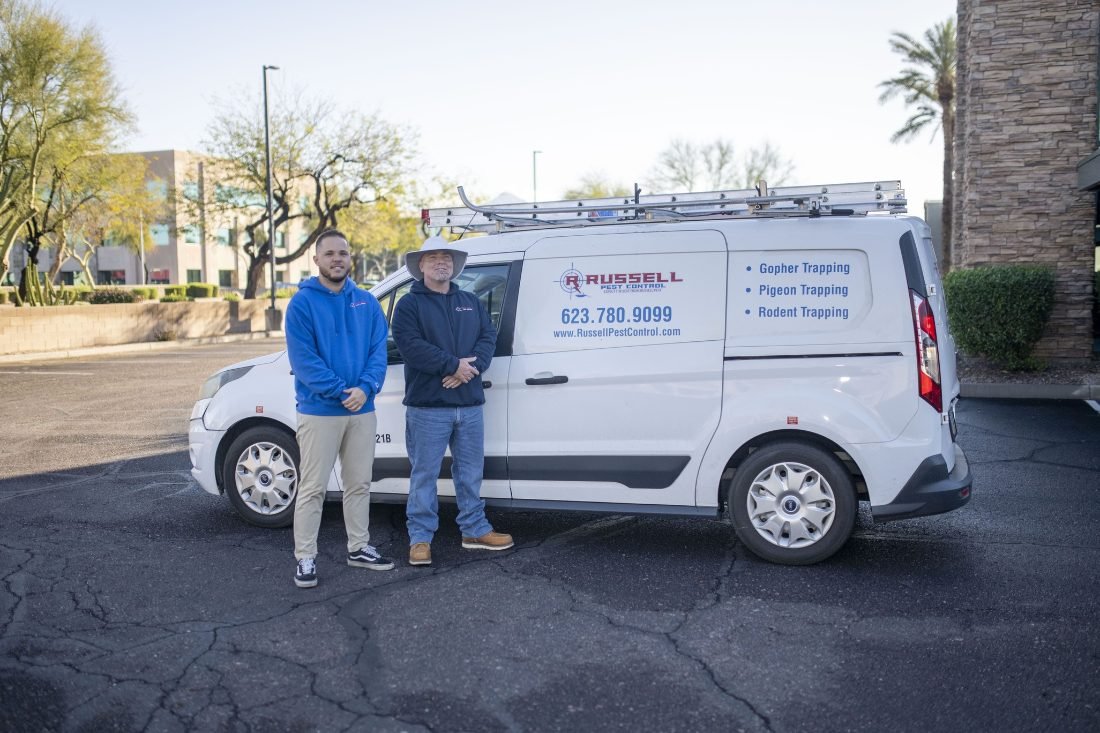
Thirty years of Arizona desert work, with a second generation on the routes. One call gets Steve, Steven Jr., or the office. Never a call center.
We start with your pump-out history and the fixture schedule, which shortens the survey and costs you nothing.
Arizona OPM License #I5321B, and a family company that's been answering its own phone in the Valley since 1996.
What Fly Work Costs in Tempe
One clarification on the badge above and the terms below: the 15-day re-treat warranty covers treatment service. Home Seal carries its own one to two year warranty, and the two are separate things.
Number of fixtures, how many drains are actually producing, whether the problem is one branch or the whole line, and how much documentation you need are what move the number. Food service runs as a program with a service frequency; a home fruit fly problem is usually one visit and a short list of what to move
The standing Russell terms apply here: no initial fees, no contracts, and a 15-day re-treat warranty
Black Light Scorpion Search: $125 per hour, after dark. We'll tell you what we expect your property to take before we start
Home Seal is quoted as its own job, typically $600 to $2,500 with a one to two year warranty depending on the work
Estimates are free. Attic and hive searches can carry a charge, waived if you hire us
Food service runs on its own terms, priced against frequency and documentation, and written down before anybody signs
What Else We Run in Tempe
Commercial and Property Management
Documented programs for food service and multi-unit buildings, on simple terms.
Cockroach Control
German roach work at the plumbing chase, including stacked and multi-unit buildings.
General Pest Control Plans
Monthly, bi-monthly or quarterly, with no contracts and a 15-day re-treat warranty.
Rodent Control and Exclusion
Roof rats removed before anything gets sealed, then screened out at the roofline.
Scorpion, Mosquito, Bee and Weed
Black light searching after dark, station-based mosquito work, live bee relocation where a beekeeper can take the colony, and pre-emergent timed to both desert weed seasons.
All Tempe services: /tempe
What Tempe Operators and Households Ask Us
We clean every night. How is this still happening?
Because the film lives above the water line on the inside of the pipe, and a nightly clean of the surfaces you can see never touches it. Kitchens with excellent cleaning standards get small flies for exactly this reason, and it's no comment on your crew.
Do those enzyme pours from the supply house work?
Not on their own. The film has to be broken up mechanically first, and then a product has something to act on. Poured onto an intact film, most of it runs straight past and down the line.
Can you tell me which drain it is?
Usually, yes. Overnight traps set at individual drains narrow it down properly, and starting from your grease records often gets us close before we set anything.
Do you service the grease interceptor?
No. That's a permitted hauler's job, and it needs to stay with them for your records. We work the drain lines and fixtures, and we'll say plainly if what we're seeing looks like a servicing question rather than a pest one.
How long until the flies stop?
Once the source is genuinely gone, the remaining adults die off over a couple of weeks. If you're still seeing new ones after that, something's still producing, and we go back and find it.
Will an inspector accept what you leave behind?
We write findings, actions, and open items with dates, which is what an inspector or auditor looks for. Whether it satisfies a specific inspection is their call, and we wouldn't promise otherwise.
Can you do same-day service in Tempe?
Often, yes. Call or text before noon, and same-day is realistic more often than not, and an indoor sighting is the kind of call we try hardest to fit in. After hours, the phone reaches Steve's cell for triage.
Do you treat termites in Tempe?
No, and we're straight about it. We'll identify termite signs honestly and refer you to a licensed termite specialist, then handle everything else on the property. Straight lanes, straight answers.
Start With Your Own Records
Pull the fixture schedule and the last few pump-out tickets before you call anyone. Then have us walk the kitchen with them in hand and tell you which branch is producing. On most kitchens, the paperwork gets us close before anybody lifts a grate.
Expect the best from Russell Pest, and have a bug-free day.
Hours
- Monday–Friday: 8:00 AM – 5:00 PM
- Same-day & emergency service available — after hours and weekends, owner-answered
(623) 780-9099 · Call or text · 6750 N 7th Ave, Phoenix, AZ 85013