
Scorpion Control in Scottsdale, AZ — Built for Lots the City Protects as Natural Area
If your property sits inside Scottsdale's Environmentally Sensitive Lands overlay, some part of it is marked as Natural Area Open Space, and the city's own homeowner guidance says that ground can't be cleared, graded, or covered with granite. It's still your land, you still pay tax on it, and on a lot of Scottsdale properties it's the strip between the back of the house and the open desert. That one document decides most of what a scorpion program on your address can and cannot do, which is why we ask for it before we quote anything.
Here, the Plat Decides the Program
The overlay covers most of the city
How much of your parcel is spoken for depends on landform and slope, and the range is wide: the recorded share generally runs from about 20 percent of a property to as much as 80 percent of a steep one, and can be reduced as far as 15 percent. That comes from the city's Environmentally Sensitive Lands Overlay, which governs 134 of Scottsdale's 184.5 square miles, all of it desert and mountain ground north and east of the Central Arizona Project canal. Your plat carries your number. It's also why two houses on the same street can need genuinely different scorpion programs, and why we ask for the plat before quoting anything.
What the city says about that ground
Scottsdale publishes a guide to natural area open space, and it's blunt. No grading, filling, clearing, or excavation of any kind inside the easement. No structures, no walls, no pools, no barbecues. Native plants stay. Decomposed granite and mulch don't get added. And one line matters more on this page than any of the others: pesticides, chemicals, or traps of any kind are not to be introduced in NAOS. Not restricted. Not by permit. Not at all. What that means for a scorpion problem is simple enough: the land stays yours, and on a great many Scottsdale properties it's the strip between the back of the house and the open desert. Every conventional piece of yard advice you've read assumes you can walk out and change that strip. The guide is on the city's website, and the city is the right place to check anything specific to your parcel.
So the leverage moves to two places
Which is why, on an easement lot, exclusion stops being the part of scorpion control people put off until next year. Treatment still does its job: we read where the population crosses at night and work the pressure points, the transitions, and the structure line. But treatment is the part that has to be repeated, and here it works against a supply nobody is permitted to reduce, on ground where a treatment is not permitted in the first place. That is worth being plain about, because it rules out the thing a homeowner would most reasonably ask for. Nobody can spray or trap the easement, us included, and any company that offers to should be asked which document they read. What is unusual about a NAOS lot is that the constraint is RECORDED: it is on the plat, it was knowable before anybody bought the house, and it will read the same to the next owner. That makes this a documents-first job rather than a walk-the-yard one.

What the Program Actually Does
The Arizona bark scorpion is the only scorpion in the country considered medically significant. It's nocturnal, it doesn't travel far in a night, and the University of Arizona Cooperative Extension puts the overwhelming majority of reported encounters in and immediately around the house. That's the useful part on a constrained lot: whatever ground it came from, the animal meets you at the building, and the building is the part of the property you're permitted to change.
The service runs as a program. We work the harborage and the routes the animal actually travels, take down the insect population that feeds it, and keep the same technician on the property wherever the schedule allows, so that knowledge accumulates. Where the building is the problem, sealing gets scoped and priced as its own job, separate from a service visit. And where proof beats an opinion, the black-light search maps the population after dark at $125 per hour.
What Scottsdale Owners Call Us About
The calls that come off easement lots
- One indoors at night, and nobody in the house sleeping well since
- A count that climbed after a remodel, a pool build, or new construction next door
- Sightings concentrated along one wall, usually the wall facing the untouched ground
- A new owner who's just read their title documents and found an easement they didn't expect
- A landscaping notice from an HOA that turns out to concern the protected area
- Repeat activity in a casita, a courtyard, or a pool equipment enclosure nobody sealed
The openings every desert house has
- The stem wall and weep screed line, where the stucco meets the ground
- Garage thresholds and the gap under a roll-up door
- Irrigation and valve boxes, hose bib penetrations, and pool equipment pads
- Block wall voids, weep holes, and gate posts along the property line
What a walled Scottsdale lot adds
- Courtyard gates, where the enclosure meets grade, and the sweep was never fitted
- Casita and guest-house thresholds, often the closest built edge to the protected ground
- Gate posts and pilasters set into the easement side of a perimeter wall
The Four Steps on an Easement Property
Establish where the easement runs
Before anything gets applied, we want to know which part of the lot is recorded as a natural area and which part isn't, because it affects where the product goes, what either of us can move, and what we can honestly tell you to expect. Your plat, your title documents, or the city's mapping should show it. Plenty of owners have never had a reason to look, and if that's you, we'll look with you on the walk-through.
Treat the crossings
On a constrained lot, the goal is a defended line rather than a treated landscape. We work the structure perimeter, the transitions where undisturbed ground meets built ground, and the harborage legally within reach: block wall voids, equipment pads, stored material, gate posts, utility penetrations. Dry times run about 15 minutes outside and 30 to 35 inside; the technician gives you the figure off the label for what he's actually using, before he starts.
Deal with what's feeding them
Scorpions stay where the eating is good, and on an easement lot the food supply is the one biological lever you still control. You can't re-landscape the protected strip, but you can change what draws insects to the edge of it after dark. Fixture choice, aim, color temperature, and what time the timer fires all decide how much of a buffet sits between the natural area and your patio door. In our experience, the worst offender is a bright fixture aimed outward from the house toward the protected side.
Close the building, and keep closing it
On an easement lot, this is the step that compounds, because an opening we close doesn't reopen on its own while everything else on the property has to be done again. It's why we push Scottsdale owners toward one thorough sealing job before an extra visit a year. A bark scorpion gets through a gap around a sixteenth of an inch. Sweeps, thresholds, weep screed, slab joints, and utility penetrations are where a house actually leaks. Where the list runs long, the work moves to a scoped Home Seal, with its own price and its own warranty. Weep holes get screened rather than plugged, because they ventilate the wall cavity.
What Easement-Lot Owners Ask Us
Does an HOA have any say over the protected area?
Frequently, and it catches people off guard. Whether the easement is common area or sits on your own parcel turns on your CC&Rs and the plat, which is a question for your association rather than for us. It doesn't change our work, which happens on your side of the wall. It does change who you talk to before anyone moves a rock.
Can we clear the natural area if we get permission?
That's a question for the city, and we'd sooner send you there than guess at it. What we can tell you is that the program doesn't depend on the answer. We handle easement properties without clearing them, and we won't ask you to.
We're buying in north Scottsdale. What should we ask before we close?
Ask whether the lot carries a recorded natural area easement, where it runs, and how much of the parcel it covers. Ask the same about the neighboring lots, because an easement next door sits just as close to your wall as one on your own ground. And walk the property after dark with a UV light before you sign, if the seller will let you.
How long before we stop finding them inside?
Indoor encounters track the number of openings, so they fall as the openings close. How fast depends on how many openings your house has, which is what the survey counts. The yard is a longer conversation, and we have it at the estimate rather than later.
Are stings here dangerous?
Reactions vary, and it isn't ours to assess. We're a pest company, not a clinic, so if someone is stung, the number you want is Poison Help at 1-800-222-1222, which routes to your county's poison center. For a young child, or for anyone with trouble breathing or swallowing, call 911. Keeping them outside is the part we own.
We have a dog and small children, and the natural area starts at the back wall. What then?
That's the common Scottsdale version of this question, and it changes the placements. Tell us where the children play, where the pool gear sits, and where the protected ground begins, and the work concentrates on the wall line and the structure rather than out toward the easement. Ask the technician on the day, and he'll walk you through what he treated and where.
Can you do same-day service in Scottsdale?
Often, yes. Call or text before noon, and same-day is realistic more often than not, and an indoor sighting is the kind of call we try hardest to fit in. After hours, the phone reaches Steve's cell for triage.
Do you treat termites in Scottsdale?
No, and we're straight about it. We'll honestly identify termite signs, refer you to a licensed termite specialist, and handle everything else on the property. Straight lanes, straight answers.
Why Easement Properties Stay With Us
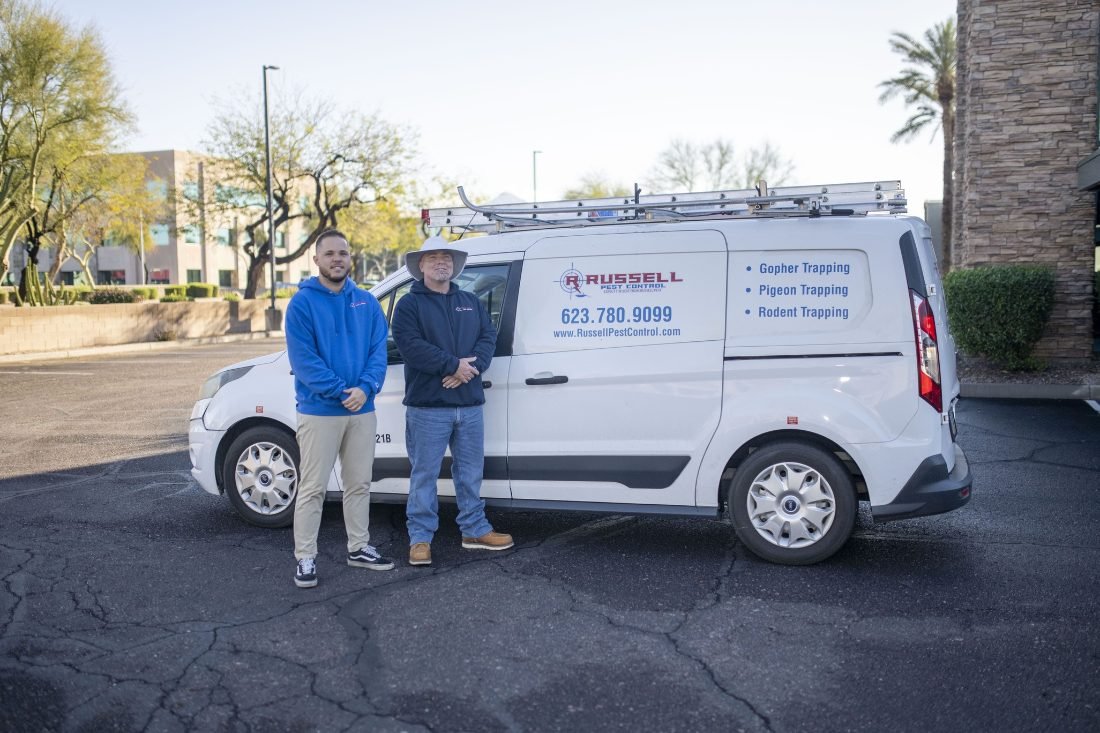
Thirty years of Arizona desert work, with a second generation on the routes. One call gets Steve, Steven Jr., or the office. Never a call center.
We'll ask for your plat before we quote. On an easement lot, the boundary decides half the plan, and guessing at it is how a program ends up priced for a property nobody understood.
No contracts and no initial fees on residential service, and a 15-day re-treat warranty if something comes back inside the window.
Arizona OPM License #I5321B, and a family company that's been answering its own phone in the Valley since 1996.
What Scorpion Service Costs in Scottsdale
Lot size, easement extent, structure count, and how much desert frontage you carry are what move the number. We price it after we've walked it
The standing Russell terms apply here: no initial fees, no contracts, and a 15-day re-treat warranty
Black Light Scorpion Search: $125 per hour, after dark. We'll tell you what we expect your property to take before we start
Home Seal is quoted as its own job, typically $600 to $2,500 with a one to two year warranty depending on the work
Estimates are free. Attic and hive searches can carry a charge, waived if you hire us
What Else We Run in Scottsdale
Black Light Scorpion Search
After-dark ultraviolet mapping of the population and its routes, billed at $125 per hour.
Home Seal and Scorpion Sealing
Structural exclusion to the 1/16-inch standard: sweeps, thresholds, weep screed, slab joints, and penetrations.
Rodent Control and Exclusion
Packrats and roof rats removed before anything gets sealed, then screened out at the roofline and the outbuildings.
View Fence and Snake Screening
Engineered screening at ground level for wall and fence lines, fitted so the sightline stays intact.
General Pest, Bee, and Weed
Plans from monthly to quarterly, live bee relocation where a beekeeper can take the colony, and pre-emergent timed to both desert weed seasons.
All Scottsdale services: /scottsdale
Get a Program Built for Your Lot
Two questions are worth answering before you spend anything on a Scottsdale scorpion problem: how much of your parcel is recorded as natural area, and how many openings your house currently has. The first is on your plat. Bring us both, and the plan more or less writes itself.
Expect the best from Russell Pest, and have a bug-free day.
Hours
- Monday–Friday: 8:00 AM – 5:00 PM
- Same-day & emergency service available — after hours and weekends, owner-answered
(623) 780-9099 · Call or text · 6750 N 7th Ave, Phoenix, AZ 85013