
Rodent Control in Scottsdale, AZ — Three Clocks Decide How Bad It Gets
Look at your trash collection day. That single square on the calendar tells you more about your rodent risk than most owners would guess, because the twenty-four hours a container spends at the curb is the richest window a roof rat gets all week. There are two more clocks behind it: the seasonal one, which runs backward from what people expect, and on many Scottsdale streets a third, set by how often the household changes. Russell Pest Control has worked on Valley rodent problems since 1996, and on this job the timing does more work than the product does.

What Rodent Work Looks Like on a Scottsdale Property
Roof rats are the Valley's dominant residential rodent, and they live above head height. Maricopa County puts them four feet or more off the ground for about 90 percent of their lives, moving along walls, wires, fence tops and canopy, well above open dirt, and squeezing through anything bigger than a nickel. They're also strongest in the cool half of the year, which inverts the pest calendar most homeowners carry in their heads.
Our approach is trap-first, which keeps the risk of someone dying inside a wall as low as we can get it. We find the runs, remove what is on the property, then close the roofline so the next one has nowhere to come in. The order matters at least as much as the products do, and so does where in the week the visit falls.
What Scottsdale Rodent Calls Sound Like
What people describe first
- Scratching or running overhead at night, usually in the same corner of the ceiling
- Droppings on a garage shelf, a pantry floor, or the top of a water heater
- Droppings along the top of a block wall, or a worn run where a shrub touches the fascia
- A container lid propped open by a full bag, and activity that arrived the same week
- A stick-and-debris pile under stored equipment, which is a packrat midden
- Rats visible on a wall or a fence top at dusk, moving in one consistent direction
Where they get in
- Tile roof edges and the gaps at the eave line
- Roof vents, plumbing boots, and the gap where a conduit passes the fascia
- Attic access from an unsealed soffit return
- Garage doors that no longer seal at the corners
- Air conditioning line penetrations at the wall
Rodent Work Here Runs on Three Clocks
Clock one: the twenty-four hours the container is out
Scottsdale asks that containers be set out by 5 a.m. on collection day and brought back in that evening, and states that loose or uncontained trash won't be collected. It also requires a tight-fitting lid, in the city's own words, to prevent spills and deter pests. Read together, those rules describe a window: roughly one day a week when a week's food sits outside at ground level with only a lid between it and everything on the street. A closing lid makes that window uninteresting. One propped open by a full bag makes it the best night of the rodent's week.
Clock two: the season runs backward
Maricopa County describes roof rats as thriving in cool weather and most active from November through May. So the calls climb as the evenings turn pleasant, which is precisely when a household stops thinking about pests and starts using the patio. Anyone treating rodents as a summer problem here is buying service in the quiet half of the year.
Clock three: on some streets the schedule has no owner
Scottsdale's open data lists roughly 2,800 active short-term rental licenses, about one in fifty of the city's housing units. Plenty are run immaculately, and none of this is a complaint about a legal business. It is a scheduling fact: a container's routine depends on somebody being there to keep it, and on those addresses the somebody changes. The city itself lists overflowing or uncontained trash among its short-term rental violations and runs daily checks of rental property compliance.
Why the timing beats the product on this job
University of Arizona work puts an urban roof rat's normal range at up to about 120 yards from the nest, and Maricopa County describes a territory of 200 to 300 feet. The two figures don't quite agree, and either way it's a short commute. It means the animal makes a nightly decision about where the easiest food is. You can't do much about the neighbors. You can decide whether your building is available on the night that decision gets made, and you can put the service where the week is busiest.
The Tuesday Property and the Friday Property
Two houses on the same route, the same size, the same construction, both on a bi-monthly program. One gets serviced on a Tuesday and its containers go out Thursday night. The other gets serviced on a Friday and its containers go out Friday morning. On paper they buy exactly the same thing. In practice the second property has fresh exterior work in place during the one night of the week when a week's food is sitting outside at ground level, and the first has work that is two days old by the time that night arrives, on a route where nothing else about the two properties differs. We've not seen it offered as a feature anywhere, and it costs nothing to arrange. It is the one change on a rodent program that happens entirely inside the scheduling software.
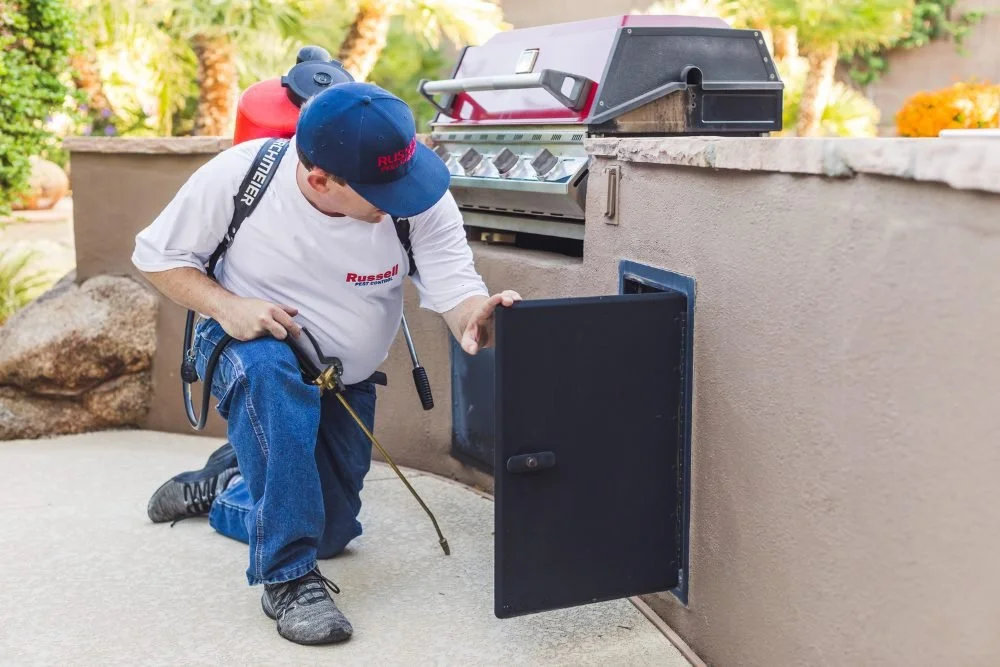
Six Steps on a Scottsdale Rodent Job
Find the runs before setting anything
Rub marks, droppings, gnaw damage, and the grease line along a travel route tell you where the traffic is. Traps set on evidence work; traps set on guesswork mostly sit there and cost you a week.
Work the roofline
Roof rats commute overhead, so the inspection goes up a ladder. Tile edges, eave gaps, vent boots, soffit returns, and the conduit penetrations are where a Scottsdale house actually opens, and none of them are visible from the driveway.
Trap first, and check often
Removal comes before exclusion, because sealing a building with rodents still inside creates a worse problem than the one you started with. Traps get checked on a short cycle, not left out to become furniture.
Cut the bridges onto the building
Branches touching the fascia, a vine on the wall, a fence top running to the roofline, a bin stored against the house. These are the routes onto your structure, and every one of them is on your side of the line, which means every one is fixable without anyone else's cooperation.
Close the roofline
Exclusion is the part that lasts. Stucco diamond mesh at the tile edge, sealed vent boots, screened soffit returns, copper mesh behind sealant at the utility penetrations. Anything larger than a nickel is a door.
Put the service against the busiest night
This is the part almost nobody asks for, and it costs us nothing to arrange. Tell us your collection day, and we'll set the service day near it wherever the route allows, so the exterior work is freshest during the window the week actually turns on. One safety note before anyone clears anything. Maricopa County publishes the protocol for rodent droppings, and it matters. Rubber gloves on. Ventilate the area the night before you clean, by opening doors and windows, and don't shortcut that step to the few minutes before you start. Never sweep or vacuum droppings dry. Spray the droppings, nests, and the area around them with a 10% bleach solution (1 part bleach to 9 parts water), and allow at least 15 minutes of contact time before removing anything. Wipe up with paper towels or a mop, double-bag it, and wash your gloved hands in disinfectant before the gloves come off, then wash your hands with soap and water once they are off. The county sets the onset window for illness at 1 to 5 weeks. If a flu-like illness shows up in the weeks after a clean-up, the standing public-health advice is to see a physician promptly, to mention the rodent exposure, and to treat difficulty breathing as urgent, because early diagnosis is what changes the outcome. Gloves and closed shoes, and never reach into a pile you can't see into. The same harborage holds bark scorpions, and near open ground it holds snakes. If something has sat undisturbed for months, don't move it by hand. For a snake, that's a call to a licensed wildlife removal service or to Arizona Game and Fish; a bite is a 911 call. For anything else, leave it for us.
What Rodent Service Costs in Scottsdale
Roof pitch, tile type, canopy contact, and how much exclusion the building needs are what move the number. We price it after we've walked it
The standing Russell terms apply here: no initial fees, no contracts, and a 15-day re-treat warranty
Black Light Scorpion Search: $125 per hour, after dark. We'll tell you what we expect your property to take before we start
Home Seal is quoted as its own job, typically $600 to $2,500 with a one to two year warranty depending on the work
Estimates are free. Attic and hive searches can carry a charge, waived if you hire us
What Scottsdale Rodent Callers Ask Us Most
We think the problem starts next door. What can we actually do?
Work on what you own, because it decides whether they get inside. Close the building, cut the bridges onto it, keep your own container sealed. A rat that can't get in is a rat you don't have, whatever is happening two doors down.
Are there actual rules about trash containers here?
Scottsdale publishes them. Containers need a tight-fitting lid; loose or uncontained trash is not collected, and containers go out by 5 a.m. on collection day and come back in that evening. The city also lists overflowing or uncontained trash as a short-term rental violation and conducts daily compliance checks. What it does about any particular address is the city's call, and their pages set out how they handle it.
We only see them in the trees. Are they in the house?
Not necessarily, and it's worth knowing which. Rats in the canopy are a food-and-travel problem; rats in the attic are a structural one. The inspection is what sets them apart, and the answer determines how much you should spend.
How big an opening does a roof rat need?
Maricopa County's rule of thumb is anything larger than a nickel. On a tile roof, that describes a great many eave gaps, which is why this exclusion work is done at height using mesh and sealant.
When is rodent season in Scottsdale?
The cool half of the year. November through May, per Maricopa County, which surprises people who expect summer to be the bad stretch. If your evenings just got pleasant, that's the signal to look.
We own a short-term rental here. What should we be doing between guests?
Three things carry most of it. Make sure the container lid actually closes, and that someone brings it back in on collection day, not at the next changeover. Clear any fruit on the property. And get the roofline closed once, properly, because it is the only part of this that does not depend on whoever is staying that week. Sealing is the piece we would push hardest on a rental, precisely because it survives the turnover.
Can you do same-day service in Scottsdale?
Often, yes. Call or text before noon, and same-day is realistic more often than not, and an indoor sighting is the kind of call we try hardest to fit in. After hours, the phone reaches Steve's cell for triage.
Do you treat termites in Scottsdale?
No, and we're straight about it. We'll identify termite signs honestly and refer you to a licensed termite specialist, then handle everything else on the property. Straight lanes, straight answers.
The Rest of the Scottsdale Work
What else we run in Scottsdale:
Scorpion Control
Black Light Search and Sealing
All Scottsdale services: /scottsdale
Start With the Day of the Week
If something is running over your ceiling at night, the order that works is removal, then exclusion, then a service schedule set against the week instead of the calendar. Tell us your collection day when you call.
Expect the best from Russell Pest, and have a bug-free day.
- Thirty years of Arizona desert work, with a second generation on the routes. One call gets Steve, Steven Jr., or the office. Never a call center.
- Tell us your collection day, and we'll set the service day near it wherever the route allows, because the week has a shape and a scheduling calendar ignores it.
- No contracts and no initial fees on residential service, and a 15-day re-treat warranty if something comes back inside the window.
- Arizona OPM License #I5321B, and a family company that's been answering its own phone in the Valley since 1996.
Hours
- Monday–Friday: 8:00 AM – 5:00 PM
- Same-day & emergency service available — after hours and weekends, owner-answered
(623) 780-9099 · Call or text · 6750 N 7th Ave, Phoenix, AZ 85013