
Mosquito Control in Scottsdale, AZ — Public Fogging Works by the Square Mile
Maricopa County sets more than 800 mosquito traps a week through the season, 56 of them inside Scottsdale. When a trap comes back positive, the county treats by grid: its own documentation says areas are fogged based on the one-square-mile section where the trap sits, not by a mile buffer around it. A square mile is a lot of ground. Your yard is either within a treated section or it isn't, and the container water that supports the day-biting species is almost always on private property.
What the County Does, and Where It Stops
The grid is a mile wide
Maricopa County's mosquito program is genuinely good, and it is genuinely coarse. Traps go out weekly throughout the season; samples are tested for West Nile and St. Louis encephalitis, among others, and when something comes back positive, the response is applied to the square-mile section containing that trap. A property one parcel outside a treated section gets nothing from that response, and the fogging itself is applied over the section rather than inside anyone's backyard. The county does reach private property by another route: it takes complaints, works with owners on breeding sources, and treats neglected pools. What it does not do is run a weekly program on your lot.
Scottsdale is well covered by surveillance
Of the county's mapped trap sites, 56 sit in Scottsdale, spread across the 85250, 85251, 85254, 85255, 85257, 85258, 85259 and 85260 ZIP codes. That's useful to know, because it means the county has real data on your area. It also means the intervention you're inside is a monitoring one, and the fogging that follows is a section-level response, not a service call.
One year the numbers ran high here
In its 2023 end-of-year report, Maricopa County listed Scottsdale at 2.9 confirmed human West Nile cases per 100,000 residents, compared with a countywide rate of 1.5 and a Phoenix rate of 1.1. That figure counts confirmed human illnesses in a specific year among cities with populations above 100,000. It says nothing about mosquito numbers or risk today, and it moves a great deal: in the 2024 report, Scottsdale doesn't appear in the city table at all. The honest version is a real local risk with big year-to-year swing.
The season has a shape, and it tracks the water
The county's trapping runs roughly March through October, and the pressure inside that window isn't flat: it follows rain more closely than it follows the thermometer. Within that window, standing water and warm temperatures do most of the work, which is why the weeks after significant rain are worth watching. What it means for a household is straightforward: a program aimed at the trapping season is doing something, and one aimed at the calendar year mostly isn't. It also means starting before the pressure arrives, because a station system needs time on the property to build.
The one biting you didn't come far
Maricopa County puts the usual flight range of the day-biting container mosquito at roughly 150 to 300 feet. That's the most useful fact for a homeowner on this page: the day-biting mosquito on your patio was very likely born on your lot or the one beside it. The night-flying species the county tracks for West Nile ranges further, so the two problems want different answers, and only one of them is entirely yours to fix.
Where the Water Actually Is
The sources people expect
- Pool and spa water that's gone untended, including a pool left down between owners
- Water features, fountains and ornamental ponds without circulation
- Irrigation low spots and drip emitters that pool instead of draining
The ones that actually produce
Maricopa County treats water standing more than three days as a breeding site, which is a precaution rather than the point where adults emerge, and that eliminating breeding on a property is the property owner's responsibility, not the county's. Which is the whole argument for having someone walk the yard.
- Pot saucers under shaded patio plants, which is the classic Valley producer
- Tarps, buckets, wheelbarrows, toys and anything left the right way up
- Air conditioning condensate pans and the drip line under the unit
- Blocked scuppers, roof drains and the base of a downspout
- Bromeliads and other plants that hold water in the leaf axil
Five Steps on a Scottsdale Mosquito Program
Walk the property for water first
Before anything is applied, we go container by container. Most yards have more producers than the owner expects, and the obvious one is rarely the only one. This is the part that changes the number, and it's where the program starts.
Work out which section you're in
We can tell you whether your address sits inside a section the county has been treating, which is worth knowing before you decide how much of this you want to pay for. Some Scottsdale properties are getting more public help than they realize, and some are getting none.
Place In2Care where the mosquitoes already are
The station system is designed to work with the water you can't remove: per the manufacturer's EPA-registered labeling, mosquitoes visiting a station carry larvicide back to breeding sites, so the protection builds through the season. Placement is in shade, low wind, and proximity to the water.
Treat the resting harborage
Adult mosquitoes spend the daylight hours somewhere shaded, still, and humid, which on a Scottsdale property means the undersides of dense shrubs, the north face of a wall, the gap behind the pool equipment, and the dark side of anything stored against the house. A barrier application put on those surfaces reaches the adults between feeds. Put on open turf or an exposed wall in full sun, the same product does very little, which is why placement matters more than frequency here.
Come back on the season's schedule
The county's trapping season runs roughly March through October, which is a fair guide to when a residential program should be active. We step it up in season and back off out of it, because twelve identical months is a billing schedule, not a program. Two things you control that no yard treatment can: an EPA-registered repellent, and long sleeves at dawn and dusk. We're a pest company, so the medical half is short, and it isn't ours. For the small share who do get seriously ill, the CDC is direct, and we'll quote it rather than paraphrase it: seek immediate medical attention for high fever, neck stiffness, muscle weakness, confusion, or tremors. If that is what you are seeing, get medical help now. Anything short of that is still a question for a clinician and not for us.
What Mosquito Service Costs in Scottsdale
Lot size, how much water the property carries, and how many stations it takes to cover it are what move the number. We price it after we've walked it
The standing Russell terms apply here: no initial fees, no contracts, and a 15-day re-treat warranty
Black Light Scorpion Search: $125 per hour, after dark. We'll tell you what we expect your property to take before we start
Home Seal is quoted as its own job, typically $600 to $2,500 with a one to two year warranty depending on the work
Estimates are free. Attic and hive searches can carry a charge, waived if you hire us
The Other Scottsdale Services
What else we run in Scottsdale:
Scorpion Control and the Black Light Search
All Scottsdale services: /scottsdale
Before You Buy a Mosquito Program Here
Doesn't the county already spray my street?
Possibly, and possibly not, and the answer is geographic. The county treats the square-mile section containing a positive trap, so whether your address is covered depends on which side of a section line it sits. Either way, that response is applied across the section rather than in your yard. If you have a specific breeding source, a neglected pool in particular, the county takes complaints and will act on those separately.
Scottsdale's West Nile rate was high in 2023. Should we be worried?
It's worth taking seriously and worth reading precisely. In 2024 Scottsdale doesn't appear in that table at all. So the useful conclusion is a real risk that swings hard year to year, which argues for a program in season and against panic in either direction.
Where is it actually breeding?
If it's biting you in daylight, almost certainly within 150 to 300 feet, which is Maricopa County's stated flight range for the container species. In practice, that means your yard or the one beside it. The walk-through finds it.
Does In2Care work with a pool?
A maintained pool isn't usually the producer, because circulating chlorinated water is poor habitat. The saucers, the AC pan, and the low spot in the irrigation are. In2Care is designed for exactly those sources, which is why a pool alone isn't a reason to skip it. Whether it's the right fit for your property is what the walk-through settles.
There's a neglected pool two doors down. Anything we can do?
A neglected pool is a far larger production site than anything in a normal yard. For a Scottsdale address, start with the City: Scottsdale Code Enforcement handles green pools directly, on 480-312-2546. Maricopa County Environmental Services is the second call and takes standing-water complaints countywide, on 602-506-0700. Between them, one of the two will have it. On our side, we can cut what's producing on your own lot and put stations between you and any water we can't reach.
We only get bitten at dusk. Does that change anything?
It's a useful clue. Dusk and after dark point toward the night-flying species the county tests for West Nile; bites in the middle of the afternoon point toward the container breeder. Tell us when it's happening and the program gets aimed accordingly.
Can you do same-day service in Scottsdale?
Often, yes. Call or text before noon, and same-day is realistic more often than not, and an indoor sighting is the kind of call we try hardest to fit in. After hours, the phone reaches Steve's cell for triage.
Do you treat termites in Scottsdale?
No, and we're straight about it. We'll honestly identify termite signs, refer you to a licensed termite specialist, and handle everything else on the property. Straight lanes, straight answers.
How We Run It
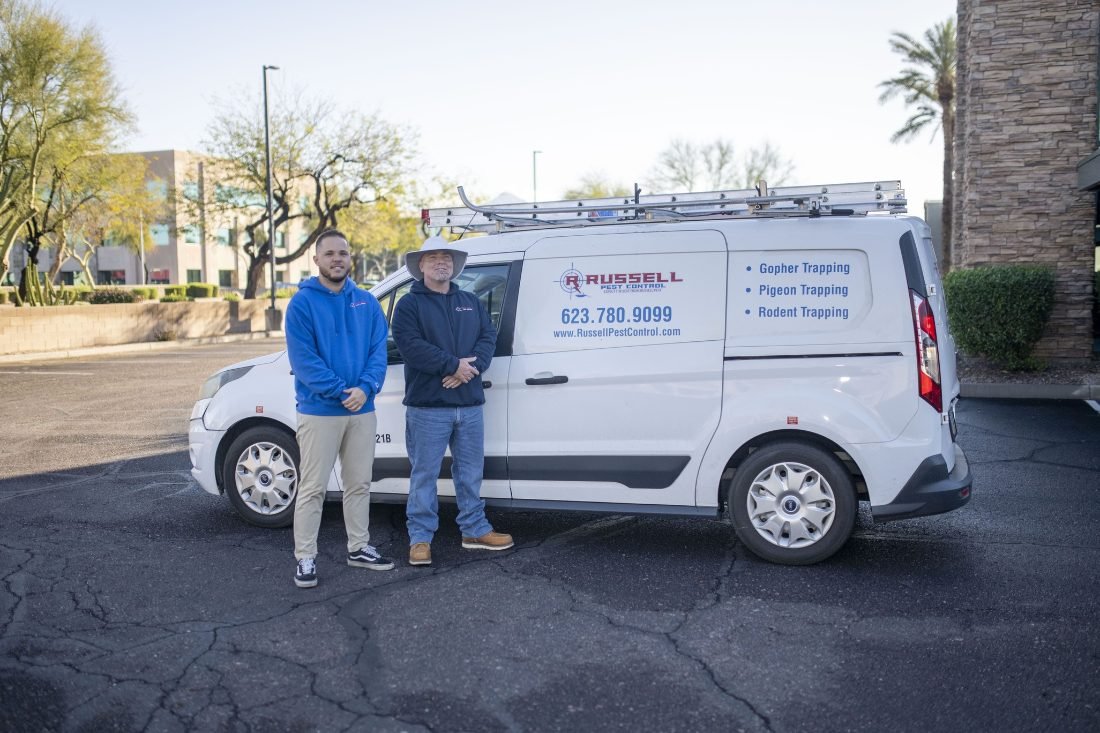
Thirty years of Arizona desert work, with a second generation on the routes. One call gets Steve, Steven Jr., or the office. Never a call center.
We'll look up which county section your address falls in and tell you what the county's published data shows for it, before you decide what to buy from us.
The walk-through for standing water happens before anything is applied, because on a mosquito job the water is the program and the spray is the support.
In2Care stations are placed where the mosquito is: shade, low wind, and near the water, which is rarely where a customer would put them.
No contracts and no initial fees on residential service, and a 15-day re-treat warranty if something comes back inside the window.
Arizona OPM License #I5321B, and a family company that's been answering its own phone in the Valley since 1996.
Start With the Water on Your Own Lot
It's where the day-biting ones were born, and the estimate is free. Call or text, and we'll walk it with you.
Expect the best from Russell Pest, and have a bug-free day.
Hours
- Monday–Friday: 8:00 AM – 5:00 PM
- Same-day & emergency service available — after hours and weekends, owner-answered
(623) 780-9099 · Call or text · 6750 N 7th Ave, Phoenix, AZ 85013