
Home Seal in Scottsdale, AZ — No Two Houses Here Seal the Same Way
Checklist exclusion works fine in most cities because a tract builder installs the same door sweep and the same weep screed detail on 400 houses, and the openings repeat. Scottsdale is a harder place to run a checklist. Of the single-family permits the city has issued since the start of 2020, more are classified as custom than standard, 1,545 against 1,196, and the custom ones average around 5,075 square feet of conditioned space. That's new construction only, and most Scottsdale houses are older than it, but it tells you what kind of city this is to work in. That's a city where one-off detailing is normal rather than exceptional, and where a list written for tract construction is of little use. There's a survey, and then there's a scope.

What Home Seal Is, and What It Isn't
Home Seal is the structural half of pest control. It closes the routes so less gets in, which is a different job from treating what already has. The work is sweeps and thresholds, weep screed screening, slab and expansion joints, utility and conduit penetrations, hose bibs, dryer and bath vents, garage door corners, roof vents and soffit returns. On a Scottsdale house, it usually also includes courtyard gates, casita thresholds, and whatever the architect did where the conditioned space meets the covered space.
It isn't a substitute for a treatment plan, and we won't sell it as one. What it does is change the arithmetic: a sealed building gives less to get in through, which is why we'd sooner close the openings than raise the product. What that changes on a particular property is what the survey tells you and the following season confirms. It's quoted as its own job with its own warranty, typically $600 to $2,500 with a one to two year warranty depending on the work, because it's construction and it deserves a real number.
The Permit Record Explains the Problem
More one-off houses than tract houses
Since the start of 2020, the City of Scottsdale has issued roughly 1,545 permits classified as custom single-family construction, compared with about 1,196 classified as standard or production, all of it new construction rather than existing stock. Its own permit taxonomy splits custom further into subdivision lots, metes-and-bounds parcels, multi-level and green builds. That level of sub-classification is itself the point: a city keeps four kinds of custom because it issues enough of each to need them.
They're substantially bigger buildings
Those custom permits average around 5,075 square feet of air-conditioned area, against roughly 3,577 for the production permits. They also carry an average of about 2,575 square feet of covered but unconditioned area: patio, ramada or breezeway. That's the interesting number, because the junction between conditioned and unconditioned space is exactly where a building tends to open. Where a house has that much covered area, it has a lot of junctions. The city has an opinion about gaps, and it's smaller than you'd guess In its own published guidance, Scottsdale tells homeowners to fill holes an eighth of an inch or larger in walls and in structures with voids inside, and to use a quality sealant on cracks and gaps in walls, rooflines and around foundations. That is not a hole anyone notices. University of Arizona Extension puts the working figure for a bark scorpion smaller still, at around a sixteenth of an inch. Those two numbers are why exclusion is slow work done on hands and knees, and why a walk-around with a caulk gun accomplishes very little.
The code cares about the same gaps, for its own reasons
Scottsdale's adopted energy code is specific about air sealing and is written for energy performance and checked during construction. We mention it only because it confirms the openings are real and worth closing. What it does not do is answer the pest question, and on a custom building the pest question is about detailing rather than about a code minimum.
A note on protected ground
About 56 percent of those custom permits, 869 of 1,545, sit on parcels inside the city's Environmentally Sensitive Lands overlay. Read that as a description of where the largest custom houses are going up: at the edges rather than the middle. What the overlay means for a particular parcel is a question for the city's planning department, and what it means for scorpions is a separate page.
Seven Steps in a Scottsdale Home Seal
Survey before quoting
The whole building gets walked, and the openings get counted before a number is given. On a custom house that's an hour or more, and it's the reason we won't quote this over the phone. What you get back is a list of specific openings, each with a price against it.
Start at grade
In our experience, the weep screed line where stucco meets the ground is the most productive single feature on an Arizona house. It gets screened with a coarse mesh, never plugged, because those openings ventilate the wall cavity, and blocking them creates a moisture problem rather than a pest one.
Do the doors properly
Sweeps, thresholds, and astragals on every exterior door, including the garage side door and the casita. A door that latches can still show daylight along the bottom corner, and daylight is the test. Brush or rubber, and never vinyl, which stiffens and gaps.
Take the garage seriously
In most Scottsdale houses we survey, the garage is the readiest route in, and inside the garage the roll-up door is the widest opening you have. Bottom seal, side seals, and the two bottom corners where the seal stops short. It's unglamorous, and it's frequently the highest-value hour of the job.
Close the penetrations
Every pipe, conduit, hose bib, gas line, dryer vent, and air conditioning line set passes through the envelope, and they were finished for weather and not for exclusion. Copper mesh behind sealant on the wider ones, silicone over latex, because it moves with the temperature swing.
Work the conditioned-to-covered junctions
This is the Scottsdale-specific hour. Where a patio ceiling meets the house, where a ramada ties in, where a courtyard wall returns to the structure, where a multi-slide door track drains. These are one-off details on a one-off house, and the only way to price them is to look at them.
Go up
Roof vents, soffit returns, fascia gaps and the tile edge finish the job, because a building sealed at grade and open at the eave still has a door.
What Home Seal Costs in Scottsdale
Building size, the number of separate structures, how the covered areas tie in, and how many openings the survey finds are what move the number. We price it after we've walked it
One clarification on the badge above and the terms below: the 15-day re-treat warranty covers treatment service. Home Seal carries its own one to two year warranty, and the two are separate things.
The standing Russell terms apply here: no initial fees, no contracts, and a 15-day re-treat warranty
Black Light Scorpion Search: $125 per hour, after dark. We'll tell you what we expect your property to take before we start
Home Seal is quoted as its own job, typically $600 to $2,500 with a one to two year warranty depending on the work
Estimates are free. Attic and hive searches can carry a charge, waived if you hire us
The Casita Nobody Counted
The pool house was there the whole time. It has its own slab edge, its own hose bib, its own door that never latched clean, and a covered walkway running to the kitchen. Nobody mentioned it, because the conversation was about the house. A casita, a pool house, a detached office, a workshop, a covered outdoor kitchen with a plumbed sink. On a large Scottsdale lot, these are separate buildings with their own doors, their own penetrations, and frequently their own slab edge, and several of them share a wall or a covered walkway with the main house. Whatever gets in one has a short walk to the other. It's the reason we most often see a good seal underperform, and it's entirely avoidable at the survey: count the structures before counting the openings, and price the whole campus.
Before You Book the Survey
Why won't you quote it over the phone?
Because on a custom house, the number depends on things nobody can describe accurately from memory. How the patio ties in, whether the weep screed is buried, how many penetrations the mechanical contractor made, whether the garage seal has already been replaced once. An hour on site produces a real number. A phone estimate produces a number that changes.
Our house is nearly new. Doesn't the building code handle this?
Not the part you're asking about. Codes are checked at construction and written for energy, and on a custom build the openings that matter to us are usually in the detailing rather than in anything a code minimum addresses. A new Scottsdale house is often a shorter list, and it is still a list.
What's the smallest gap that matters?
Scottsdale's own homeowner guidance says an eighth of an inch or larger for general exclusion. University of Arizona Extension puts the bark scorpion figure closer to a sixteenth. We seal to the sixteenth: the city's eighth-inch figure is general-exclusion guidance, not our standard. Both are smaller than most people picture, which is why this is a slow job.
How long does it take?
A residential seal is usually a day. Larger properties with multiple structures run to two. If it's going to run to three, that's what we aim to tell you at the survey.
Will it lower our power bill?
We're not going to sell it on that. The same gaps matter to the energy code, so it's reasonable to assume that closing them does something, but we don't measure it and won't put a figure on it. Buy this for the pests. Anything else it does is a bonus nobody promised you.
What about the covered patio?
It's in scope, and it's where the interesting problems are. A covered but unconditioned space is neither inside nor outside, and the junction where it meets the house is a genuine seam. On Scottsdale custom homes, those areas are large.
Do you guarantee it?
The work carries a one to two year warranty depending on what was done. What we won't guarantee is that nothing ever gets in again, because a house is not a sealed vessel and anyone promising otherwise is selling you something.
We have a casita and a guest house. Separate job?
Same job, bigger scope, and it should be quoted that way from the start. Sealing a main house while leaving a shared-wall casita open is how this work ends up half-finished.
Does sealing replace our treatment plan?
No, and we'd be suspicious of anyone who said it did. It reduces what the plan has to handle. Both halves earn their place, and neither substitutes for the other.
Can you do same-day service in Scottsdale?
Often, yes. Call or text before noon, and same-day is realistic more often than not, and an indoor sighting is the kind of call we try hardest to fit in. After hours, the phone reaches Steve's cell for triage.
Do you treat termites in Scottsdale?
No, and we're straight about it. We'll identify termite signs honestly and refer you to a licensed termite specialist, then handle everything else on the property. Straight lanes, straight answers.
How We Scope It
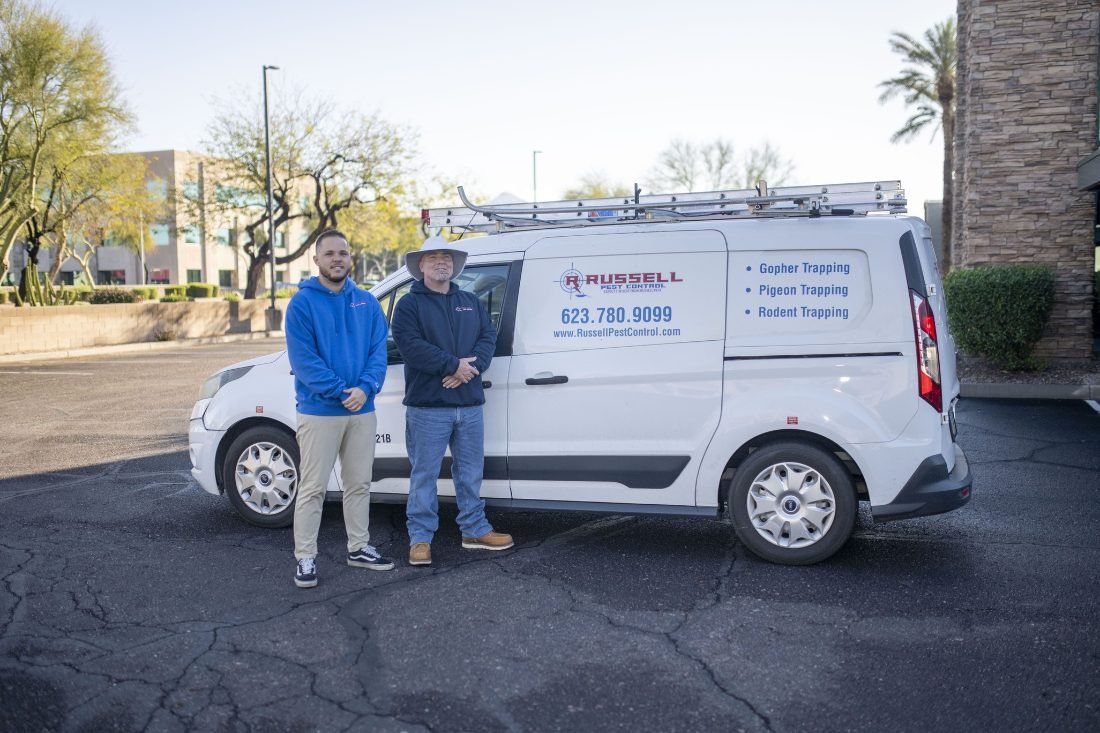
Thirty years of Arizona desert work, with a second generation on the routes. One call gets Steve, Steven Jr., or the office. Never a call center.
The survey comes before the quote, and the quote itemizes the openings, so you're buying a specific list of work, priced line by line.
We count the structures before we count the openings, because a sealed house next to an open casita is a half-finished job.
Arizona OPM License #I5321B, and a family company that's been answering its own phone in the Valley since 1996.
The Rest of What We Do Here
What else we run in Scottsdale:
Scorpion Control and the Black Light Search
General Pest
Rodent, Bee and Mosquito
All Scottsdale services: /scottsdale
Book the Survey, Then Decide
The survey is what turns this from a vague service into a list you can read. Call or text, tell us how many structures are on the property, and we'll bring enough time to walk all of them.
Expect the best from Russell Pest, and have a bug-free day.
Hours
- Monday–Friday: 8:00 AM – 5:00 PM
- Same-day & emergency service available — after hours and weekends, owner-answered
(623) 780-9099 · Call or text · 6750 N 7th Ave, Phoenix, AZ 85013