
Bee Removal in Scottsdale, AZ — Live Relocation First, in Line With the City
The City of Scottsdale warns its own residents, on its own environmental pages, that most commercial bee removal services they call will kill the hive. That's the city's own sentence, and it sits in a paragraph where the city recommends humane removal instead. It's unusual for a city to publish, but Scottsdale did. We have worked that way in the Valley since 1996: relocation when a beekeeper can take them, safety-first removal when they can't. Swarm photo triage by text is free.
Two Different Jobs That Look the Same From the Patio
A swarm
A cluster of bees hanging from a branch, a wall, a gatepost, or a piece of garden furniture, typically a dense cluster with bees flying around it in a loose cloud. A swarm is a colony in transit. It has no comb, no honey and nothing to defend, and it's the version a beekeeper can usually take away intact. It will frequently move on by itself before long.
A colony
A steady, purposeful stream of bees going in and out of one specific opening: a weep hole, a gap in the stucco, a roof vent, a valve box lid, a water meter box. That's an established nest with comb and honey inside a cavity, and it's a construction job as much as a bee job. It doesn't move on by itself, and it gets larger.
Where Scottsdale colonies settle
- Hollow-block perimeter wall voids, entered at a weep hole or an unfilled cap
- Wall voids behind stucco, entered at a stress crack or a pipe penetration
- In-ground irrigation valve boxes and water meter boxes, entered at the lid gap
- Roof vents, soffit returns, and the void above a patio ceiling
- Chimneys, rainspouts, and unused barbecue or fireplace flues
- Sheds, casitas, and pool equipment enclosures nobody opens in summer
A City That Published Its Own Position
The city asked for humane removal, by name
Scottsdale's guidance recommends humane removal, which doesn't destroy the swarm or hive, and notes that killing a hive might solve a short-term problem while creating a long-term one for the local ecosystem. Very few municipalities take a published position on how a private pest job should be done. It means a Scottsdale homeowner asking for live relocation is asking for exactly what the city recommends.
It also published the rule that stops people from getting hurt
The same guidance says plainly: do not attempt to seal holes or fill voids if bees are actively moving in and out of it. This is the single most important sentence on this page. Sealing a live colony traps it, its comb, and its honey inside a wall cavity. What comes next is bees finding another way out, which is often into the living space, and a fermenting mass of honey behind drywall that stains, attracts everything else, and has to come out anyway. Removal first, sealing second, always in that order.
Every wild colony here gets treated as defensive
University of Arizona Cooperative Extension states that all wild honey bees in Arizona are considered Africanized to some extent, and that only genetic testing can reveal the lineage in a given colony. Scottsdale's own fire department notes that these bees have been known to pursue a perceived threat well over 1,640 feet away. So there's no useful sorting to be done from a patio door. Every established colony gets approached as a defensive one, which is a decision about protective equipment and timing, and only then about product.
Three Steps, and the First One Is Free
Send a photo before anyone drives out
Text a picture to the number on this page, and you get an answer on whether it's a swarm, an established colony, or something that isn't bees at all. That triage costs nothing, and it decides everything downstream, because a swarm on a branch and a colony inside a block wall are different jobs with different equipment. Keep your distance to take the photo; the city's own advice is to stay well back, and nothing about this is worth a sting.
Match the job to the honest option
Where a beekeeper can take them, that's the route, and it's the one the city asks for. Where the colony is deep in a structural cavity, has been there through a season, or sits somewhere a relocation can't be done safely, we say so plainly instead of promising a rescue that isn't available. You'll be told which situation you're in before any work is agreed.
Close the cavity once it's empty
This is the step people skip, only to repeat the whole job a year later. Comb and residual honey get removed where the structure allows, and the entry gets closed. The city publishes a gap figure for this, an eighth of an inch, and our Home Seal work closes to that or tighter. An empty cavity with an open door is an advertisement.
Why the Photo Comes First
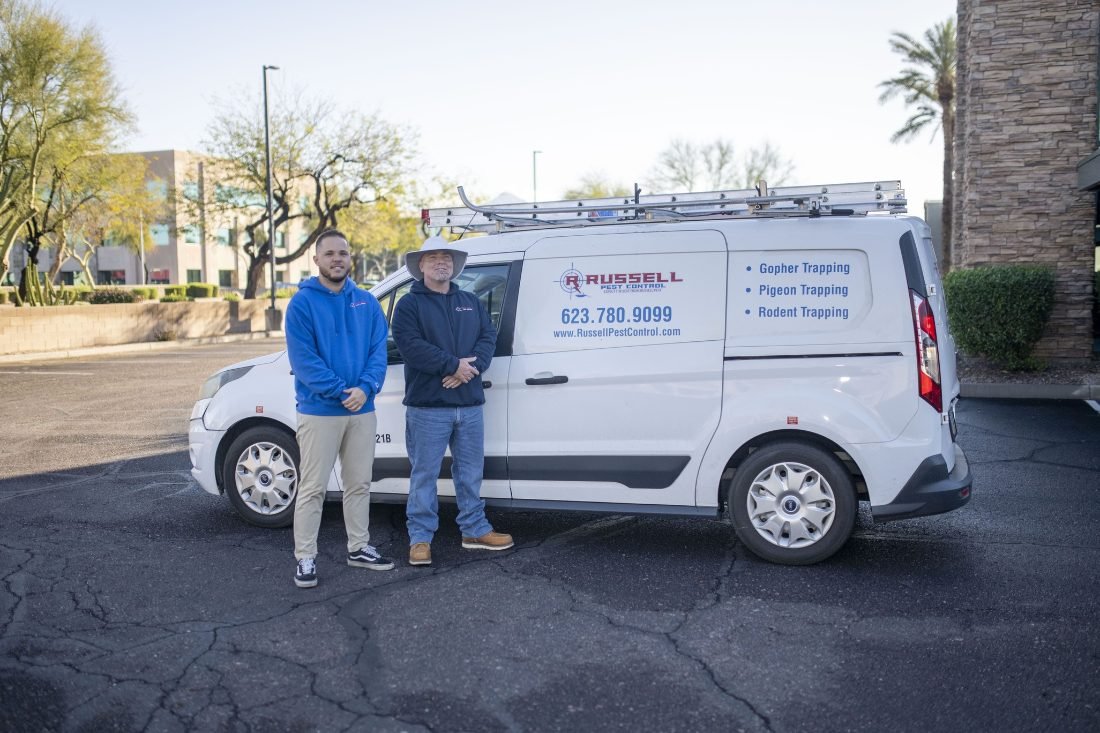
Thirty years of Arizona desert work, with a second generation on the routes. One call gets Steve, Steven Jr., or the office. Never a call center.
Free photo triage by text, before anyone is dispatched and before you've committed to anything, so you know which of the two jobs you actually have.
Relocation when a beekeeper can take them, safety-first removal when they can't, and a straight answer about which one applies to your cavity.
Arizona OPM License #I5321B, and a family company that's been answering its own phone in the Valley since 1996.
What Bee Work Costs in Scottsdale
Bee jobs are quoted individually. Access, cavity type, how long the colony has been established, and whether comb has to come out of a structure are what set it. The photo triage is what lets us tell you before anyone is on site
Swarm photo triage by text is free
The standing Russell terms apply here: no initial fees, no contracts, and a 15-day re-treat warranty
Where closing the cavity is the bigger half of the job, that goes out as a Home Seal quote, typically $600 to $2,500 with a one to two year warranty depending on the work
Estimates are free. Attic and hive searches can carry a charge, waived if you hire us
What Scottsdale Callers Ask About Bees
There are bees going in and out of a hole in our wall. Can we just seal it?
No. Scottsdale's own guidance says not to seal a void bees are actively using. Sealing a live colony traps the bees, the comb, and the honey inside your wall, and the usual outcome is bees finding a route into the house and a mess behind the drywall that has to come out anyway. Get them removed first. Then close it.
The city says most companies kill the hive. Do you?
Relocation when a beekeeper can take them, safety-first removal when they can't. Both of those are real answers, and which one applies depends on the cavity and the access, not on what's easier to sell. You'll know which before you agree to anything.
Are these Africanized bees?
Treat them as though they are. University of Arizona Cooperative Extension states that all wild honey bees in Arizona are considered Africanized to some extent, and that only genetic testing can determine lineage. Nobody can identify it from a photo or from behavior on the day, so the safe assumption is the only useful one.
How far will they chase?
Bees actively attacking somebody is 9-1-1, and none of the rest of this page matters. Scottsdale's fire department notes that pursuit of well over 1,640 feet has been recorded, which is why the instruction is to keep going until you are inside rather than to count yards. Cover your head and face with clothing or your hands, get inside a building or a vehicle and shut the door, and if there's no shelter, run at least 240 yards, which the University of Arizona describes as two football fields, and keep going until you're inside. Don't swat, and don't jump into a pool: the same source says the bees will wait longer than you can hold your breath.
After the attack, scrape stingers out sideways and avoid pinching them. Call 9-1-1 if anyone is stung many times, or has trouble breathing, swelling of the face or throat, or dizziness. Anyone with a known bee allergy uses their epinephrine and calls 9-1-1, and follows the plan their doctor gave them. We're a pest company, so the medical half stops there.
Will they come back to the same wall?
If the cavity is left open and the comb is left in it, that's a strong possibility, because the scent of old comb is exactly what a scouting swarm is looking for. Take the comb out and close the entry, and the wall stops being an obvious candidate. That's the whole reason the third step exists.
The colony is in our HOA's shared perimeter wall. Whose job is it?
That turns on your CC&Rs and how the wall is platted, which is a question for your association and not for us. What we can say is that cutting into shared masonry isn't a decision an individual owner should make alone. Send the photo anyway. We're happy to talk to a board or a property manager directly, and whether it's a swarm or an established colony is the first thing a board will ask.
When is swarm season here?
Mainly spring, and Scottsdale's guidance describes it as usually a two or three week window depending on the locale, with occasional swarms through the rest of the producing season. Nobody publishes fixed dates for the Valley, and we're not going to invent them.
Can you do same-day service in Scottsdale?
Often, yes. Call or text before noon, and same-day is realistic more often than not, and an indoor sighting is the kind of call we try hardest to fit in. After hours, the phone reaches Steve's cell for triage.
Do you treat termites in Scottsdale?
No, and we're straight about it. We'll identify termite signs honestly and refer you to a licensed termite specialist, then handle everything else on the property. Straight lanes, straight answers.
Everything Else We Run Here
What else we run in Scottsdale:
Scorpion Control and the Black Light Search
Rodent Control
Exclusion, and General Pest Control
All Scottsdale services: /scottsdale
Send the Photo First
It costs nothing, it takes a minute, and it is the difference between a beekeeper collecting a swarm off your mesquite and a wall opening up next month. Text the picture from a safe distance, and you'll know what you've got.
Expect the best from Russell Pest, and have a bug-free day.
Hours
- Monday–Friday: 8:00 AM – 5:00 PM
- Same-day & emergency service available — after hours and weekends, owner-answered
(623) 780-9099 · Call or text · 6750 N 7th Ave, Phoenix, AZ 85013