
View Fence & Snake Screening in Peoria, AZ — Built to the Opacity the Code Allows
Most companies screen a view fence by looking at the fence. In Peoria's hillside overlay the fence is already specified, and screening one without knowing how is how a job turns into a compliance question. For perimeter fences the Zoning Administrator has approved on a hillside lot in the ten to fifteen percent slope band, where the lot abuts open space, the code caps the fence at six feet eight inches, allows no more than three feet of solid or opaque material in that height, requires the rest to be open in design, and names chain-link and wood as materials you may not use. Whether that provision covers your parcel is a Planning question. Where it does, the screen has a budget before anybody measures anything.
The Fence Is Already Specified
A height cap and, unusually, an opacity cap
Where the Zoning Administrator has approved a perimeter wall or fence on a hillside lot in the ten to fifteen percent slope category abutting open space, the code sets a maximum of six feet eight inches with no more than three feet of it built of solid or opaque material. The portion that isn't solid has to be open in design. Height limits are ordinary. A written limit on how much of a fence may be solid is unusual, and it is the whole design constraint for a screening job.
Two materials are named and excluded
The same provision says the open portion may not be chain-link or wood. Chain-link is the usual way to close the bottom of a view fence, and it is off the table on these lots, which removes the option most homeowners are quoted first. What goes on instead has to read as open while still stopping something at ground level, and that is a narrower brief than it sounds. On many hillside lots, there is no perimeter fence to screen at all This is the part that surprises people. The code prohibits perimeter walls and fences surrounding a lot, except as provided elsewhere in the section, and restricts fences to privacy walls attached to, or directly screening, a portion of the main residence. So on a good number of hillside properties the line worth working is the house and the patio enclosure, not the property boundary. A quote written for a perimeter that doesn't exist is a quote for the wrong job.
Retaining walls change the arithmetic
The code allows a view fence not exceeding six feet above the highest part of adjacent natural grade to be added to a retaining wall. That produces a common Peoria assembly: a wall face with a fence sitting on top of it, and a gap under the bottom rail that is well above your ground but at grade on the desert side. It is a different closure detail from a fence set into soil, and the one most often missed.
And the gate isn't yours alone
Where a pedestrian gate gives access to public open space, the code requires written approval from the Community Services Department. Which matters here because the gate is usually the worst gap in a screened run, and on these lots it is a feature with a paper record behind it.
What Screening Is For, and What It Is Not
What comes through the bottom of a view fence
- Rattlesnakes and other snakes moving along the fence line looking for a way through
- Bark scorpions, which cross at ground level through very little gap
- Packrats and ground squirrels working the boundary between yard and open desert
- Rabbits, which most people treat as a landscaping problem
Where the gaps actually are
- The strip under the bottom rail, especially where the ground has settled or washed
- Gate thresholds and the vertical gap at the hinge and latch sides
- The joint where a fence meets a pilaster, a retaining wall or a block return
- Wash crossings, where a fence spans a low point, and the ground drops away beneath it
What screening doesn't do
It is a physical barrier at ground level on the run where it is fitted. It won't make a property snake-free; it treats nothing, and it covers only the ground it was installed on. Anyone telling you a screen ends the question is selling you something. What it does is close a specific, measurable route that would otherwise stay open every night.
Five Steps on a Peoria Screening Job
Establish what you are actually allowed to fit
On a hillside lot that means the height and opacity limits, and whether the fence you want screened is one the code contemplates at all. Peoria Planning is the right place to settle any parcel-specific matters, and we'll tell you when a question belongs there.
Walk the run and find the gaps
Fence lines aren't uniform. The gap under a bottom rail changes with every foot of settlement, and the productive spots are almost always the gate, the wash crossing and the joint at a pilaster. We measure it. A screen fitted to the average gap leaves the worst ones open.
Fit to the bottom of the run and keep the sightline
The code provides a budget for solid materials without specifying where it goes. We put it at the bottom, because that is where the crossing happens. Above it the fence stays open, which is what the view fence was for.
Detail the gate properly, because it is the failure point
A screened run with an unscreened gate has a door in it. Threshold, hinge side, latch side, and the swing clearance all get closed, and the gate still has to open. This is the part that separates a job that holds from one that looks finished.
Tell you what is still open
The run we fitted is screened, and it needs re-checking as the ground settles under it. The neighbor's run is not screened, and neither is a boundary with no fence on it. We say where the barrier stops. Gloves and closed shoes, and never reach into a pile you can't see into. The same harborage holds bark scorpions, and near open ground it holds snakes. If something has sat undisturbed for months, don't move it by hand. For a snake, that's a call to a licensed wildlife removal service or Arizona Game and Fish, and a bite is a 911 call. For anything else, leave it for us.
What Peoria Households Ask Us
Will this keep snakes out of my yard?
It screens the run it's fitted to, which is often the route they're using. It won't make a property snake-free, and we won't tell you it does. A yard with open boundary on two sides and a screened fence on the third is better off than it was. It isn't sealed.
Can we just put chain-link along the bottom?
Not where that provision applies, which is approved perimeter fencing on a ten to fifteen percent slope lot abutting open space. There, the code names chain-link and wood as materials the open portion may not use. Whether your parcel is covered is a question for Peoria Planning, and it is worth asking before you compare quotes, because chain-link is the first thing most people are offered.
How high can the solid part go?
On the hillside lots that the provision covers, no more than three feet of the fence may be solid or opaque, within an overall height of six feet eight inches. Where those three feet sit is not specified by the code. We put them at the bottom, because that is where the animal crosses.
We don't have a perimeter fence. Can we build one and screen it?
That is a Planning question, and it is worth asking before you spend anything. The hillside code restricts perimeter fencing and points toward privacy walls attached to the residence instead. We can screen what is there or what gets approved; we can't tell you what will be approved.
Our fence sits on top of a retaining wall. Does that change the price?
Usually, and it is worth flagging early. The gap under a fence set on a wall is at grade on the desert side and above grade on yours, so the closure detail is different and the work is less straightforward than a fence in soil.
Does the screen affect the view?
At the bottom, yes, and that is where the code allows opacity anyway. From standing height on a patio, the sightline through the upper part of the fence is what you are looking at, and that stays open.
What about the gate to the trail?
It gets screened like the rest of the run, and it is the part we spend most time on. One thing to know: where a pedestrian gate gives access to public open space, the code requires written approval from the Community Services Department, so a gate isn't something to add casually.
Do you remove snakes?
No. It's outside what we're set up for, and it isn't what an OPM pest license is about. For a snake in the yard, call a licensed wildlife removal service or Arizona Game and Fish, and treat a bite as a 911 call. What we do is close the route at ground level so there's less reason for the question to come up.
Do we still need a scorpion program if the fence is screened?
Usually yes. Screening closes one route at one boundary. A bark scorpion gets through a gap around a sixteenth of an inch, and most buildings have plenty of those. The two jobs sit together, and we'll tell you honestly which one your property needs more.
Can you do same-day service in Peoria?
Often, yes. Call or text before noon, and same-day is realistic more often than not, and an indoor sighting is the kind of call we try hardest to fit in. After hours, the phone reaches Steve's cell for triage.
Do you treat termites in Peoria?
No, and we're straight about it. We'll identify termite signs honestly and refer you to a licensed termite specialist, then handle everything else on the property. Straight lanes, straight answers.
What Screening Costs in Peoria
Linear feet of run, the number of gates, whether the fence sits on a retaining wall, and how much the ground has settled underneath are what move the number. We measure before we quote
The standing Russell terms apply here: no initial fees, no contracts, and a 15-day re-treat warranty
Black Light Scorpion Search: $125 per hour, after dark. We'll tell you what we expect your property to take before we start
Home Seal is quoted as its own job, typically $600 to $2,500 with a one to two year warranty depending on the work
Estimates are free. Attic and hive searches can carry a charge, waived if you hire us
What Else We Run in Peoria
Scorpion Control and Black Light Search
Programs built for overlay lots with salvaged native plantings, with after-dark UV mapping at $125 per hour.
Home Seal and Scorpion Sealing
Whole-house exclusion, worked against the standard Peoria's own residential code describes.
Rodent Control and Exclusion
Roof rats and packrats removed before anything gets sealed, then screened out at the roofline.
General Pest and Mosquito
Plans ranging from monthly to quarterly, and station-based mosquito work for properties with permanent water.
Bee and Weed
Live bee relocation where a beekeeper can take the colony, and pre-emergent timed to both desert weed seasons.
All Peoria services: /peoria
Why Peoria Households Have Us Fit It
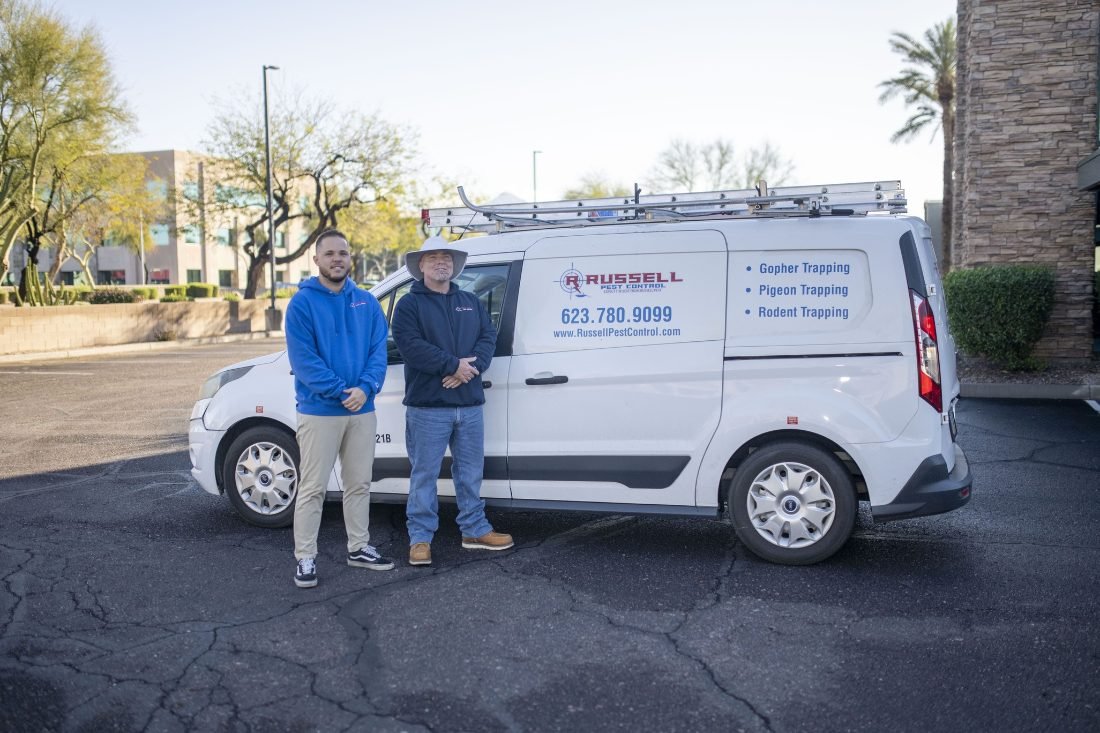
Thirty years of Arizona desert work, with a second generation on the routes. One call gets Steve, Steven Jr., or the office. Never a call center.
We fit within the limits the overlay sets out, and we tell you when a question belongs with Planning before we touch anything.
We tell you the limits of what a screen does, which is the part most quotes leave out.
Measure the Run
Screening is one of the few things we do where the answer is a number: how many feet, how many gates, how much gap. Walking a fence line takes under an hour, and you'll know afterward whether this is the right spend on your property or whether the money belongs at the building.
Expect the best from Russell Pest, and have a bug-free day.
Hours
- Monday–Friday: 8:00 AM – 5:00 PM
- Same-day & emergency service available — after hours and weekends, owner-answered
(623) 780-9099 · Call or text · 6750 N 7th Ave, Phoenix, AZ 85013