
Scorpion Control in Peoria, AZ — The Desert in Your Yard Was Put There on Purpose
On a lot inside Peoria's desert lands overlay, that big multi-trunk native by the patio may well not have grown there. The City's native plant permit covers inventory, tagging, salvage, a temporary nursery, and transplanting, so on lots where salvage happened, the densest harborage on the property sits in a location somebody chose and wrote down. Which of those your lot is worth finding out, and it changes the program.
Inventoried, Tagged, Moved, Replanted
The permit process is five steps, and all five leave a record
Peoria's Desert Lands Conservation Overlay covers the part of the city north of Pinnacle Peak Road, so the first question on any of this is whether your lot is inside it. Where applicable, the overlay requires a native plant permit, and the code sets out what that permit covers: a plant inventory, plant tagging, plant salvaging, establishing and managing a temporary salvage nursery, and transplanting salvaged plants. Read that as a homeowner and it tells you something useful. Where salvage occurred, the specimens were counted before grading started, and their final position was decided by someone.
The code names exactly the plants that hold scorpions vertically
A significant vegetation specimen, in the City's own definition, is a native tree with an eight-inch or greater caliper trunk that is multi-trunk and in good health, or a saguaro. Those are the plants with deep bark fissures, skirts and cavities, and they are the ones a bark scorpion uses to get off the ground. The regulated objects and the productive harborage are the same objects.
Some stands were never moved at all
The code also defines a significant vegetation area: a stand of Sonoran Desert vegetation thirty percent more concentrated than the surrounding ground, hard to salvage because of slope, rocky soil, or exposed roots near a wash, and best kept where it is. So a Peoria lot can hold two different ages of desert. Replanted specimens that arrived with the house, and an untouched stand that has been building population since before the subdivision. They behave differently and are treated differently.
And the ground rules change by landform
The overlay writes separate standards for desert floor, bajada, and hillside. Three substrate regimes, legally distinguished, inside one city. The ground genuinely changes across Peoria, and those three categories are a useful shorthand for it, which is why we ask which one you're on before quoting.
Six Things We Do on a Peoria Overlay Lot
Ask whether there is a native plant plan
If the property has one, it shows what was salvaged and where it went. Plenty of owners have never seen theirs and that's fine, but it is worth asking the builder or checking with the City, because it turns a guess about the yard into a map of it.
Read the two ages of planting separately
Replanted specimens sit in prepared holes with amended backfill and irrigation. An undisturbed stand sits on original desert soil, with whatever has built up beneath it over decades. The first is a harborage you work around the base of. The second is a population source you work the edge of.
Work the trunk, not only the ground
On a lot where the regulated plants are the multi-trunk natives and the saguaros, treatment that stops at the drip line misses the part of the plant a scorpion is actually using. The base, the fissures at reachable height, and the boulder grouping placed around it are one harborage, and they get worked as one.
Take the food supply down
Crickets first, because they're what a bark scorpion follows, and irrigated plantings on prepared soil tend to hold more of them than raw desert. Gloves and closed shoes, and never reach into a pile you can't see into. The same harborage holds bark scorpions, and near open ground it holds snakes. If something has sat undisturbed for months, don't move it by hand. For a snake, that's a call to a licensed wildlife removal service or to Arizona Game and Fish; a bite is a 911 call. For anything else, leave it for us.
Match the plan to the landform
A hillside lot with exposed rock and a wash line at the boundary is a different job from a desert floor lot on a flat pad, and the overlay already says so. We tell you which you are on and what that means, including where the program will need more of our time.
Then close the building
This is the part that compounds, because it doesn't have to be repeated the way the yard does. A bark scorpion gets through a gap around a sixteenth of an inch. Sweeps, thresholds, weep screed, slab joints, and utility penetrations are where a house actually leaks. When the list runs long, the work moves to a scoped Home Seal, with its own price and warranty. Weep holes get screened rather than plugged, because they ventilate the wall cavity.
What the Program Actually Does
The Arizona bark scorpion is the only scorpion in the country considered medically significant. It's nocturnal, and it doesn't travel far in a night, and the encounters people call us about are overwhelmingly at and around the building. On an overlay lot that's the useful part: whatever the plant plan did with the vegetation, the animal still meets you at the building.
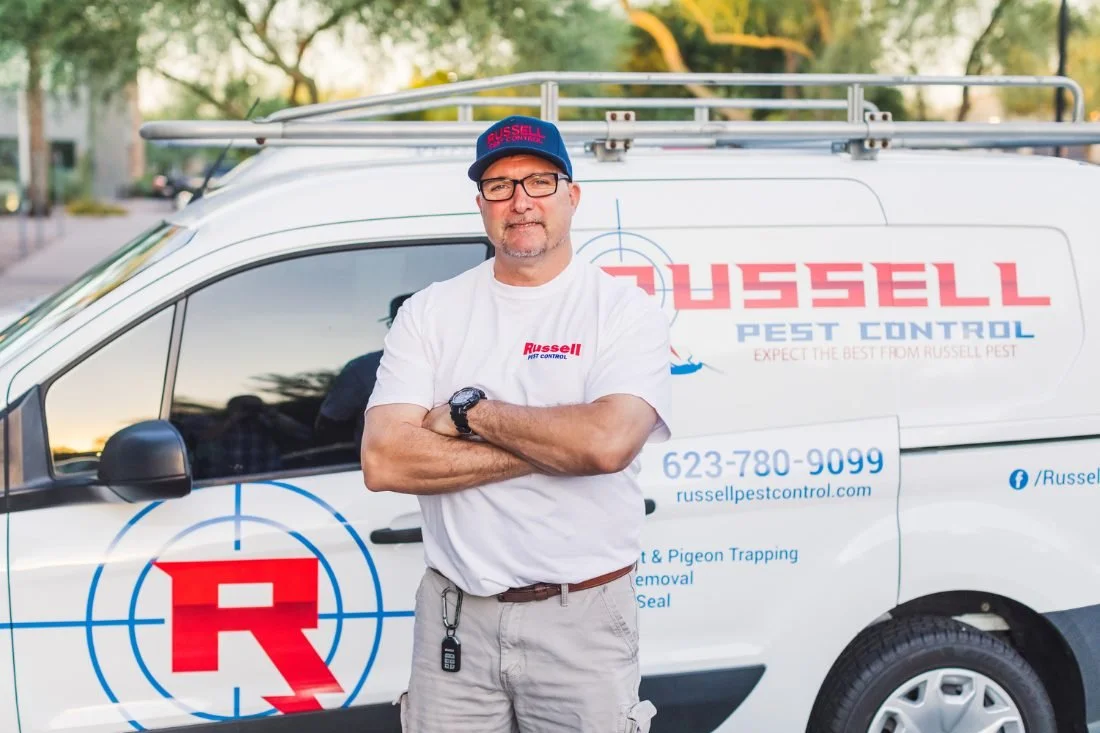
The service runs as a program. We work the harborage and the routes the animal actually travels, take down the insect population that feeds it, and keep the same technician on the property wherever the schedule allows, so that knowledge accumulates. Where the building is the problem, sealing gets scoped and priced as its own job, separate from a service visit. And where proof beats an opinion, the black-light search maps the population after dark at $125 per hour.
What Peoria Households Ask Us
How do I find out if my lot is in the overlay?
Peoria's Planning department is the place to ask, including which landform category applies. For our purposes, an approximate answer is usually enough, because what changes the program is the plants and the ground rather than the line on the map.
Can we just take the big native out?
That's a question for the City rather than for us, and it is worth asking before anyone hires a landscaper. The overlay regulates what happens to protected native plants, and a specimen that was salvaged and replanted under a permit is not the same as a shrub you bought at a nursery. Our program doesn't depend on removing anything.
Is the boulder grouping part of the problem?
Frequently, yes, and it's rarely the first thing people suspect. Stacked boulders set as landscape features hold gaps that stay cool and dark all day. It doesn't mean they come out. It means they get treated as harborage.
Our neighbor has an untouched stand, and we don't. Does that affect us?
It can, and the honest answer is that it depends on distance and what sits between. A bark scorpion doesn't cover much ground in a night, so a dense stand two lots away matters less than one against your shared wall. We'll tell you what we see rather than guess from the street.
Is a black-light search worth it here?
It's one of the better places for it because, with salvaged plantings, there are a small number of high-value harborage points, and the search shows you which ones are live. Scorpions fluoresce under ultraviolet light, so an after-dark pass maps what's on the surface that night and the routes it travels. It runs at $125 per hour.
Are stings here dangerous?
Reactions vary, and it isn't ours to assess. We're a pest company, not a clinic, so if someone is stung, the number you want is Poison Help at 1-800-222-1222, which routes to your county's poison center. For a young child or anyone having trouble breathing or swallowing, call 911. Keeping them outside is the part we own.
Can you do same-day service in Peoria?
Often, yes. Call or text before noon, and same-day is realistic more often than not, and an indoor sighting is the kind of call we try hardest to fit in. After hours, the phone reaches Steve's cell for triage.
Do you treat termites in Peoria?
No, and we're straight about it. We'll identify termite signs honestly and refer you to a licensed termite specialist, then handle everything else on the property. Straight lanes, straight answers.
What Else We Run in Peoria
Black Light Scorpion Search
After-dark ultraviolet mapping of what's on the surface and the routes it travels, billed at $125 per hour.
Home Seal and Scorpion Sealing
Structural exclusion to the 1/16-inch standard: sweeps, thresholds, weep screed, slab joints and penetrations.
View Fence and Snake Screening
Ground-level screening for wall and fence lines, fitted so the sightline stays intact.
Rodent Control and Exclusion
Roof rats and packrats removed before anything gets sealed, then screened out at the roofline.
General Pest, Mosquito and Weed
Plans from monthly to quarterly, station-based mosquito work, and pre-emergent timed to both desert weed seasons.
All Peoria services: /peoria
What Scorpion Service Costs in Peoria
Lot size, landform, how much protected vegetation you carry and the number of boulder groupings are what move the number. We price it after we've walked it
The standing Russell terms apply here: no initial fees, no contracts, and a 15-day re-treat warranty
Black Light Scorpion Search: $125 per hour, after dark. We'll tell you what we expect your property to take before we start
Home Seal is quoted as its own job, typically $600 to $2,500 with a one to two year warranty, depending on the work
Estimates are free. Attic and hive searches can carry a charge, waived if you hire us
Why Peoria Households Stay With Us
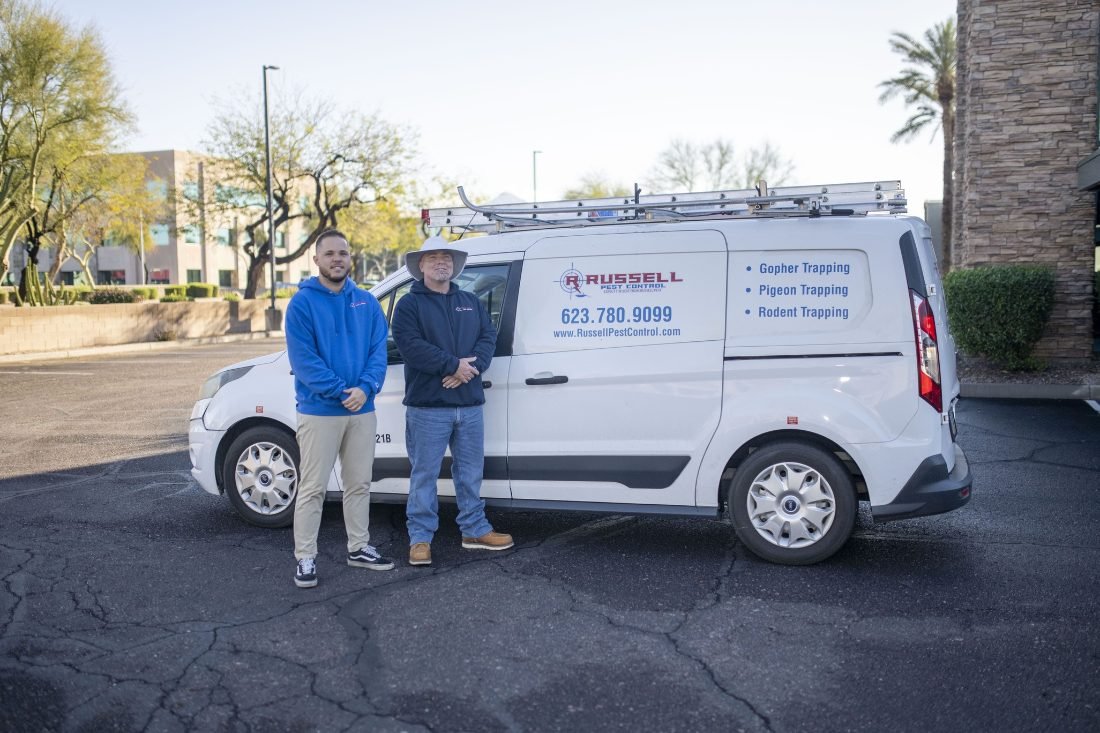
Thirty years of Arizona desert work, with a second generation on the routes. One call gets Steve, Steven Jr., or the office. Never a call center.
We ask which landform your lot sits on before quoting, because the overlay already treats desert floor, bajada, and hillside as three different problems.
No contracts and no initial fees on residential service, and a 15-day re-treat warranty if something comes back inside the window.
We treat protected plantings as harborage to work around, and our program doesn't depend on removing regulated plants.
Arizona OPM License #I5321B, and a family company that's been answering its own phone in the Valley since 1996.
Start With What's Actually Planted
The fastest way to a real quote on a Peoria overlay lot is a walk with somebody who can tell a salvaged specimen from an untouched stand and knows why the difference matters. That takes about an hour, and you get the findings whether or not you hire us.
Expect the best from Russell Pest, and have a bug-free day.
Hours
- Monday–Friday: 8:00 AM – 5:00 PM
- Same-day & emergency service available — after hours and weekends, owner-answered
(623) 780-9099 · Call or text · 6750 N 7th Ave, Phoenix, AZ 85013