
Rodent Control in Peoria, AZ — Check the Side Gate First
Peoria's code does something most Valley cities do not. Where a single-family home has an alley behind it, the container still goes to the curb at the front, and the code says a container may not be stored any closer to the street than the building setback and never between the front of the house and the sidewalk. Follow those two rules and the container ends up out of the front yard, which on most Peoria lots means the side yard, behind the gate, in shade, six and a half days a week. That is where a Peoria rodent survey starts.
What Peoria Households Call Us About
The calls
- Something moving in the ceiling after dark, loudest at the end of the house nearest the gate
- Gnaw marks on the container itself, or a lid that no longer seats flush
- A stick pile assembled under a parked trailer or behind the pool pump
- Shredded insulation, chewed low-voltage wire, or an irrigation line that started weeping
- A smell in the side yard that nobody can place and that gets worse in the afternoon
Where they get in
- Roof and tile-line entries, gable vents and soffit gaps
- Garage thresholds and the gap under a roll-up door
- Utility and plumbing penetrations through the exterior wall
- Side-gate walls and the ground line behind stored containers

What the Program Actually Does
+ RODENT_DEF + Sealing reduces how much gets in, which is what makes a treatment program hold. It doesn't replace treatment, and a quote implying otherwise is selling you something. Where a property needs both, we price them separately so you can see what you're buying.
One safety note before anyone clears anything. Maricopa County publishes the protocol for rodent droppings, and it matters. Rubber gloves on. Ventilate the area the night before you clean by opening doors and windows, and don't shortcut that step to the few minutes before you start. Never sweep or vacuum droppings dry. Spray the droppings, nests, and the area around them with a 10% bleach solution (1 part bleach to 9 parts water), and allow at least 15 minutes of contact time before removing anything. Wipe up with paper towels or a mop, double-bag it, and wash your gloved hands in disinfectant before the gloves come off, then wash your hands with soap and water once they are off. The county sets the onset window for illness at 1 to 5 weeks. If a flu-like illness shows up in the weeks after a clean-up, the standing public-health advice is to see a physician promptly, to mention the rodent exposure, and to treat difficulty breathing as urgent, because early diagnosis is what changes the outcome.
The Bin Moved, and So Did the Problem
Single-family containers go to the front, alley or no alley
The code is direct about it: individual residences that have an alley shall place their container at the curb at the front of the residence, unless the home faces a major thoroughfare or the container would block a bike lane. Which means the alley behind a Peoria single-family block isn't doing the job an alley does in most cities. Much less of the refuse is back there. Multi-residence properties are the exception, and they're the ones with the corridor Containers serving more than one residence remain in the alley, positioned along the rear or side alley within 100 feet of the property line of any residence they serve. So duplexes and small multi-unit properties keep the shared rear corridor while the single-family street next door does not. Two completely different rodent profiles, a block apart, decided by a line in the code rather than by anything you can see from the street.
And storage is pushed back to the side yard
The code says containers shall be stored no closer to the street right-of-way than the building setback, and that no container shall be placed between the front of the residence and the sidewalk for storage at any time. Between those two rules, the container spends most of the week behind the side gate. Shaded, against a wall, out of sight from the street and out of sight from the kitchen window.
The city named the animal itself
This part isn't our inference. Peoria's own solid waste section says open lids attract vectors such as roaches, flies and rodents and contribute to putrid odors, and a later section requires that lids on all containers remain completely closed at all times. The city wrote down the mechanism. What it couldn't do is put the container somewhere you would notice it.
Four Steps on a Peoria Property
Start at the side gate
The container storage area is the first thing we look at, along with the ground line behind it, the wall it leans against, and whatever else has accumulated in the same strip. On most Peoria single-family lots, this is the highest-value ten minutes of the visit, and it is the part households rarely look at, because it sits behind a gate they use twice a week.
Work out which animal you have
Roof rats travel high, along fence tops, canopy and rooflines, and leave droppings on beams and in the attic. Packrats build a midden at ground level against stored material or pool equipment. Different animals, different programs, and the wrong call wastes a season. Send a photograph of what you found, and we can usually tell you before we arrive.
Remove first, then close
Sealing an animal inside a wall is how a rodent problem becomes a smell problem. Removal comes first, and closure follows, which means more than one visit, and we say so at the estimate.
Close the building and clear the harborage
Vent screens, tile-line entries, gable and soffit gaps, penetrations, garage thresholds. Then the stored material, the woodpile, and the dense planting against the wall. Rodent exclusion works to a wider threshold than scorpion sealing does, and a scope should tell you which one applies where. Gloves and closed shoes, and never reach into a pile you can't see into. The same harborage holds bark scorpions, and near open ground it holds snakes. If something has sat undisturbed for months, don't move it by hand. For a snake, that's a call to a licensed wildlife removal service or Arizona Game and Fish, and a bite is a 911 call. For anything else, leave it for us.
What Rodent Service Costs in Peoria
Population size, how many openings the building has, roof type, and whether there are outbuildings are what move the number. Removal and exclusion are quoted separately so you can see what you are paying for
The standing Russell terms apply here: no initial fees, no contracts, and a 15-day re-treat warranty
Black Light Scorpion Search: $125 per hour, after dark. We'll tell you what we expect your property to take before we start
Home Seal is quoted as its own job, typically $600 to $2,500 with a one to two year warranty depending on the work
Estimates are free. Attic and hive searches can carry a charge, waived if you hire us
What Else We Run in Peoria
Rodent Exclusion
The closure half of the job, quoted on its own: roofline, vents, penetrations and thresholds.
Home Seal
Whole-house exclusion scoped and priced as its own job, worked against the standard Peoria's own code describes.
Scorpion Control and Black Light Search
Programs built for overlay lots with salvaged native plantings, with after-dark UV mapping at $125 per hour.
View Fence and Snake Screening
Ground-level screening for wall and fence lines, fitted so the sightline stays intact.
General Pest, Mosquito and Weed
Plans from monthly to quarterly, station-based mosquito work, and pre-emergent timed to both desert weed seasons.
All Peoria services: /peoria
Why Peoria Households Stay With Us
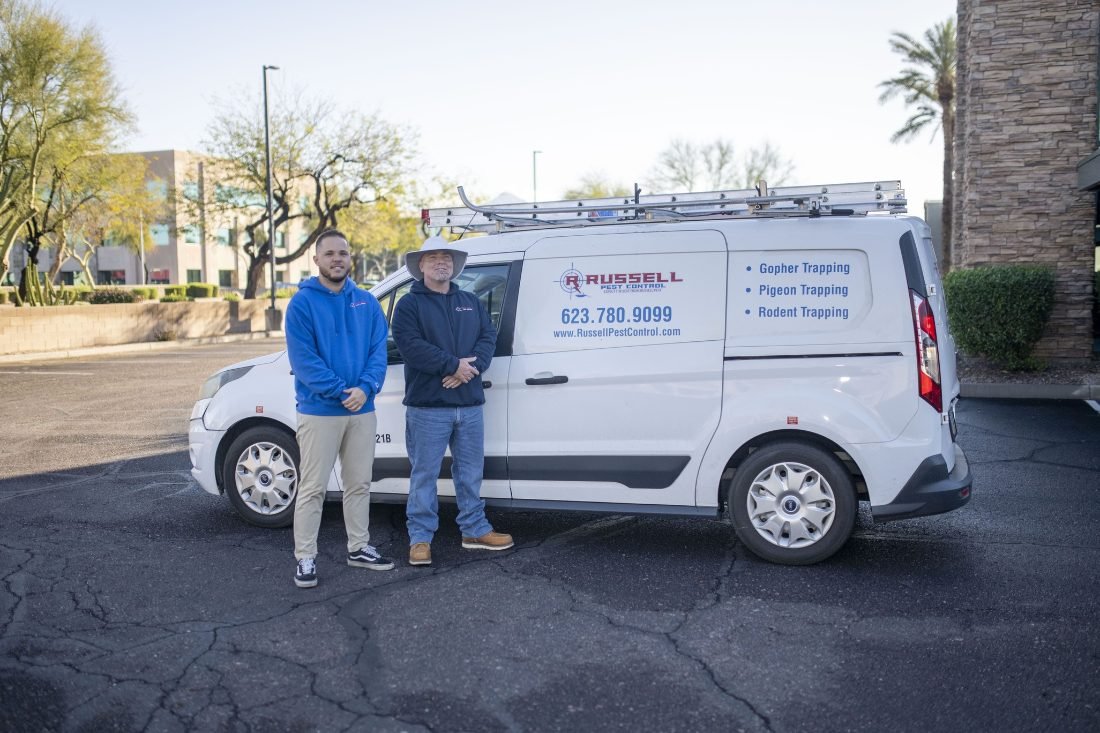
Thirty years of Arizona desert work, with a second generation on the routes. One call gets Steve, Steven Jr., or the office. Never a call center.
We start at the container storage area, because on a Peoria lot that is where the container usually ends up, and it is the part households rarely look at.
No contracts and no initial fees on residential service, and a 15-day re-treat warranty if something comes back inside the window.
Arizona OPM License #I5321B, and a family company that's been answering its own phone in the Valley since 1996.
What Peoria Households Ask Us
Our bin is in the side yard because there is nowhere else. Is that wrong?
It is a common and generally compliant spot, given where the code says a container can't go, and anything behind the setback works. What it means is that the storage area needs the same attention a bin enclosure would get anywhere else: the lid closing flush, the ground line clear, and nothing stacked against the wall behind it.
We're a duplex and our bin is on the alley. Does this page apply?
Partly, and the differences matter. Containers serving more than one residence stay on the alley under the code, so you keep the shared rear corridor that single-family neighbors don't have. The pressure comes from a different direction and the program shifts to match.
Can you do same-day service in Peoria?
Often, yes. Call or text before noon, and same-day is realistic more often than not, and an indoor sighting is the kind of call we try hardest to fit in. After hours, the phone reaches Steve's cell for triage.
Do you treat termites in Peoria?
No, and we're straight about it. We'll identify termite signs honestly and refer you to a licensed termite specialist, then handle everything else on the property. Straight lanes, straight answers.
We hear scratching in the ceiling at night but never see anything. What is it?
Night noise with nothing visible by day is the classic roof-rat pattern: they work after dark and travel the same few routes. An inspection reads the evidence — droppings, rub marks, entry gaps — and tells you what you have and where it's getting in, before anything else gets decided.
Will one visit fix a rodent problem?
Removal usually takes more than one trip because traps have to be checked and reset, and the honest fix has two parts: getting the animals out, then closing the openings so the next ones don't move in. We quote those separately so you can see what each is doing.
Do the plug-in sonic repellers work?
Not in any way we've seen hold up. Rodents habituate to the sound within days, and every yard we've serviced with repellers plugged in still had activity. Save the outlet; spend the effort on removal and screening, which work for structural reasons.
Does it matter whether we have mice or roof rats?
Yes — the plan changes. Mice work low and nest close to food; roof rats travel high and nest in attics, so trap placement, entry points, and screening priorities are different animals entirely. The inspection settles which you have before anything goes down.
Open the Side Gate
On most Peoria single-family lots, the answer is behind a gate the household walks past twice a week without looking. That, plus a count of how many ways there are into the building, is an hour's work and it is the difference between a program and a guess.
Expect the best from Russell Pest, and have a bug-free day.
Hours
- Monday–Friday: 8:00 AM – 5:00 PM
- Same-day & emergency service available — after hours and weekends, owner-answered
(623) 780-9099 · Call or text · 6750 N 7th Ave, Phoenix, AZ 85013