
Home Seal in Peoria, AZ — Peoria Filled In the Blank With the Whole Year
The property maintenance code most cities adopt has a screening rule with two dates left blank, so each city can write in its own bug season. Cities in cooler places write five months, or eight. Peoria wrote January 1 to December 31. There is no off-season in the ordinance because there isn't one on the ground, and unlike a building code, a maintenance code attaches to the house you already own rather than to the permit it was built under. That is the standard a Peoria sealing survey works against.
A Written Standard, and It Applies to the House You Already Own
Two blanks, and what Peoria put in them
The model property maintenance code gives every city that adopts it a sentence with two dates missing in the section covering insect screens. The city fills them in. That is the whole mechanism, and it is where a local choice becomes visible: a city in the upper Midwest writes something like May to October, a city in the humid Southeast writes March to December. Peoria's amendment inserts January 1 and December 31. Twelve months, no gap, no shoulder season.
What the section actually requires
Where an outside opening is required for ventilation, it must carry an approved, tightly fitting screen of not less than 16 mesh per inch, and a screen door used for insect control must have a self-closing device in working order. Note the limit, because it matters for what you're buying: it covers the openings required for ventilation, not every opening in the building. A survey covers the rest. But sixteen mesh is a finer aperture than the sixteenth-of-an-inch gap we work a scorpion scope to, which tells you the code drafters were not being casual about it.
This one applies backward, and that is the unusual part
A building code governs what gets built. This code opens by stating that its provisions apply to all existing residential structures and premises as minimum requirements. So the question is not whether the standard was in force when your house was permitted. It is in force now, on the house as it stands. That single sentence is what makes the rest of it usable to somebody who bought a thirty-year-old place last spring.
And it names who is responsible
For a one-family dwelling, the duty sits with the occupant, and the code says so in plain terms, including a duty to keep the structure in a continued pest-free condition. There is an exception worth knowing: where an infestation is caused by a defect in the structure, responsibility moves to the owner. A hole is a defect. That is the sentence a sealing job actually turns on. The same code also requires foundation walls to be kept free of open cracks and breaks and in a condition that prevents the entry of rodents and other pests, which is a sealing duty in everything but name.
There is a second list, written for a completely different reason
Peoria's residential code also includes a sound-attenuation section, which is a prescriptive sealing specification. Exterior wall penetrations by pipe, duct or conduit: caulked. Operable windows: weather-stripped and airtight. Window and door frame perimeters: sealed to airtight specifications. Exterior side-hinged doors: solid core or insulated hollow metal, fully weather stripped. It even rules out a mailbox cut through the door or the wall, which is a permanent hole in the envelope at a height a roof rat will use and almost nobody counts as an opening. None of that was written about pests. It is about getting a room down to forty-five decibels. But it names four of the places a house leaks, and the overlap is not a coincidence, because there is only one set of holes. Where the building is the problem, sealing gets scoped and priced as its own job, separate from a service visit, so you can see exactly what it covers.

What a Home Seal Covers
Home Seal is a whole-house exclusion: the ground line, the roofline, and the penetrations between them, closed or screened to a stated standard and listed in the scope. We seal to a sixteenth of an inch, because that's the gap a bark scorpion gets through. Rodent work uses a wider threshold, and bee work is different again, so a scope should tell you which standard applies where. If somebody quotes you sealing without naming a gap size, ask.
Sealing reduces how much gets in, which is what makes a treatment program hold. It doesn't replace treatment, and a quote implying otherwise is selling you something. Where a property needs both, we price them separately so you can see what you're buying.
Three Passes on a Peoria Home Seal
Walk it against the written standard
Ventilation openings and their screens first, because that is where the maintenance code puts a testable duty, and a torn screen or a screen door with a dead closer is the fastest thing on the list to find. Then the penetrations, window frames, door frames, and thresholds. Then everything neither code covers and a scorpion does: weep screed, slab joints, garage thresholds, roofline and vents. The walk and the written list are free either way, whoever ends up doing the work.
Close what should be closed, detail what has to keep working
Dead penetrations and abandoned openings get closed properly, with materials chosen to last where they sit. Vents, weep screed and terminations get screened or fitted, never blocked. That principle runs through the whole job: an opening with a function keeps it and gets screened or detailed, and an opening with no remaining purpose gets closed properly.
Hand over the list and the terms
What was closed, what was screened, what was left and why, in writing. One clarification on the badge above and the terms below: the 15-day re-treat warranty covers treatment service. Home Seal carries its own one to two year warranty, and the two are separate things.
What a Peoria Survey Counts
The openings every desert house has
- The stem wall and weep screed line, where the stucco meets the ground
- Garage thresholds and the gap under a roll-up door
- Irrigation and valve boxes, hose bib penetrations, and pool equipment pads
- Block wall voids, weep holes, and gate posts along the property line
The ones the codes put in writing
- Ventilation openings and the condition and mesh of the screen across them
- Screen doors, and whether the self-closing device still works
- Foundation walls, for open cracks and breaks a pest can use
- Pipe, duct and conduit penetrations, window frames, door frames and thresholds
And the ones a checklist misses
- Through-wall or through-door mail slots, and the void behind a wall-mounted box
- Dryer and bath vent terminations where the flapper no longer closes
- Utility penetrations added later by a trade that never sealed behind itself
What Peoria Owners Ask Us
Does the code mean my house is already sealed?
It means there is a standard your house is measured against today, rather than one it was measured against on the day it was permitted. That is the useful difference. A maintenance code is written to apply to existing buildings, so a torn screen on a thirty-year-old house is a current condition, not a grandfathered one. Whether the house meets the standard is a question a walk answers in about an hour.
Can you certify the house to the decibel standard?
No, and we'll be straight about that. The sound-attenuation section offers an alternative route through a certification by a registered architect or engineer, and neither of those is us. We work to the gap size, which is what keeps a scorpion out. If you need the acoustic certification, that is a different professional, and we will say so rather than take the job.
We have a mail slot in the front door. Is that really a problem?
It's a permanent hole in the envelope at a convenient height, so yes, more often than people expect. It's also one of the easier things on the list to solve. And Peoria's residential code says a mailbox should not be used through the door or the wall, though it's for acoustic reasons rather than yours.
What gap size do you work to?
A sixteenth of an inch, because that's the gap a bark scorpion gets through. Rodent work uses a wider threshold and bee work is different again, so a scope should tell you which standard applies where.
Will you seal the weep holes?
Weep holes get screened rather than plugged, because they ventilate the wall cavity. Anyone offering to fill them should be asked what happens to the cavity afterward.
How long does it take?
The survey is about an hour, and most houses are a day or two of work. A larger home, or one that's been added to over the years, runs longer, and we note that in the estimate.
Do you do the structural side of it?
No. Our scope is the openings. Anything below that- movement in a slab or a footing that has dropped- gets named on the list and goes to the trade that handles it, and we will say plainly that it is outside what we do.
Can I do some of it myself?
Yes, and the walk-through gives you the list whether you hire us or not. Door sweeps and thresholds are genuinely doable. Weep screed detailing and roofline work are the parts most people leave to us, mostly because of where they sit.
Can you do same-day service in Peoria?
Often, yes. Call or text before noon, and same-day is realistic more often than not, and an indoor sighting is the kind of call we try hardest to fit in. After hours, the phone reaches Steve's cell for triage.
Do you treat termites in Peoria?
No, and we're straight about it. We'll identify termite signs honestly and refer you to a licensed termite specialist, then handle everything else on the property. Straight lanes, straight answers.
Why Peoria Owners Have Us Do the Sealing
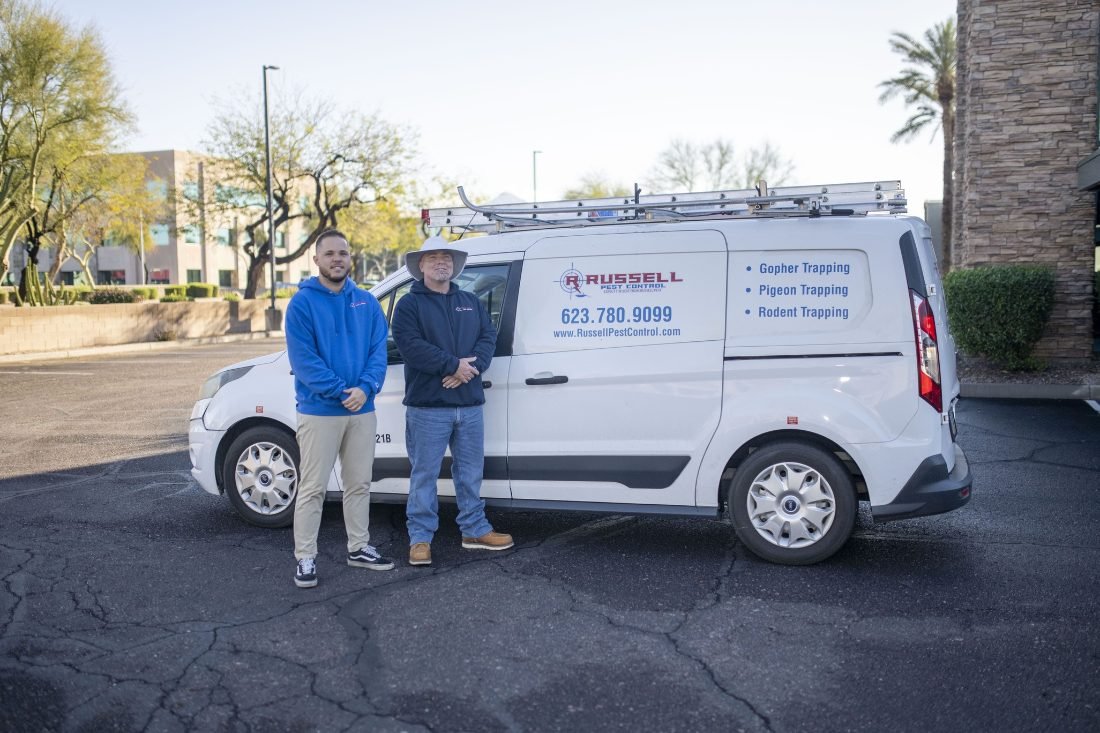
Thirty years of Arizona desert work, with a second generation on the routes. One call gets Steve, Steven Jr., or the office. Never a call center.
We survey against a written standard where one exists, so the quote is a comparison and not an opinion. In Peoria, that standard applies to the house as it stands, not as it was permitted.
We name the gap standard in writing, so you can hold the scope to it.
No contracts and no initial fees on residential service, and a 15-day re-treat warranty if something comes back inside the window.
Sealing is quoted as its own job with its own one to two year warranty, separate from any treatment plan.
You get the written list of openings whether or not you hire us.
Arizona OPM License #I5321B, and a family company that's been answering its own phone in the Valley since 1996.
What a Home Seal Costs in Peoria
The opening count sets the price. Age of the stock, remodels, added penetrations, and how many doors face the weather are what move the count. We survey before we quote, and the survey is free
The standing Russell terms apply here: no initial fees, no contracts, and a 15-day re-treat warranty
Black Light Scorpion Search: $125 per hour, after dark. We'll tell you what we expect your property to take before we start
Home Seal is quoted as its own job, typically $600 to $2,500 with a one to two year warranty depending on the work
Estimates are free. Attic and hive searches can carry a charge, waived if you hire us
What Else We Run in Peoria
Scorpion Sealing and Scorpion Control
The same exclusion work scoped against the bark scorpion gap, plus the treatment program that sits on top of it.
Black Light Scorpion Search
After-dark ultraviolet mapping of what's on the surface that night and the routes it travels, at $125 per hour.
Rodent Exclusion
The roofline half of the job, worked to the rodent standard.
View Fence and Snake Screening
Ground-level screening for wall and fence lines, fitted so the sightline stays intact.
General Pest, Mosquito, Bee and Weed
Plans include monthly to quarterly station-based mosquito work, live bee relocation so a beekeeper can take the colony, and pre-emergent for both weed seasons.
All Peoria services: /peoria
Get the Count
A Home Seal price is based on one number: how many openings your house currently has. In Peoria, there is a written standard that applies to the house today rather than to the permit it was built under, which makes the survey faster and the quote easier to argue with. An hour on the property gets you both.
Expect the best from Russell Pest, and have a bug-free day.
Hours
- Monday–Friday: 8:00 AM – 5:00 PM
- Same-day & emergency service available — after hours and weekends, owner-answered
(623) 780-9099 · Call or text · 6750 N 7th Ave, Phoenix, AZ 85013