
Home Seal in Paradise Valley — The Only Solid Part of a Boundary Is the Bottom
A sealing quote in the Valley usually assumes a solid block wall is doing part of the job. In Paradise Valley, the Zoning Ordinance opens its walls and fences article by saying that walls and fences are inconsistent with what the Town is trying to preserve, and it defines a view fence as one whose openings make up at least seventy percent of the fence surface. That is a good rule, and it is why the town looks the way it does. Where a boundary here is one of those, the only piece of it worth sealing is the couple of solid feet at the bottom, and everything above them has to sit on the buildings.
Seven Passes, In This Order
Start at the bottom of the boundary
Where there is a fence, the eye goes to the open part because that is what it was built for. We go to the lowest three feet: the base course, the gap under a rail, the place a driveway crosses, and the ground beside a gate post. On this service, that is the only part of a boundary that was ever going to matter.
Then leave the boundary alone and go to the walls that hold the house up
Everything from here is structure. Ground line first, all the way round, at a walking pace with a light: the joint where the wall meets the slab, thresholds and sweeps, hose bibs, and every penetration crossing in. We seal to a sixteenth of an inch, because that's the gap a bark scorpion gets through. Rodent work uses a wider threshold, and bee work is different again, so a scope should tell you which standard applies where. If somebody quotes you sealing without naming a gap size, ask.
Open every lid at grade before anybody quotes anything
Irrigation valve boxes, meter boxes, clean-outs, the low-voltage transformer, the pool equipment pad. These are covered, undisturbed, temperature-stable and connected to one another, and fifteen minutes with the lids off is worth an hour anywhere else on the lot.
The planted strip between two stacked walls
Where the Town allows a second wall, it requires a separation between them, and it requires that separation to be planted. That produces a narrow, shaded, irrigated strip with a wall on each side. We walk it, we photograph it, and we say what we can and cannot close from which side.
Go up, and go up separately
The roofline is its own survey with its own ladder and its own findings. Tile lines, eave closures, vent screens, and the point where any line crosses to the structure. Bundled into one price with the ground line, this is reliably the half that quietly gets skipped.
Write the scope as a list of openings, with a size beside each one
Not rooms, not elevations, not a lump sum. An opening, where it is, what it is, how wide, and what we would put in it. One rule decides each entry. That principle runs through the whole job: an opening with a function keeps it and gets screened or detailed, and an opening with no remaining purpose gets closed properly.
Say what we did not reach and why
Height, access, a locked equipment yard, something a licensed trade has to open. It goes on the report with the reason attached, because an item left off a report reads as an item that passed.
A Town That Wrote Down Its Dislike of Walls
Fences are regulated everywhere in the Valley. What is unusual here is that Paradise Valley's ordinance begins by saying it would rather you did not have one, and then writes the rules on that basis.
The intent clause says it outright
The walls and fences article opens by saying the Town encourages visual openness and the preservation of the natural environment, that walls and fences are inconsistent with that intent, and that where residents want them for safety, noise, or security, they have to meet the article's criteria. Municipal codes are not usually candid about disliking the thing they are about to regulate. This one is, and everything downstream of it follows from that sentence.
A view fence has a defined opening percentage
The ordinance defines a view fence as one whose openings make up at least seventy percent of the total fence surface area. Seventy percent open is a property line you can see through, which is the entire point of it, and it is nothing a pest program can lean on.
And on a combination fence, the solid part has to be at the bottom
A combination view fence has to meet the view fence definition for at least half its height, and the ordinance requires the open portion to be positioned above the solid portion. Read that as a design rule and it is obvious: you want the view at eye level. Read it as a sealing document, and it says something else. On a property with one, the only solid piece of boundary is the one at ground level, where an animal crosses, and it is the piece nobody looks at because the whole fence was designed to draw the eye upward. Where two walls are allowed, a planted gap is required between them The ordinance permits no more than two stacked walls on a lot, requires a minimum separation between them, and requires the space between to carry adequate vegetation. Terraced retaining walls carry larger separations on the same principle. Those gaps are not landscaping choices; they are conditions of the permission.
The perimeter here is upside down
A sealing quote written on the usual assumption prices a perimeter and treats the building as a finishing pass. On a lot with a view fence that is inverted: the boundary gives you a couple of solid feet at ground level and nothing above it, and the structure has to carry everything else. The honest version spends more of the technician's day and less of the customer's money in the wrong places. Paradise Valley wrote this article about sightlines, so the reading is ours.
The Quote That Priced Six Feet of Wall and Found Two
A household gets two numbers for the same job, and they are far apart. The lower one is quoted from a walk that took 20 minutes, and it has a perimeter line. A perimeter is fast to price and fast to do, and on a conventional Valley lot it is genuinely the bulk of the job.
Then somebody stands at the property line and sees through it. There is a fence; it is open the way the ordinance describes an open fence, and the solid part of it is a base course a couple of feet high with settled ground under one end. That is a real thing, and it is worth closing. It is also two feet of a boundary that was priced as though it were six, and the difference between those two numbers is work that belongs on the house, where the findings are smaller and more numerous and slower to close. The second quote is higher because it counted them.


What Home Seal Covers
The openings a survey looks at
• The stem wall and weep screed line, where the stucco meets the ground
• Garage thresholds and the gap under a roll-up door
• Irrigation and valve boxes, hose bib penetrations, and pool equipment pads
• Block wall voids, weep holes, and gate posts along the property line
• On a boundary here: the solid base course under a view fence, its weep holes and voids, and the ground beside every gate post, which is the only part of a boundary a survey can use
Where a property needs both sealing and a treatment program, we price them separately so you can see what you are buying.
Why Paradise Valley Households Have Us Scope It
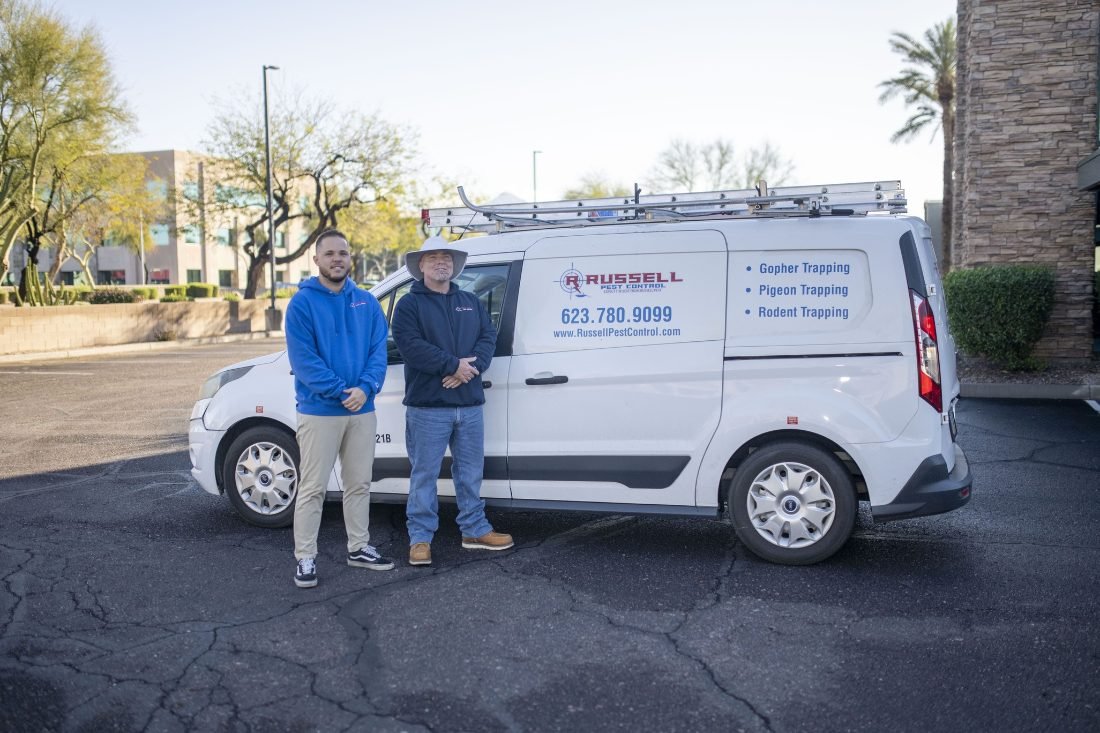
Thirty years of Arizona desert work, with a second generation on the routes. One call gets Steve, Steven Jr., or the office. Never a call center.
We price the part of a boundary that is actually solid, which here is the bottom of it, and we price the structures for everything else. That usually makes our number the higher one on the table and always makes it the one describing the job.
Arizona OPM License #I5321B, and a family company that's been answering its own phone in the Valley since 1996.
What Home Seal Costs in Paradise Valley
One clarification on the badge above and the terms below: the 15-day re-treat warranty covers treatment service. Home Seal carries its own one to two year warranty, and the two are separate things.
The number is set by how many openings the survey finds and what each one takes, not by the length of the property line. We count them, size them, and list them before anybody quotes, and the list goes to you whether or not you hire us
The standing Russell terms apply here: no initial fees, no contracts, and a 15-day re-treat warranty
Black Light Scorpion Search: $125 per hour, after dark. We'll tell you what we expect your property to take before we start
Home Seal is quoted as its own job, typically $600 to $2,500 with a one to two year warranty depending on the work
Estimates are free. Attic and hive searches can carry a charge, waived if you hire us
What Else We Run in Paradise Valley
Scorpion Control and Black Light Search
Ground-level work with after-dark ultraviolet mapping quoted by the hour.
Mosquito Control
Survey-first work with a written source list and a season-long program, starting with a question about what is under the lot.
View Fence and Snake Screening
Screening at the ground line, which on an open boundary is the only line there is.
Rodent Control and Exclusion
Removal before anything gets closed, then screening at the roofline and the ground line.
General Pest Control Plans
Monthly, bi-monthly or quarterly, with no contracts and a 15-day re-treat warranty.
Bee, Wasp and Weed
Live relocation where a beekeeper can take a colony, and pre-emergent timed to both desert weed seasons.
Commercial and Property Management
Documented programs for buildings, food service, hospitality, and multi-tenant sites.
All Paradise Valley services: /paradise-valley
What Paradise Valley Households Ask Us
Can you just seal the wall instead?
There is usually not enough wall to seal. Where a boundary is a view fence, it is by definition at least seventy percent openings, and closing it is a screening job at the ground line with its own scope and its own limits. That is a different service, and we will say which one your property actually wants.
Our fence has a solid section at the bottom. Does that help?
It is the most useful part of the boundary, and it is worth walking end to end. A solid base course with sound ground beneath it does close a low-crossing route. A solid base course with a settled channel under one end does not, and from ten feet away the two look identical.
Why is your quote higher than the other one?
Usually because the other one has a perimeter in it. A perimeter line is quick to price, and on Valley lots, it generally earns its place. Ask both quotes to show you the count of openings and where each one is. The difference explains itself in about a minute.
Are we allowed to build a solid wall instead?
That is a Community Development question, and it is worth asking before you spend anything, because the ordinance sets criteria and the answer depends on your lot. What we can tell you is what a solid wall would and would not do for this service, which is less than most people assume.
There is a planted strip between our two walls. Is that a problem?
It is a condition of the permission, and it does need to be looked at. Narrow, shaded, irrigated ground with a wall on each side behaves as the description suggests. We photograph it, we say what is reachable from which side, and we do not pretend a strip nobody can get into has been dealt with.
Does sealing replace a service program?
No, and anybody saying otherwise is overselling. Sealing reduces how much gets in, which is what makes a treatment program hold. It doesn't replace treatment, and a quote implying otherwise is selling you something. Where a property needs both, we price them separately so you can see what you're buying.
How long does a Home Seal scope take to walk?
On a property here, longer than people expect, because the count is high and the items are small. We spend the time and hand you the list, because a figure guessed from the driveway is worth what it costs you.
Do you seal a house you have not treated?
For scorpions and general exclusion, yes. For rodents, no, and that rule holds without exception. Anything living inside a wall has to come out before the wall gets closed.
Can you do same-day service in Paradise Valley?
Often, yes. Call or text before noon, and same-day is realistic more often than not, and an indoor sighting is the kind of call we try hardest to fit in. After hours, the phone reaches Steve's cell for triage.
Do you treat termites in Paradise Valley?
No, and we're straight about it. We'll identify termite signs honestly and refer you to a licensed termite specialist, then handle everything else on the property. Straight lanes, straight answers.
Stand at Your Property Line and Look Through It
If you can see the desert on the other side, the boundary is giving you two solid feet and nothing above them, and a quote that priced six is a quote for a different property. The walk that follows is a count and a list, and the list belongs to you at the end of it. The walk and the written list are free either way, whoever ends up doing the work.
Expect the best from Russell Pest, and have a bug-free day.
Hours
- Monday–Friday: 8:00 AM – 5:00 PM
- Same-day & emergency service available — after hours and weekends, owner-answered
(623) 780-9099 · Call or text · 6750 N 7th Ave, Phoenix, AZ 85013