
Home Seal in North Mountain Village — Who Owns the Wall You Want Sealed?
Here is a question no sealing quote in the Valley asks and one recorded subdivision in this village makes unavoidable: whose wall is it? A declaration recorded in 1967 against a subdivision inside the Moon Valley area says the wall built on the line between two lots belongs to both of them, and that altering it takes the adjoining owner's written consent. Whether sealing a wall counts as altering it is a real question with a real answer, and it is one worth settling before a crew is standing at the boundary rather than after.
What Gets Sealed, and Who Has to Agree to It
Beyond argument, on every property
Worth checking before anybody prices it
Outside the scope, and named on the walk
Outward From the Building, and Stop at the Line
The slab edge and everything crossing it
Where the stucco meets the ground, the weep screed, the garage threshold and the gap under a roll-up door, hose bibs, the equipment pad, and every place a pipe or a conduit crosses into the structure. We seal to a sixteenth of an inch, because that's the gap a bark scorpion gets through. Rodent work uses a wider threshold and bee work is different again, so a scope should tell you which standard applies where. If somebody quotes you sealing without naming a gap size, ask.
Up top, where an opening still has a job
Weep holes get screened rather than plugged, because they ventilate the wall cavity. That principle runs through the whole job: an opening with a function keeps it and gets screened or detailed, and an opening with no remaining purpose gets closed properly.
The gaps a previous trade left
An air conditioner, a satellite bracket, a dryer vent, a re-run gas line. Somebody drilled each of those and somebody was supposed to close it afterward, and the standard applied at the time was rarely a pest standard.
Freestanding things inside your own line
The outbuilding, the equipment enclosure, the planter that has been built up against something. Nothing here raises a question you cannot answer yourself, and on most properties this is the quickest part of the walk.
Stop at the boundary and look it up
This is the step that makes this page. Before anything on a boundary wall is quoted, we want to know what the recorded covenants for your subdivision say about it, because on at least one subdivision here the answer changes who can authorize the work.
Two numbers, so one of them can wait
You get a price for the work nobody else has a say in and a separate price for anything on a shared structure. A conversation with a neighbor then holds up one line and never the job.
Order of operations, and why it is not negotiable
If something is living in the building, this is a rodent job before it is a sealing job, and the sealing gets declined until it is empty. Removal first, sealing after.
The Ten-Minute Conversation
The version of this that goes well is undramatic. Somebody rings the doorbell next door before the work starts, says what is being done to the wall and roughly when, and asks whether that is all right. It usually is. The neighbor has generally been looking at the same wall and the same problem, and more than once has asked whether the crew can do their side while it is open.
The version that goes badly is the same conversation happening afterward, with the work already done and somebody feeling it was done to something half theirs. Nothing about the physical job changes between those two outcomes. What changes is whether anybody knew to knock, and the only reason people do not is that nothing in a normal sealing quote tells them the question exists.
One Subdivision Wrote the Wall Into Its Covenants
The Moon Valley area is not one community with one rulebook. Its own neighborhood association says so plainly: it is not a homeowners association as state statute defines one, it covers twenty-nine subdivisions, it has no rules its board can enforce, and each property is bound by whichever covenants were recorded against its own subdivision. Some of those subdivisions do have active associations. What governs a wall here is usually a title document, and the documents disagree with one another.
What the 1967 declaration actually says
The amended declaration of restrictions recorded in 1967 for Hillcrest, one of those subdivisions, says that every wall built as part of the original construction and placed on the dividing line between separate lots shall constitute and be considered a party wall, and that each of the owners immediately adjacent assumes the obligations and is entitled to the rights of the covenants. It runs to twenty-nine lots and four tracts. That is the size of it, and the size is the honest part: this is evidence that the question exists here, not a description of the whole village.
And then it says what you have to do before touching it
The declaration reads, in substance, that an owner proposing to modify, rebuild, repair or make additions to a structure on his lot in a manner that requires the extension, alteration or modification of any party wall shall first obtain the written consent of the adjacent owner, in addition to meeting the building codes or similar ordinances of any governmental body affected, and in addition to the requirements of the improvement association's own articles and by-laws. That last clause matters as much as the first: two other paragraphs of the same declaration bear on walls, one covering screening and one requiring the association's approval before any fence, wall or structure is commenced, erected or maintained, and requiring that same approval again for later additions and alterations. So the neighbor's signature is not the only permission in play, and anybody planning wall work should read all three paragraphs rather than this one.
Whether sealing counts is a question worth asking out loud
The covenant is triggered by work requiring the extension, alteration or modification of the wall. Capping open cells, closing the gap where the wall meets the house, patching a footing joint, drilling and injecting: whether each of those crosses that line is a judgment about the words, and it is not one a pest company gets to make for you. What we do is raise it, so that it becomes a decision instead of an oversight. The covenant does not forbid the work. It names who else may have to agree to it.
What it does to a sealing quote
A scope treating every wall on the lot as the customer's is a scope that has not read the covenants, and on a property where one wall is shared the honest quote has two columns in it. The declaration itself is about property and about neighbors and was written with no pests in mind, so the step from it to a sealing scope is ours rather than the document's.
Which lots this actually covers
Lots in a subdivision whose recorded covenants create a party wall, which is a small and specific set inside a much larger village. If your walls are yours outright, none of the above governs your job and everything else on this page still does: Section 2's first four steps are the whole of an ordinary seal and they are written for you. A couple of dozen lots is not an audience, it is evidence that the question is real. The only way to know which you are is to look at the recorded document for your own subdivision, and we will ask you for it before we quote.
What Home Seal Costs in North Mountain Village
One clarification on the badge above and the terms below: the 15-day re-treat warranty covers treatment service. Home Seal carries its own one to two year warranty, and the two are separate things.
Sealing reduces how much gets in, which is what makes a treatment program hold. It doesn't replace treatment, and a quote implying otherwise is selling you something. Where a property needs both, we price them separately so you can see what you're buying.
House size, how much of the ground line and roofline needs work, what the walls are built of and whether any of them are shared are what move the number. The shared-wall work is quoted as a separate line so it can be deferred or dropped without repricing the job
The standing Russell terms apply here: no initial fees, no contracts, and a 15-day re-treat warranty
Black Light Scorpion Search: $125 per hour, after dark. We'll tell you what we expect your property to take before we start
Home Seal is quoted as its own job, typically $600 to $2,500 with a one to two year warranty depending on the work
Estimates are free. Attic and hive searches can carry a charge, waived if you hire us
Why This Village Sends Us Its Sealing Work
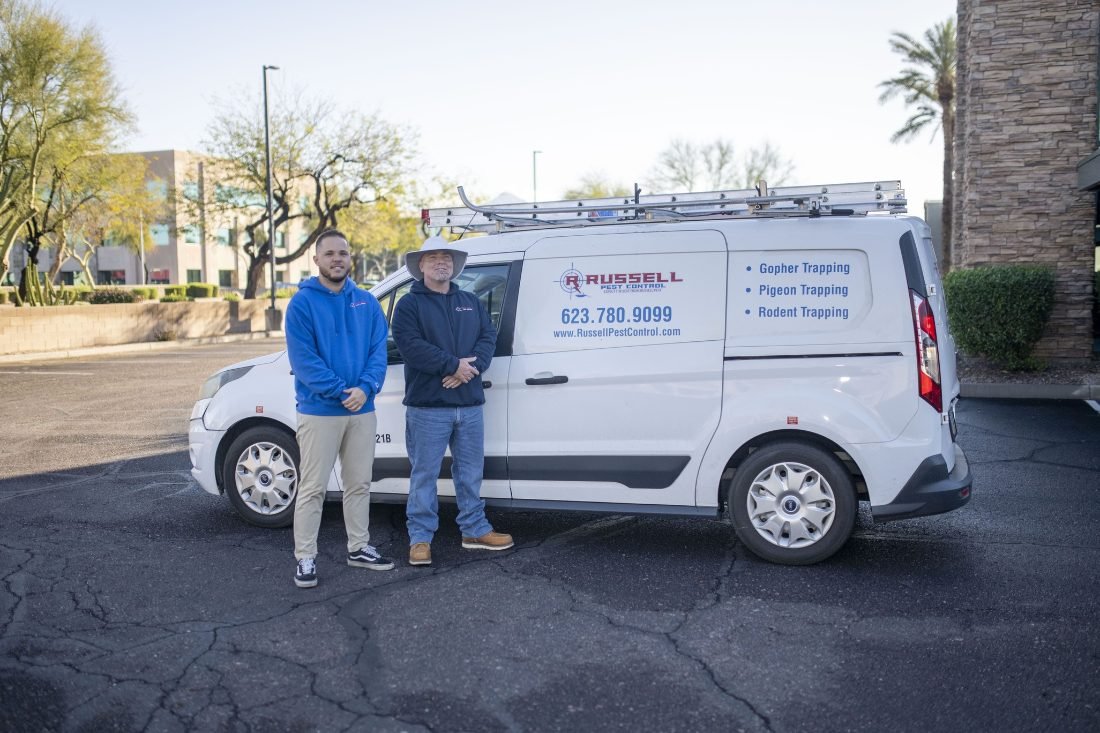
Thirty years of Arizona desert work, with a second generation on the routes. One call gets Steve, Steven Jr., or the office. Never a call center.
Nobody else on a sealing quote will ask what your subdivision is called. Here it is the difference between a scope that can be carried out and one that stalls at the wall.
No contracts and no initial fees on residential service, and a 15-day re-treat warranty if something comes back inside the window.
We split the quote at the ownership line, so the part needing somebody else's agreement is a decision you can take on its own.
Arizona OPM License #I5321B, and a family company that's been answering its own phone in the Valley since 1996.
What Sealing Customers Here Want Settled
How do I find out whether my wall is shared?
The recorded covenants for your own subdivision, which your title paperwork will name and which is usually a short document. The physical wall tells you nothing: a party wall and a wall you own outright are built the same way and look the same from both sides.
Do we really need the neighbor's signature to seal a wall?
Where the covenant says so, yes. The requirement is written consent before work that alters the wall. It gives nobody a veto over your house, and it reaches nothing on the building itself.
What if the neighbor says no?
Then that line comes off the quote and the rest of the job goes ahead, which is why we price the two columns separately. A shared wall is one route among several, and on most houses it is well down the list.
Is there an association we should be asking?
Usually not, and that surprises people. The Moon Valley Neighborhood Association states outright that it is not a homeowners association and that its board cannot enforce anything. A few subdivisions inside the area do have active associations with fees, and yours may be one of them.
Our house is old. Doesn't that decide the work?
It shapes it, and the age question is the one everybody already asks. Ownership sits underneath it: a fifty-year-old wall and a five-year-old wall raise it identically, and the recorded covenants answer it the same way regardless of when the house went up.
Does any of this mean taking the wall apart?
Almost never. Where a block wall's cells are open at the top, the work happens at the cap, which is why most of it looks like nothing much when it is done. Where something does have to be opened, you get the openings and the reasons before anybody starts.
Can you do same-day service in North Mountain Village?
Often, yes. Call or text before noon, and same-day is realistic more often than not, and an indoor sighting is the kind of call we try hardest to fit in. After hours, the phone reaches Steve's cell for triage.
Do you treat termites in North Mountain Village?
No, and we're straight about it. We'll identify termite signs honestly and refer you to a licensed termite specialist, then handle everything else on the property. Straight lanes, straight answers.
What Else We Run in North Mountain Village
Scorpion Control and Black Light Search
An after-dark pass that counts what is on the surface and maps the routes it travels.
Rodent Control and Exclusion
Removal before anything gets closed, then screening at the roofline and the ground line.
Bee and Wasp
Live relocation where a beekeeper can take the colony, and the cavity is closed afterward against reoccupation.
General Pest Control Plans
Monthly, bi-monthly or quarterly, with no contracts and a 15-day re-treat warranty.
Mosquito and Weed
Source reduction plus a serviced station program, and pre-emergent timed to both desert weed seasons.
Commercial and Property Management
Documented programs for buildings, food service, medical offices, and multi-tenant sites.
All North Mountain Village services: /north-mountain-village
Find Out What Your Subdivision Is Called
It is on your title paperwork, and it is the one piece of information that changes what we can quote you before anybody has looked at an opening. Most households have never needed it and cannot say it off the top of their head, which is exactly why nobody asks. The walk and the written list are free either way, whoever ends up doing the work.
Expect the best from Russell Pest, and have a bug-free day.
Hours
- Monday–Friday: 8:00 AM – 5:00 PM
- Same-day & emergency service available — after hours and weekends, owner-answered
(623) 780-9099 · Call or text · 6750 N 7th Ave, Phoenix, AZ 85013