
Bee Removal in North Mountain Village — The Cavity Outlasts the Colony
Take the colony out, and the hole is still there. Still scented, still exactly the right size, and still in the one spot on the property that a colony has already proved suitable. Bees are seasonal, and a colony is temporary; a void in a block wall or under an eave is neither. That is the whole reason the work does not finish when the bees leave.
The Cavities We Find Around Here
What the University of Arizona lists, and what we actually open
Arizona Cooperative Extension's own list of where wild honey bees establish runs to old or abandoned hives, natural voids such as tree hollows and stumps, rock crevices, and human-made structures including hollow block walls, buildings, and irrigation boxes. On a residential lot in this village, the last two do most of the work.
Block wall cells
The classic one, and the reason is geometry. A wall cell is dry, dark, insulated, and vertical, which is close to the shape of a hollow limb. Colonies here do not need much of an entrance to reach a run of them, and the run can be a good deal longer than the section of wall you were looking at.
Boxes at grade
Irrigation boxes, water meter boxes, valve boxes. A Southern Arizona beekeepers' association describes the hole provided for a padlock as a favorite entrance and calls these boxes essentially swarm traps placed at every residence, which is a fair description of what we find in them. That group writes for Tucson, and it is the same box we open here.
Eaves, soffits, and anything with a void behind a small hole
The opening a colony uses is often nothing like the size of the space behind it. A gap you could put a pencil through is a perfectly good door to a cavity the size of a suitcase, which is why the entrance tells you very little about the job.
The Same Wall, Two Springs Running
A household has bees in the garden wall, gets them removed, and is pleased with the outcome. The following spring there are bees in the garden wall. They usually assume it is the same colony coming back, or that somebody did the job badly.
Neither is normally the answer. The cavity was left open with the comb still in it, and a cavity with comb in it is a furnished, scented, weatherproof address that has already been advertised to anything looking for one. The second colony did not arrive because the removal failed. It arrived because the removal stopped where it did.
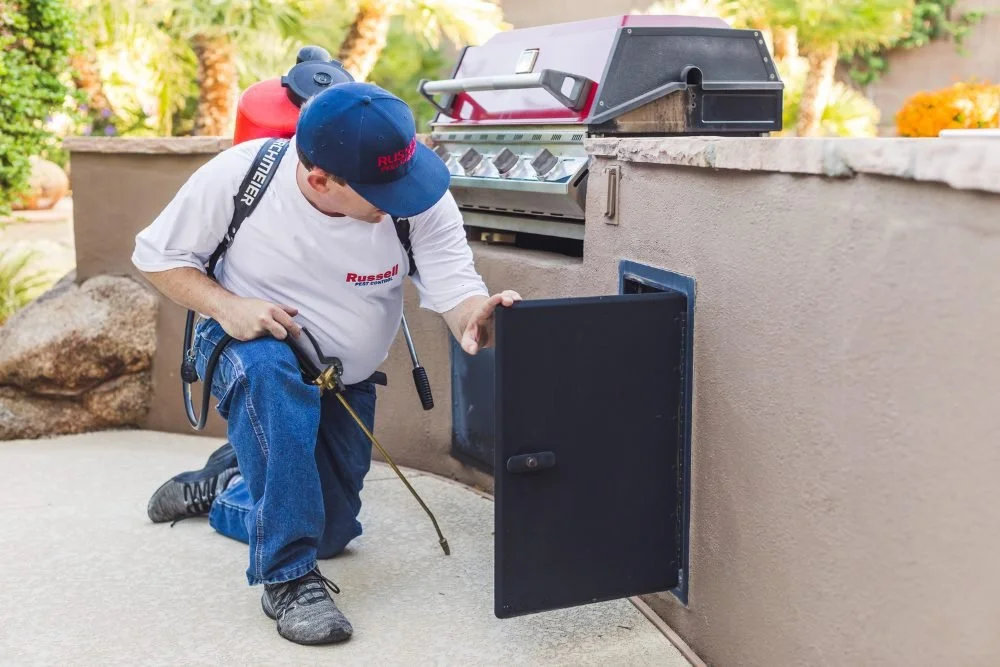
Three Things, and the Third Is the One People Skip
Distance, and nothing else, until somebody with gear arrives
Bees actively attacking somebody is 9-1-1, and none of the rest of this page matters. Cover your head and face with clothing or your hands, get inside a building or a vehicle and shut the door, and if there's no shelter, run at least 240 yards, which the University of Arizona describes as two football fields, and keep going until you're inside. Don't swat, and don't jump into a pool: the same source says the bees will wait longer than you can hold your breath. After the attack, scrape stingers out sideways and avoid pinching them. Call 9-1-1 for anyone stung many times, or for trouble breathing, swelling of the face or throat, or dizziness. Anyone with a known bee allergy uses their epinephrine and calls 9-1-1, and follows the plan their doctor gave them. We're a pest company, so the medical half stops there.
Open it properly or leave it entirely alone
Arizona Cooperative Extension is direct about the middle ground, and we will quote it: do not attempt to seal holes or fill voids if bees are actively moving in and out of it. Closing the entrance on a live colony does not end anything. It puts a large quantity of comb, brood, and honey inside a wall with nowhere to go, and the bees will usually find another way out, frequently into the building.
Clear the cavity, then close it
Comb out, the space cleaned as far as the access allows, and the opening closed. The University of Arizona's guidance is to fill holes an eighth of an inch or larger in walls and in structures with voids inside, and to seal cracks and gaps in walls, rooflines and around foundations, and, in the same guidance, not to attempt to seal holes or fill voids if bees are actively moving in and out of one. Both halves matter and the order is not negotiable: empty first, closed second. Tree cavities are their own case: the same source says not to pack them with concrete, gravel, or sand, because that damages the tree and becomes a hazard if it ever comes down. The standard for a bee closure is its own: it is about the entrance and the void behind it, and it is a wider threshold than scorpion sealing works to. A scope should say which standard it is quoting where, and if it does not, ask.
Bee Questions We Get in This Village
Can the colony be taken alive?
Often, and it is the outcome we aim for. Where a beekeeper can take the colony, we route it that way. Where the colony is inside a structure and cannot be taken intact, or where there are people or animals immediately at risk, that changes, and which situation you are in is settled out loud before anything happens.
Why does the cavity matter so much?
Because it is the part that survives the job. Bees are seasonal, and a colony is temporary. A void in a wall is permanent, and one that has held a colony is more attractive than one that has not.
Can't we just close the hole up ourselves?
Not while there is anything in it, and the University of Arizona says so in as many words. Sealing an occupied cavity traps everything inside the wall and pushes the exit elsewhere, often indoors. If it is empty and stays that way for a good while, closing it is sensible, and it is a short conversation.
Is it worth doing the other cavities while you're here?
Frequently, and it is the smallest part of the whole thing. Capping open cells at the top of a wall, screening a vent, taping or screening the padlock hole on a box at grade. Each of those is a small job that removes an address.
How aggressive are they going to be?
We are not going to predict a colony's temperament for you, and nobody honest will. We will say that Arizona Cooperative Extension states that all wild honey bees in Arizona are Africanized to some extent, and that we approach every wild colony on that basis. How it looked from a window does not enter into it.
There's a cluster hanging on a branch and nothing in the wall.
Then it is worth a photograph before anybody does anything, because that is a different situation from bees going in and out of a hole, and it is often handled by a beekeeper for nothing. Text us a picture from a sensible distance, and you will have an answer the same day.
How many visits is this?
The removal is usually one visit. The closure may be the same visit or a separate one, depending on what has to come off the wall to reach the cavity and whether the space needs to dry out first. Which of those it is gets settled before we start.
Do you have to open the wall?
Sometimes, and where we do, you get the exact section and a description of what it will look like afterward. A colony reached through the original opening is the easier job, and the extent depends on how long it has been in there. The number of bees you can see says almost nothing about it.
What about a colony in a tree or in rock on open ground?
That is not a job in the way a wall is. A cavity in rock cannot be cleared and closed by anybody, and ground that is not yours is not ours to work on. If it is on public land, the parks department is the right party to raise it with, and what happens next is theirs to decide, not ours to predict.
Is there anything we should be doing before spring?
Closing the empty cavities, and winter is the right time for it. One rule governs the whole job, and it is not negotiable: look at an opening for a few minutes on a warm day before anything goes near it, and if anything at all is going in or out, stop and call somebody. On an opening that is genuinely dead, capping a cell, screening a vent or closing the padlock hole on a box at grade takes an afternoon, and it is the only bee work that happens on your own schedule. Gloves and closed shoes, and never reach into a pile you can't see into. The same harborage holds bark scorpions, and near open ground it holds snakes. If something has sat undisturbed for months, don't move it by hand. For a snake, that's a call to a licensed wildlife removal service or to Arizona Game and Fish; a bite is a 911 call. For anything else, leave it for us.
Can you do same-day service in North Mountain Village?
Often, yes. Call or text before noon and same-day is realistic more often than not, and an indoor sighting is the kind of call we try hardest to fit in. After hours, the phone reaches Steve's cell for triage.
Do you treat termites in North Mountain Village?
No, and we're straight about it. We'll honestly identify termite signs, refer you to a licensed termite specialist, and handle everything else on the property. Straight lanes, straight answers.
What Bee Work Costs in North Mountain Village
One clarification on the badge above and the terms below: the 15-day re-treat warranty covers treatment service. Home Seal carries its own one to two year warranty, and the two are separate things.
Where the colony is, how long it has been there, how much has to be opened to reach it, and whether the cavity is being closed afterward are what move the number. The closure is quoted as its own line so you can see what you are paying for
The standing Russell terms apply here: no initial fees, no contracts, and a 15-day re-treat warranty
Black Light Scorpion Search: $125 per hour, after dark. We'll tell you what we expect your property to take before we start
Home Seal is quoted as its own job, typically $600 to $2,500 with a one to two year warranty depending on the work
Estimates are free. Attic and hive searches can carry a charge, waived if you hire us
What Else We Run in North Mountain Village
Wasp Control
A different animal and a different job, handled on the same visit where both are present.
Scorpion Control and Black Light Search
An after-dark pass that counts what is on the surface and maps the routes it travels.
Rodent Control and Exclusion
Removal before anything gets closed, then screening at the roofline and the ground line.
General Pest Control Plans
Monthly, bi-monthly or quarterly, with no contracts and a 15-day re-treat warranty.
Mosquito, Weed and Commercial
Station-based mosquito programs, pre-emergent on both desert weed seasons, and documented commercial work.
All North Mountain Village services: /north-mountain-village
Why Bee Calls Come to Us Here
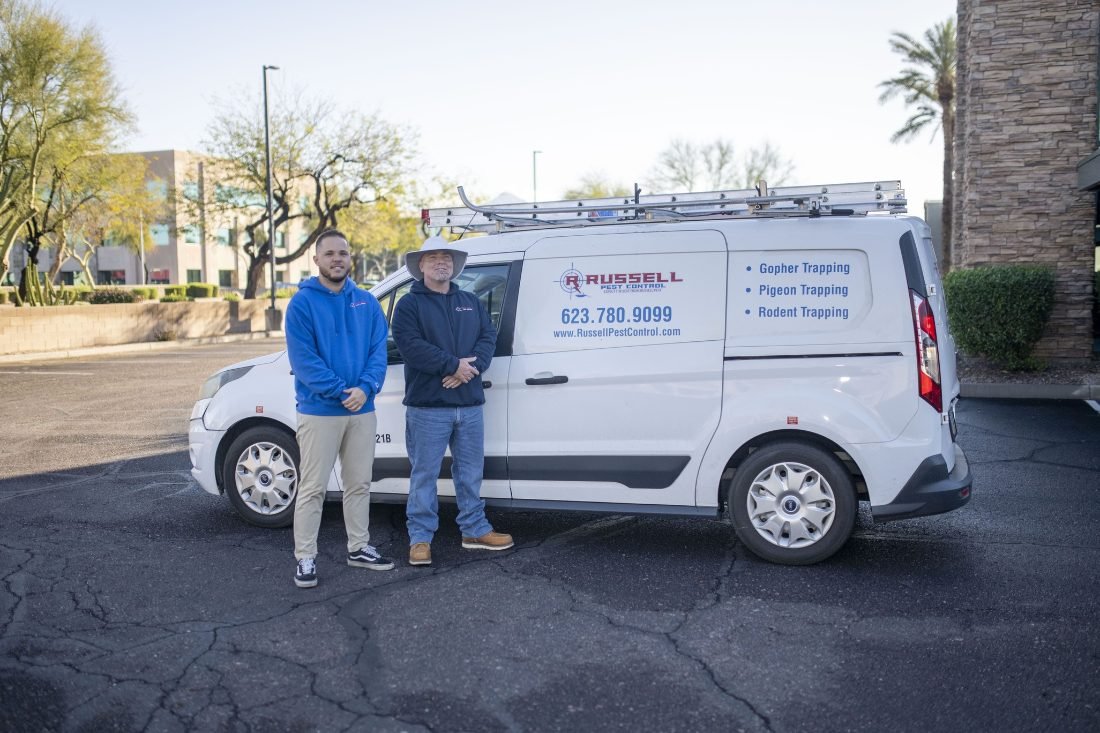
Thirty years of Arizona desert work, with a second generation on the routes. One call gets Steve, Steven Jr., or the office. Never a call center.
We quote the closure alongside the removal, because a cleared cavity left open is the job half done, and that argument is better had now than next April.
No contracts and no initial fees on residential service, and a 15-day re-treat warranty if something comes back inside the window.
We route a colony to a beekeeper where one can take it, and say plainly when that is not going to be possible.
We triage from a photograph before anybody drives out, which costs nothing and occasionally ends with us telling you to leave it alone.
We put the extent of the opening in writing before anything comes off, so nobody discovers it halfway through.
Arizona OPM License #I5321B, and a family company that's been answering its own phone in the Valley since 1996.
Send the Photograph From a Long Way Back
From a distance, through a window if that is what it takes, and never from close enough to be interesting to anything. A picture and a description of where it is settle most of what we need to know, and it is free. If anybody has already been stung, the instructions in the process section above are the ones to follow, and they are there rather than here because they matter more than booking a visit.
Expect the best from Russell Pest, and have a bug-free day.
Hours
- Monday–Friday: 8:00 AM – 5:00 PM
- Same-day & emergency service available — after hours and weekends, owner-answered
(623) 780-9099 · Call or text · 6750 N 7th Ave, Phoenix, AZ 85013