
Home Seal in Chandler, AZ — Tight Is Not the Same as Sealed
Chandler's current code sets out a compliance route in which an independent air-leakage test, carried out by a certified third-party rater, demonstrates that the envelope was built as designed. A builder can get there another way, but this is the route the ordinance spells out. That applies to plans submitted from July 2025 onward, so it covers new construction and almost nothing already standing. It's a good requirement, and it produces a real number. It also measures something different from what we measure. An air leakage test measures how much air the entire building lets through in aggregate. A pest-exclusion walk asks whether there is any single opening wider than a sixteenth of an inch. A house can do well on the first question and still fail the second, because they aren't the same question. We've sealed Valley houses since 1996, and this distinction is worth understanding before you buy either one.
Chandler Started Testing, and It's Worth Knowing What Gets Tested
What the city adopted
Chandler amended and adopted the 2024 editions of the International Codes, with all plans submitted for review on or after the first of July 2025 required to comply. Among the amendments is a third-party testing and inspection protocol run to Residential Energy Services Network standards. Follow that protocol, and you are deemed to have met the underlying requirements. Within it, three things have to be verified by an independent party: the building envelope thermal and air-barrier checklist, the air leakage rate, and duct tightness.
Who this actually covers, which is almost nobody reading this
It applies to plans submitted from July 2025 onward. The overwhelming majority of Chandler houses were built decades before that and have never been through it, and we're not going to let this page suggest otherwise. If your home is new construction from the last stretch, some of this is about you. If it isn't, this section is context and the rest of the page is the work.
What an air leakage rate is measuring
A whole-building total. The test pressurizes or depressurizes the house and measures how much air moves across the entire envelope at once, which is exactly the right way to answer an energy question. It gives you one number for the building.
What we're measuring instead
A list of individual openings and their widths. A bark scorpion gets through a gap around a sixteenth of an inch. Sweeps, thresholds, weep screed, slab joints, and utility penetrations are where a house actually leaks. When the list runs long, the work moves to a scoped Home Seal, with its own price and warranty. Those two methods can disagree about the same house, and neither is wrong: a building can have a good aggregate number and one bad threshold, because one bad threshold is a small fraction of a whole-house total and an open door to something the thickness of a stack of six business cards.
So the honest summary
A tested house is likely to be better built, and we'd expect fewer problems on average. What a passing test does not do is answer the question we're asked, which is whether anything can walk in. That conclusion is ours rather than the city's, and you should weigh it as reasoning.
The Openings an Aggregate Number Can Hide
Where we find them
- The stem wall and weep screed line, where the stucco meets the ground
- Garage thresholds and the gap under a roll-up door
- Irrigation and valve boxes, hose bib penetrations, and pool equipment pads
- Block wall voids, weep holes, and gate posts along the property line
And the ones that survive a good build
Weep holes get screened rather than plugged, because they ventilate the wall cavity. That principle runs through the whole job: an opening with a function keeps it and gets screened or detailed, and an opening with no remaining purpose gets closed properly.
- A door sweep that seals against air pressure but sits proud of an uneven threshold at one corner
- Weep screed left open at the stucco line, which is doing its job and still needs screening
- A garage that was never in the conditioned envelope and so was never in the test
- Roof and attic vents, which are supposed to be open
- Penetrations added after the certificate of occupancy by a satellite, solar, or irrigation installer
Three Things We Do on a Chandler Scope
Measure openings, not airflow
We walk the envelope with a gauge and a light and list what's wider than the standard, item by item, with locations. That list is the deliverable, and you get it whether or not you hire us. It's a different document from an energy report, and it answers a different question.
Pay attention to what changed after handover
On a newer Chandler house, the most productive part of the walk is often everything installed since the build: satellite mounts, solar penetrations, a water softener line, an irrigation controller, a replaced water heater. None of it was in any test, because it did not exist yet.
Detail what has to breathe, close what doesn't
Vents, weep screed and terminations get screened or fitted, never blocked. Dead penetrations get closed properly, with materials chosen to last where they sit. Where the building is the problem, sealing gets scoped and priced as its own job, separate from a service visit, so you can see exactly what it covers.

What You're Actually Buying
A written list of every opening on your building wider than the exclusion standard, with locations, sorted so you can see what's ours, what's another trade's, and what's a weekend. Then the work itself, priced as its own job with its own warranty.
Sealing reduces how much gets in, which is what makes a treatment program hold. It doesn't replace treatment, and a quote implying otherwise is selling you something. Where a property needs both, we price them separately so you can see what you're buying.
Chandler Home Seal Questions, Answered Straight
Our house passed its energy test. Do we still need sealing?
Possibly, and the test doesn't answer it either way. It measures aggregate air leakage across the entire envelope; we measure individual openings to the nearest sixteenth of an inch. A house can post a good total and still have one threshold that a scorpion walks under. If you've got a recent build and no sightings, you may well be fine. If you've got sightings, the certificate isn't evidence against them.
Was my house tested at all?
Only if the plans went in from July 2025 onward, which rules out almost every house in Chandler. If yours is older, there was no third-party envelope test, and there's nothing to reconcile.
Isn't a tighter house automatically better for pests?
On average, probably, and we'd expect a well-built new home to need less work. That's a tendency and not a guarantee, and the test doesn't certify it. The only way to answer it for your house is to look at your house.
What's the actual standard you're sealing to?
We seal to a sixteenth of an inch, because that's the gap a bark scorpion gets through. Rodent work uses a wider threshold, and bee work is different again, so a scope should tell you which standard applies where. If somebody quotes you sealing without naming a gap size, ask.
We just had solar installed. Does that matter?
It's one of the most common things we find on newer Chandler homes. Roof penetrations, conduit runs, and mounting hardware are all added after testing by the trade responsible for the array. Worth a look after any roof work, solar included.
Will sealing lower my power bill?
No, and on this page especially it would be an easy claim to make badly, because the city now has an air-leakage number attached to new work. A pest scope and an energy scope prioritize different openings. If energy performance is the goal, a rater is who measures it.
Do I need a permit?
For ordinary sealing, no. Boundary work is the part where cities differ, and rather than tell you Chandler's fence threshold from memory, we confirm it with Chandler Building Safety before anything at a boundary gets scoped. Gilbert, for instance, sets its threshold well below the model code, so this is not a question to answer by analogy. If a job grows into something that requires altering an opening or replacing a roof, that changes, and Chandler's building safety team is the right call.
How long does a seal last?
One to two years of warranty depending on the work. What shortens it is movement and other trades, which on a newer house means the steady stream of installers a new home attracts in its first few years. None of that is a defect in the seal.
Can you do same-day service in Chandler?
Often, yes. Call or text before noon, and same-day is realistic more often than not, and an indoor sighting is the kind of call we try hardest to fit in. After hours, the phone reaches Steve's cell for triage.
Do you treat termites in Chandler?
No, and we're straight about it. We'll identify termite signs honestly and refer you to a licensed termite specialist, then handle everything else on the property. Straight lanes, straight answers.
What Home Seal Costs in Chandler
Home Seal is quoted per property after a walk. Roof access, one story or two, and how many openings the building carries are what move the number
One clarification on the badge above and the terms below: the 15-day re-treat warranty covers treatment service. Home Seal carries its own one to two year warranty, and the two are separate things.
The walk and the written list are free either way, whoever ends up doing the work.
The standing Russell terms apply here: no initial fees, no contracts, and a 15-day re-treat warranty
Black Light Scorpion Search: $125 per hour, after dark. We'll tell you what we expect your property to take before we start
Home Seal is quoted as its own job, typically $600 to $2,500 with a one to two year warranty depending on the work
Estimates are free. Attic and hive searches can carry a charge, waived if you hire us
The Rest of the Chandler Playbook
Everything else we run in Chandler, in one place:
Rodent Exclusion and Proofing
View Fence and Snake Screening
Scorpion Control and the Black Light Search
General Pest
Mosquito, Bee, and Weed services
All Chandler services: /chandler
Why Chandler Households Stay With Us
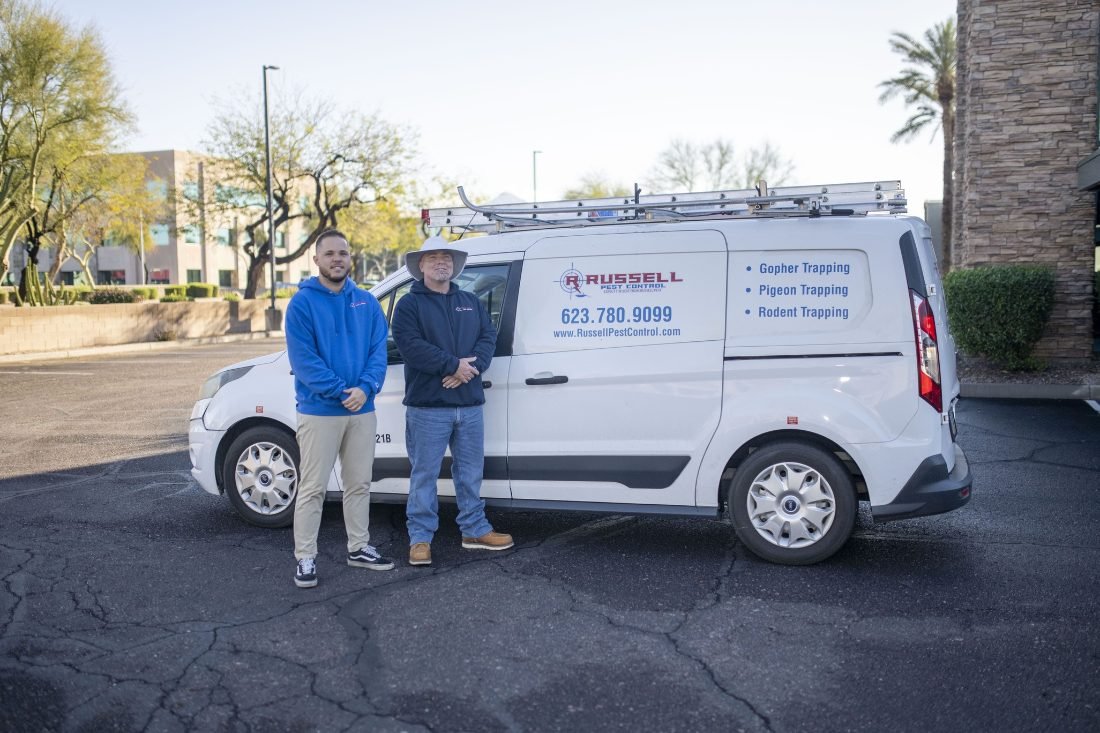
Thirty years of Arizona desert work, with a second generation on the routes. One call gets Steve, Steven Jr., or the office. Never a call center.
We name the gap size we're sealing to, which is the question that separates a real scope from a quote.
You get the written list of openings whether or not you hire us.
We won't tell you a new house doesn't need looking at, and we won't tell you it does. We'll look.
No contracts and no initial fees on residential service, and a 15-day re-treat warranty if something comes back inside the window.
Arizona OPM License #I5321B, and a family company that's been answering its own phone in the Valley since 1996.
Get the Number That Matters to You
If you've got a test certificate, keep it: it answers a good question. Then book the walk and get the other list, the one measured in sixteenths, and you'll have both halves of the picture rather than one.
Expect the best from Russell Pest, and have a bug-free day.
Hours
- Monday–Friday: 8:00 AM – 5:00 PM
- Same-day & emergency service available — after hours and weekends, owner-answered
(623) 780-9099 · Call or text · 6750 N 7th Ave, Phoenix, AZ 85013