
Rodent Control in Mesa, AZ — Two Different Rats, Two Opposite Programs
There are two rats worth knowing about in Mesa, and almost everything that works on one is wrong for the other. One lives above your head and is deeply suspicious of anything new in its world. The other builds a permanent structure on the ground and will walk into a trap the first night it sees one. On a Mesa rodent call, the identification is most of what you're paying for.
The Two Rodents in a Mesa Yard
The roof rat, which you'll almost never see
Maricopa County runs a public program for roof rats, and it puts a striking number on how they live: 90% of their lives are spent 4 feet or more off the ground. They travel power lines, oleander, vines and rooflines, range two to three hundred feet from where they sleep, and get in through any opening larger than a nickel. The county records them as most active from November through May.
The packrat, which builds something you can point at
The white-throated packrat is, in the words of the University of Arizona, the packrat most commonly found in the suburban areas of the Phoenix metro. It builds a midden: a heap of sticks, cactus joints, paper, and whatever else it has collected, usually at ground level against a wall or stored material, with a home range of less than a hundred yards from it. It climbs and digs both, and it will move into an attic when the opening is there, so the difference from a roof rat is where it dens and how far it ranges rather than whether it can get up.
What owners describe when they call
- Scratching or running overhead after dark, always in the same stretch of ceiling
- A heap of sticks and debris behind the pool equipment, under a shed, or against the block wall
- A vehicle or a trailer that has sat through a season and now won't start
- Droppings in a garage that has been shut up since spring
- Chewed irrigation line, chewed wiring insulation, or a shredded stored cushion
The openings every desert house has
The two animals use that list differently. A roof rat works the top of it, from the roofline down; a packrat works the bottom, from the ground up. The published thresholds differ too, and they aren't measuring the same thing: county guidance says roof rats enter through anything larger than a nickel, which is about eight-tenths of an inch, while the woodrat literature sets its exclusion standard at half an inch. Half an inch is the tighter of the two, so that's what we seal to on either job, and a sixteenth of an inch where scorpions are in scope as well.
- The stem wall and weep screed line, where the stucco meets the ground
- Garage thresholds and the gap under a roll-up door
- Irrigation and valve boxes, hose bib penetrations, and pool equipment pads
- Block wall voids, weep holes, and gate posts along the property line
The Conditions the Extension Guidance Names, and Where Mesa Has Them
The extension literature is specific about what packrats like
The standard extension handbook on woodrats says they're a nuisance around cabins, outbuildings, and other infrequently used structures or vehicles, and that they may take up residence in parked vehicles, gnawing wires and other mechanical components. University of Arizona publication AZ1775 illustrates the point with a photograph captioned as a packrat nest in a truck engine.
Mesa has a great deal of exactly that housing
The American Community Survey counts housing units held for seasonal, recreational, or occasional use. In its 2020 to 2024 five-year estimates, Mesa records 13,632 of them, alongside 27,843 mobile homes. Both are the largest counts of their kind in the Valley, ahead of Phoenix. Nobody publishes packrat numbers for Mesa, so we aren't going to claim the housing causes them. What we'll say is that this is the set of conditions the extension guidance names, and it matches what our technicians find on Mesa routes.
Four Things That Change the Moment We Know Which Rat
We name the animal before we set anything
University of Arizona guidance on roof rats puts it plainly: identifying the species correctly is a critical factor in whether the control works. The tells are the midden, the height of the runs, the droppings, and the damage. One walk, and it saves weeks of a wrong program. Where it's unclear, we set for both while we find out.
Trap technique inverts on temperament
Extension guidance on roof rats says they're afraid of new objects and may avoid traps for some time, so set traps baited and leave them unset until the animals are feeding confidently. The woodrat literature says the opposite in almost the same words: woodrats show little fear of new objects and are easily trapped. So a packrat job can start producing on night one, and a roof rat job that does usually means somebody got lucky. Pre-baiting looks like doing nothing. It's the part that makes the rest work.
Station design and bait form invert as well
Roof rat guidance calls for enclosed, tamper-resistant stations placed high, along fences, in trees or in dense shrubbery, with blocks preferred over pellets because these animals carry food away and cache it. The woodrat guidance says an enclosed box gets filled with sticks and debris, so open containers are used instead. Same product category, opposite handling. Where children, pets, or wildlife can reach any of it, the tamper-resistant option is the only one we'll use.
One program ends with demolition, the other with pruning
Once the packrats are out, the extension guidance is to destroy the den, because leaving it standing invites the next animal into a finished house. A roof rat job ends by cutting the aerial routes, screening the roofline, and closing the building. Where the building is the problem, sealing gets scoped and priced as its own job, separate from a service visit, so you can see exactly what it covers.
The House That Was Shut for the Summer
It runs the same way most years. A property closes up in spring. Nobody opens the garage, nobody moves the trailer, nobody starts the second vehicle. That's what the extension literature describes as ideal: an infrequently used structure, a parked vehicle, and undisturbed material at ground level.
The call comes in the first week the house is occupied again. By then the midden is established, and if a vehicle is involved the repair bill is usually the larger one.
The version we like better is the one where somebody with a key walks the property mid-season, looks behind the pool equipment and under the trailer, and sends a photograph. Ten minutes then, a real job in October.
Mesa Rodent Questions, Answered Straight
How do I tell which one I have without waiting for you?
Look for a structure. A packrat builds a visible heap of sticks and debris at ground level that stays put for years. A roof rat leaves nothing you'll find from the yard, so the evidence is overhead: sounds in the ceiling at night, droppings along a beam, greasy rub marks on a repeated route. If you can photograph a heap, send it. That one picture usually settles it.
Is a packrat protected? Can I just remove it?
University of Arizona material lists woodrats among the Arizona species that aren't protected. If you want that confirmed for your own situation, Arizona Game and Fish is the authority, and we'd rather you asked them than took it from us. There's a practical one: pulling a midden apart releases what has been living in it. University of Arizona extension material records that middens are common breeding sites for conenose bugs and warns that these insects can move to other hosts when the rodent is suddenly removed. Have it done properly, and take any bite reaction to a doctor.
Something is nesting in my car. Is that really a rat?
It's one of the things packrats are documented doing. The extension handbook describes them taking up residence in parked vehicles and gnawing wires and other mechanical components, and the University of Arizona publishes a photograph of a nest in a truck engine. We handle the property side: the den, the harborage, the ground where the vehicle sits. The repair belongs to a mechanic.
Why is my rodent problem worse in winter?
For roof rats, that's normal. Maricopa County records them as most active from November through May. A Mesa rodent program isn't a summer program, and a house with no activity in June hasn't necessarily been cleared.
We keep hearing something in the ceiling but nothing in the traps. Why?
Usually because the traps went out set. Roof rats are described in the extension literature as avoiding new objects for some time, and a trap that snapped once and caught nothing has taught the population something. The fix is unglamorous: bait without setting, let them feed, then set everything on one night. A few days at the start, and the difference between clearing a population and thinning it.
Do I need to take my fruit trees out?
No. Current University of Arizona guidance is direct: research shows roof rat populations aren't tied to the availability of food plants, so removing trees won't reduce the population or keep new animals from arriving. Where a canopy touches the roof, it's a road, and cutting that clearance is worth doing. A pathway question rather than a food one.
Can the county deal with this for me?
For roof rats, county Vector Control takes complaints about non-native rodents, and the City of Mesa's rodent page points residents there. The packrat is native, so it falls outside that. Either way, the county doesn't seal your house or clear your yard.
Our home sits empty half the year. What should we actually do?
Have someone walk the perimeter once mid-season, checking ground level behind stored material, under the trailer, and around the pool equipment. Keep anything stacked flat away from the walls, and if a vehicle is going to sit, open the hood on that same walk. We service seasonal properties on the same terms as occupied ones.
One safety note before anyone clears anything. Maricopa County publishes the protocol for rodent droppings, and it matters. Rubber gloves on. Ventilate the area the night before you clean by opening doors and windows, and don't shortcut that step to the few minutes before you start. Never sweep or vacuum droppings dry. Spray the droppings, nests, and the area around them with a 10% bleach solution (1 part bleach to 9 parts water), and allow at least 15 minutes of contact time before removing anything. Wipe up with paper towels or a mop, double-bag it, and wash your gloved hands in disinfectant before the gloves come off, then wash your hands with soap and water once they are off. The county sets the onset window for illness at 1 to 5 weeks. If a flu-like illness shows up in the weeks after a clean-up, the standing public-health advice is to see a physician promptly, to mention the rodent exposure, and to treat difficulty breathing as urgent, because early diagnosis is what changes the outcome.
Gloves and closed shoes, and never reach into a pile you can't see into. The same harborage holds bark scorpions, and near open ground it holds snakes. If something has sat undisturbed for months, don't move it by hand. For a snake, that's a call to a licensed wildlife removal service or Arizona Game and Fish, and a bite is a 911 call. For anything else, leave it for us.
How long does a rodent job take?
A packrat den on a defined piece of ground is often short, because the animals trap readily and the den is a fixed target. A roof rat population across a street is longer, because pre-baiting takes days before anything is set and some of what feeds your property isn't on your property. Which one you're in is settled at the estimate.
Can you do same-day service in Mesa?
Often, yes. Call or text before noon, and same-day is realistic more often than not, and an indoor sighting is the kind of call we try hardest to fit in. After hours, the phone reaches Steve's cell for triage.
Do you treat termites in Mesa?
No, and we're straight about it. We'll identify termite signs honestly and refer you to a licensed termite specialist, then handle everything else on the property. Straight lanes, straight answers.
What Rodent Work Costs in Mesa
Rodent work is quoted after a walk, because a single den on a defined piece of ground and a roofline population across a street are different jobs with different lengths
The standing Russell terms apply here: no initial fees, no contracts, and a 15-day re-treat warranty
Black Light Scorpion Search: $125 per hour, after dark. We'll tell you what we expect your property to take before we start
Home Seal is quoted as its own job, typically $600 to $2,500 with a one to two year warranty depending on the work
Estimates are free. Attic and hive searches can carry a charge, waived if you hire us
Why Mesa Households Stay With Us
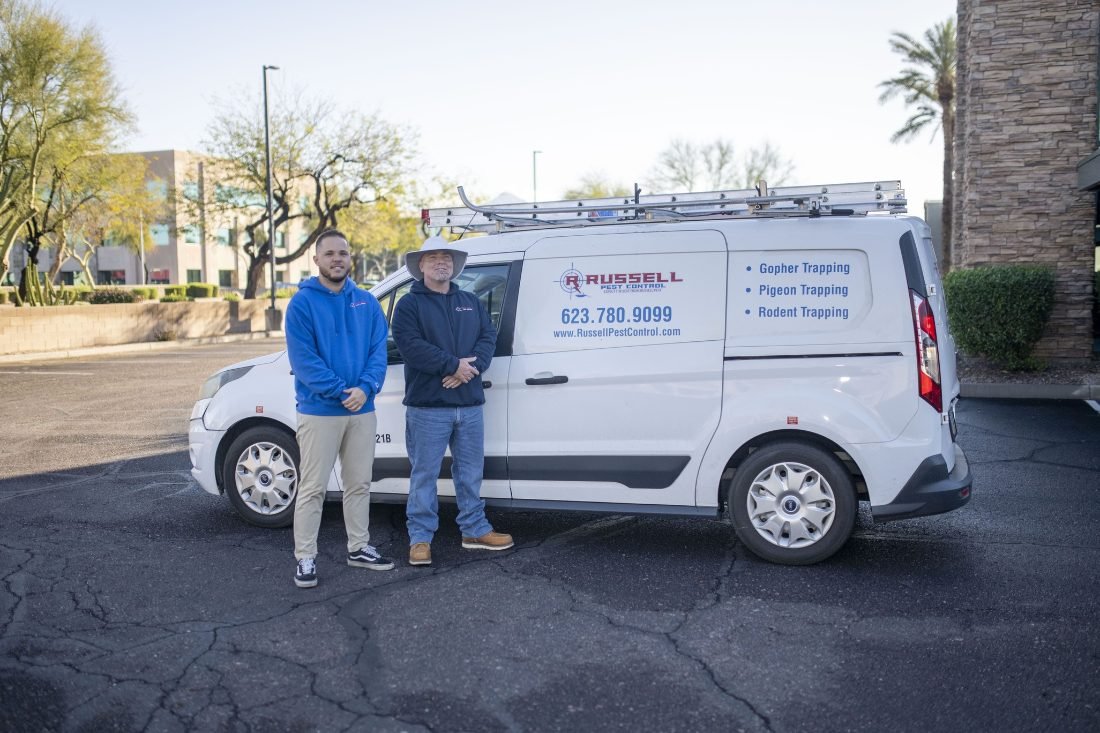
Thirty years of Arizona desert work, with a second generation on the routes. One call gets Steve, Steven Jr., or the office. Never a call center.
We name the species before we set anything, and where the answer is genuinely unclear, we say so rather than guessing and billing for the guess.
We pre-bait roof rat jobs even though it looks like doing nothing for the first few days, because the extension guidance is unambiguous about why it works.
We'll service a property that sits empty for part of the year, and we'll walk it while you aren't there.
No contracts and no initial fees on residential service, and a 15-day re-treat warranty if something comes back inside the window.
Arizona OPM License #I5321B, and a family company that's been answering its own phone in the Valley since 1996.
The Rest of the Mesa Playbook
Everything else we run in Mesa, in one place:
Rodent Exclusion and Proofing
Home Seal and Scorpion Sealing
Scorpion Control and the Black Light Search
View Fence and Snake Screening
All Mesa services: /mesa
Start With the Name of the Animal
Send a photograph of what you're seeing, or of the heap behind the pool equipment, and you'll have the answer on which of the two it is before anybody comes out.
Expect the best from Russell Pest, and have a bug-free day.
Hours
- Monday–Friday: 8:00 AM – 5:00 PM
- Same-day & emergency service available — after hours and weekends, owner-answered
(623) 780-9099 · Call or text · 6750 N 7th Ave, Phoenix, AZ 85013