
Mosquito Control in Mesa, AZ — Built Around Your Irrigation Date
Almost nothing in pest control comes with a date on it. Mesa mosquitoes are the exception. If your block takes flood irrigation, the water arrives on a schedule somebody publishes in advance, and everything after it runs on a clock you can read. The delivery itself is rarely the problem. What your yard looks like three days later is. On an irrigated Mesa lot, that single walk decides most of the season.

Two Numbers Decide Whether Your Lot Breeds
Maricopa County publishes both of them. The first is how long water has to sit: county guidance on irrigation and rainwater puts the threshold at water that ponds and stands for more than three days, and its community mosquito guide uses a five-day figure for containers. The second is how quickly the insect completes its cycle, and the county states it flatly for the species that matter here: about 7 days from egg to adult.
Put those against how flood irrigation actually behaves. Salt River Project describes a delivery as two to three inches of water that soaks into the ground, usually within a few hours, so a delivery that drains properly is finished long before anything can use it. The lots that breed are the ones with a low corner, a blocked yard drain, or a section that never got leveled, and on a two-week rotation that corner has room to run a full generation and dry out before the next delivery. Which is why almost nobody connects the bites in week two to the water in week one.
So the service is built in two halves. We work the water on the property, and we run In2Care stations for the water we can't get rid of.
Which Mosquito Is Biting You, and What It Tells Us
Bitten during the day, in your own yard
That's the container species. Maricopa County describes Aedes aegypti biting roughly two hours after sunrise and for several hours before sunset, and adds that these mosquitoes thrive in man-made containers and do not fly far, so if you're getting bitten, the standing water is probably in your own yard. Daytime bites are the most tractable problem here, because the source is somewhere you can walk to. It's also the species public health watches for dengue, so tractable isn't the same as trivial.
Bitten at dusk, in swarms, a few days after the water
That's the floodwater species. Aedes vexans eggs are laid on soil where water has ponded and lie dormant until flooded by the next rain or irrigation, producing one generation per flooding. The county calls them vicious biters and holds them responsible for most mosquito nuisance complaints. They come out at sundown and attack in numbers.
Bitten between dusk and dawn, with no obvious source
That's Culex, and it's the one the health department watches, because it carries West Nile virus. It's also the one that may have nothing to do with your property: the county puts its range at anywhere from a few blocks to ten miles in search of a blood meal. A perfectly dry yard can still have Culex, and the rest that matters here is in the safety note below.
Two things you control that no yard treatment can: an EPA-registered repellent, and long sleeves at dawn and dusk. We're a pest company, so the medical half is short, and it isn't ours. For the small share who do get seriously ill, the CDC is direct, and we'll quote it rather than paraphrase it: seek immediate medical attention for high fever, neck stiffness, muscle weakness, confusion or tremors. If that is what you are seeing, get medical help now. Anything short of that is still a question for a clinician and not for us.
What owners describe when they call
- Bites in the yard in broad daylight, mostly around the ankles
- A few quiet weeks, then several bad evenings, then quiet again
- A corner of the yard that's still soft or wet days after the water ran
- A neglected pool on the other side of the fence
- A patio that has become unusable after work
Three Agencies Deliver Mesa's Water, and All Three Publish the Date
Find out which one is yours
The City of Mesa runs its own irrigation utility, and it's small: approximately 300 customers between Mesa Drive and Country Club and between 8th Street and 8th Avenue, plus a handful of parks and schools. It publishes an irrigation calendar for the year and takes irrigation questions at 480-644-2221 on weekdays. Everyone else is served by Salt River Project or by the Roosevelt Water Conservation District, and the city's own irrigation page routes you to whichever one covers your block.
The intervals, in each agency's own words
Salt River Project schedules residential subdivision deliveries about every 14 days in summer and every 28 days in winter, except during the annual canal maintenance period, and delivers around the clock including holidays. Roosevelt Water Conservation District tells its customers their neighborhood runs every 13 days. Salt River Project puts the obligation plainly: it is your responsibility to know and follow your neighborhood's delivery schedule. Most people sign up once and never look at the calendar again.
Where the water stops being anybody else's problem
Salt River Project delivers to the delivery gate. From there, the ditches, channels, and pipelines that carry water onto your property are owned, operated, and maintained by you and your neighbors, which is also where the mosquito question starts: the low spot, the blocked drain, and the unlevel section are all on the private side of that gate. Maricopa County says the same thing in one sentence: everyone is responsible for eliminating and preventing mosquito breeding on their property.
What Mosquito Service Costs in Mesa
Lot size, how much of it holds water, and whether a pool or a water feature is in play are what move the number. We price it after we've walked it
In2Care station programs are priced across a season, because the stations work by compounding
The standing Russell terms apply here: no initial fees, no contracts, and a 15-day re-treat warranty
Black Light Scorpion Search: $125 per hour, after dark. We'll tell you what we expect your property to take before we start
Home Seal is quoted as its own job, typically $600 to $2,500 with a one to two year warranty depending on the work
Estimates are free. Attic and hive searches can carry a charge, waived if you hire us
Three Things We Do on an Irrigated Mesa Lot
Walk it wet, not dry
A dry inspection tells you very little, because the low corner looks like the rest of the yard. We would rather see the property within three days after delivery, when the water shows where it goes and where it stops. Bring us the date, and we'll schedule around it. Where the timing won't work, a photograph you take the morning after the water ran is nearly as good.
Fix the ground before buying anything
Most of what we find is drainage. A clogged yard drain, a berm that has slumped, a low section that was never leveled, a valve box that fills and holds. Some of it is a shovel and an afternoon, some of it belongs to a landscaper, and very little of it is a pest control product. We'll say which is which, including the parts that aren't ours to bill for.
Run In2Care for the water that stays
Some water on a Mesa lot isn't going anywhere: a pool in transition, a pond, a valve box that has to exist. In2Care stations use the mosquitoes themselves to carry larvicide into the water they breed in, including water we can't reach, and the effect builds across the season. How much it builds depends on the property. On an irrigated lot, that's the right tool for the residue after the drainage work is done.
Mesa Mosquito Questions, Answered Straight
How do I find my irrigation delivery date?
Depends who delivers. City of Mesa customers can get the published calendar on 480-644-2221. Salt River Project customers can look up the date online, in the SRP Water app, or by calling 602-236-3333. Roosevelt Water Conservation District customers can find it in the neighborhood sign-up box or through an online account. If you aren't sure which serves you, the City of Mesa irrigation page routes you.
My yard is flood-irrigated. Am I stuck with mosquitoes?
No, and the reason is the drainage. Salt River Project describes a delivery as two to three inches of water that soaks in, usually within a few hours. The county's figure for irrigation water is that ponding for more than three days creates a breeding site, which is a precaution rather than the point at which adults emerge. A lot that drains properly clears that gap by a wide margin. Where a yard breeds mosquitoes, something is holding water, and that's usually a fixable piece of ground work.
So what exactly should I do 72 hours after the water?
Walk the lot and look for anything still wet or soft: the lowest corner, the base of the block wall, around the valve boxes, and any spot where the ground has settled. Then check the containers. Note where the water is, and either deal with it or photograph it for us. Ten minutes, every couple of weeks in summer, is the whole discipline.
The bites come in waves. Is that normal?
It matches what the county describes for the floodwater species. Its eggs sit dormant in soil where water has ponded until the next flooding wakes them, and each flooding produces one generation. That produces a pulse, and it lines up with a delivery interval. If your bad evenings arrive on a rhythm, that rhythm is worth writing down.
How bad is West Nile virus in Mesa, honestly?
Small in most years, and once in a while not small at all. Maricopa County publishes a year-end report on it. In 2024 the county recorded 21 human cases. In 2021 it recorded roughly 1,480 cases and 101 deaths, the largest outbreak the county has seen, and Mesa's rate that year ran a little above the county's. In 2023, the county rate was 1.5 per 100,000, and Mesa's was 1.4, slightly below it. Across these years, Mesa appears in the report's city table in some and falls below its reporting threshold in others, and it's never the highest city listed. Two things are true at once: most years bring a handful of reported cases, and 2021 happened. Reported cases also undercount infections, because most people who are infected never develop symptoms. That's the whole picture, and it's why we treat Culex as worth managing rather than panicking about.
There's a green pool behind us. What can we do?
Start with a conversation if you can, because a neglected pool is usually someone overwhelmed rather than someone hostile, and the county figure is worth passing along: one pool can produce at least 10,000 mosquitoes a week. If that goes nowhere, Maricopa County Environmental Services takes standing-water and green-pool complaints on 602-506-6616 or through its online form. For a pond or an unused pool you control, the county gives away mosquito-eating Gambusia for free at 602-506-0700. Either way, we can work your side of the fence in the meantime.
Does In2Care work better than spraying the yard?
They do different things. A barrier treatment knocks down the adults present when it's applied, and it stops working as it breaks down. In2Care goes after the next generation by getting larvicide into water we can't reach. On an irrigated lot, where the water returns on a schedule, that's the half that carries across the season. We use both where both are warranted.
We're on city water and have a xeriscaped yard. Does any of this apply?
Some of it. The irrigation calendar isn't yours to worry about, which removes the biggest single driver. What is left is containers, which is the daytime species, and Culex drifting in from elsewhere. So the container sweep still matters, and the 72-hour walk doesn't.
Can you do same-day service in Mesa?
Often, yes. Call or text before noon, and same-day is realistic more often than not, and an indoor sighting is the kind of call we try hardest to fit in. After hours, the phone reaches Steve's cell for triage.
Do you treat termites in Mesa?
No, and we're straight about it. We'll honestly identify termite signs, refer you to a licensed termite specialist, and handle everything else on the property. Straight lanes, straight answers.
The Rest of the Mesa Playbook
Everything else we run in Mesa, in one place:
Scorpion Control and the Black Light Search
Rodent Control and Exclusion
All Mesa services: /mesa
Why Mesa Households Stay With Us
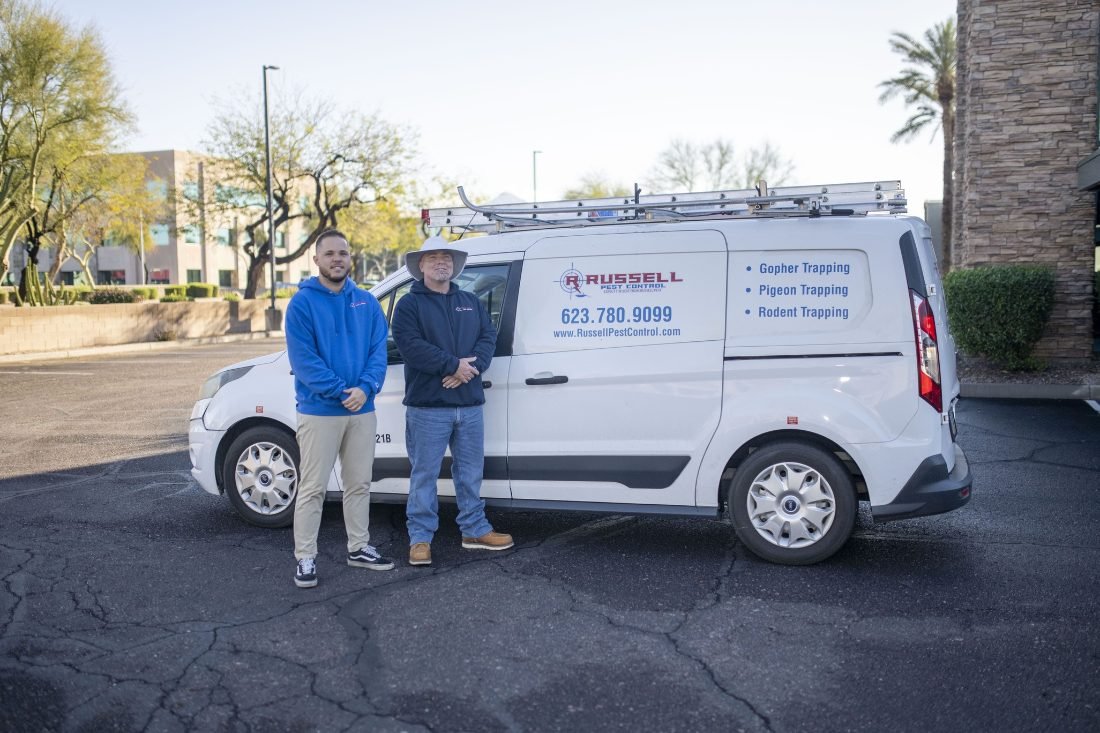
Thirty years of Arizona desert work, with a second generation on the routes. One call gets Steve, Steven Jr., or the office. Never a call center.
Give us your irrigation date, and we'll schedule the inspection inside the window where the yard actually shows us something.
We separate the drainage work from the pest work out loud, including the parts a landscaper should do and we should not bill for.
No contracts and no initial fees on residential service, and a 15-day re-treat warranty if something comes back inside the window.
Arizona OPM License #I5321B, and a family company that's been answering its own phone in the Valley since 1996.
Look Up the Date, Then Call Us
Find out who delivers your water and when it next runs. Walk the lot three days after. If anything is still wet, photograph it and send it with your cross streets, and we'll work out what's drainage, what's a station program, and what's neither.
Expect the best from Russell Pest, and have a bug-free day.
Hours
- Monday–Friday: 8:00 AM – 5:00 PM
- Same-day & emergency service available — after hours and weekends, owner-answered
(623) 780-9099 · Call or text · 6750 N 7th Ave, Phoenix, AZ 85013