
Scorpion Control in Gilbert, AZ — Follow the Water, Not the Walls
Here's the finding that should change how you look at your yard. University of Arizona guidance indicates that homes and buildings with irrigated landscapes can support scorpion populations much higher than those in the surrounding desert wildland. Not lower. Higher. A green Gilbert yard is better habitat than the open desert it replaced, and the reason is the water. Which means the most useful thing on your property isn't the block wall or the treatment schedule. It's the irrigation controller.
Where Gilbert Properties Actually Hold Water
What owners describe
One practical note before the list below. The Arizona bark scorpion is the only scorpion in the country considered medically significant. Reactions vary, and it isn't ours to assess. We're a pest company, not a clinic, so if someone is stung, the number you want is Poison Help at 1-800-222-1222, which routes to your county's poison center. For a young child, or for anyone with trouble breathing or swallowing, call 911. Keeping them outside is the part we own.
- One or two a week around the pool deck and nowhere else on the property
- Activity that climbs through the hottest weeks and eases when the yard dries out
- Something under a hose reel, a pot saucer, or a bag of pool chemicals
- One indoors at night, and nobody in the house sleeping well since
The openings every desert house has
- The stem wall and weep screed line, where the stucco meets the ground
- Garage thresholds and the gap under a roll-up door
- Irrigation and valve boxes, hose bib penetrations, and pool equipment pads
- Block wall voids, weep holes, and gate posts along the property line
And the wet spots we look for in Gilbert
- Drip emitters that have failed open, and the permanently damp ring around them
- Valve boxes and irrigation boxes that hold an inch of water after every cycle
- Hose bibs with a slow drip, and the soil under them
- Pool decks, splash-out zones, and the shaded slab that never fully dries
- Pot saucers, pet bowls, and anything left standing overnight

Why the Moisture Map Is the Treatment Map
The service runs on the premise that a scorpion on your property is there for a reason, and that the reason is usually findable. Fix what's drawing it, treat the routes it uses to get to the building, and close the building itself. In that order, because doing the last two without the first is how a property stays on service forever.
The service runs as a program. We work the harborage and the routes the animal actually travels, take down the insect population that feeds it, and keep the same technician on the property wherever the schedule allows, so that knowledge accumulates. Where the building is the problem, sealing gets scoped and priced as its own job, separate from a service visit. And where proof beats an opinion, the black-light search maps the population after dark at $125 per hour.
A Watered Town Is Better Habitat Than Raw Desert
The finding that inverts the usual assumption
University of Arizona guidance is blunt about what irrigation does: homes and buildings with irrigated landscapes can support scorpion populations much higher than the surrounding desert wildland. That's worth sitting with. A lush Gilbert yard isn't safer than open desert. In carrying-capacity terms, it's better habitat, and the water is why. That finding is regional and not a measurement of Gilbert specifically, though Gilbert is about as thoroughly irrigated as the Valley gets.
What they do with the water
The same source notes they'll drink from small pools of standing water, and that they move when they're flooded out of harborage after irrigation or rain. So a yard that gets soaked on a schedule produces a small eviction on that schedule, and the animals that leave have to go somewhere. Usually that's toward the structure.
And the pool, which deserves its own sentence
They can stay alive fully submerged in chlorinated pool water for a surprising length of time, and recover well enough to defend themselves if somebody fishes one out by hand. Use the net. The same guidance flags damp towels left on the deck as extremely attractive to scorpions seeking moisture, which is the simplest fix on this page.
Three Things We Do on a Gilbert Property
Map the water before anything else
The first pass follows moisture: the irrigation zones and their run times, every emitter that's failed open, the valve boxes, the hose bibs, the pool deck, the shaded slab, and the low ground where a yard sheds. That map shows where the population is concentrated and usually reveals something the owner didn't know about their own irrigation.
Fix the water, then treat the routes
A repaired emitter does more than a treated wall base, and it stays fixed. So we separate the list: what a landscaper or an afternoon fixes, and what we treat. Then the product follows the ground-level edges the animal actually travels, which is where it does work rather than across open landscape, where it looks thorough but does less.
Close the building
A bark scorpion gets through a gap around a sixteenth of an inch. Sweeps, thresholds, weep screed, slab joints, and utility penetrations are where a house actually leaks. Where the list runs long, the work moves to a scoped Home Seal, with its own price and its own warranty. Weep holes get screened rather than plugged, because they ventilate the wall cavity.
Why Gilbert Households Stay With Us
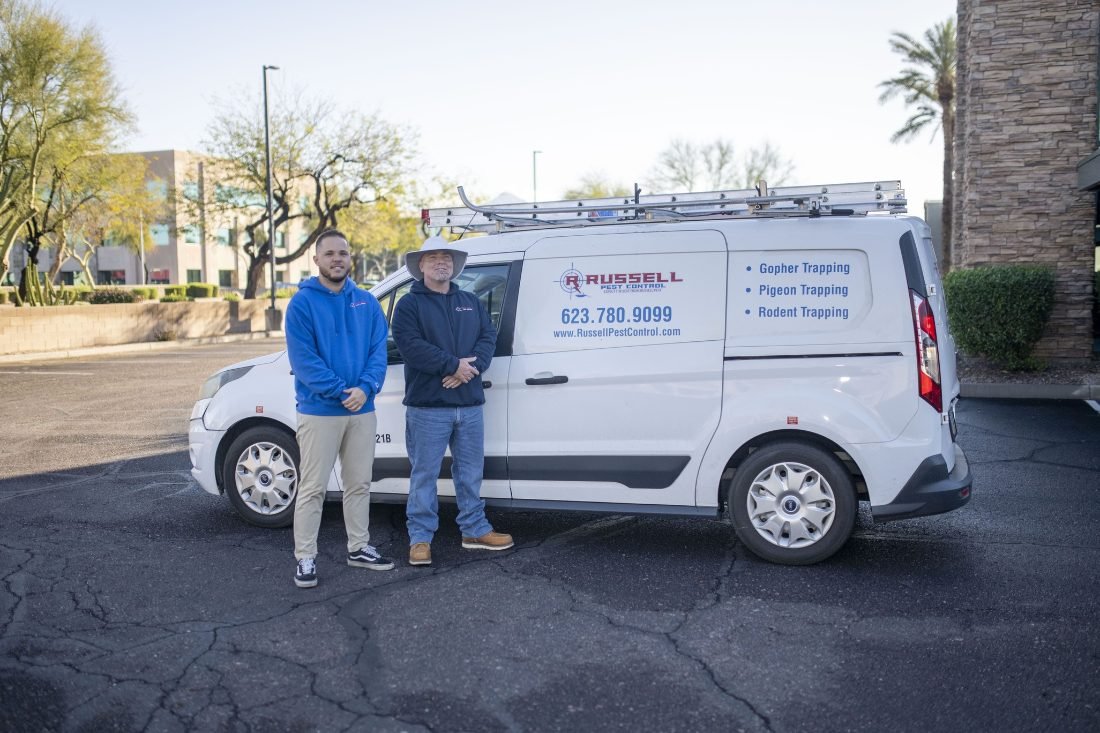
Thirty years of Arizona desert work, with a second generation on the routes. One call gets Steve, Steven Jr., or the office. Never a call center.
We hand you the irrigation repairs as a separate list, including the ones a landscaper should do and we shouldn't bill for.
No contracts and no initial fees on residential service, and a 15-day re-treat warranty if something comes back inside the window.
Arizona OPM License #I5321B, and a family company that's been answering its own phone in the Valley since 1996.
What Scorpion Service Costs in Gilbert
Lot size, how much irrigated landscape is on it, whether there's a pool, and the property's history are what move the number. We price it after we've walked it
The standing Russell terms apply here: no initial fees, no contracts, and a 15-day re-treat warranty
Black Light Scorpion Search: $125 per hour, after dark. We'll tell you what we expect your property to take before we start
Home Seal is quoted as its own job, typically $600 to $2,500 with a one to two year warranty depending on the work
Estimates are free. Attic and hive searches can carry a charge, waived if you hire us
Gilbert Scorpion Questions, Answered Straight
Does this mean I should stop watering my yard?
No, and we'd think less of anyone who told you to. Gilbert is a green town on purpose, and that's most of why people live here. The point isn't less water, it's less water in the wrong places: a dripping bib, an emitter running into a corner nobody sees, a valve box that never drains. Fix those, and the lawn stays green.
We found one in the pool. Was it swimming?
Probably not by choice, and don't assume it's dead. Use the net, and empty the skimmer with the same caution.
Why do we see more of them right after the irrigation runs?
Because flooding pushes them out of harborage, which is one of the few pest patterns you can predict from your own irrigation controller. If your sightings cluster in the day or two after a cycle, that's worth letting us know.
How far did it come?
Not far. Telemetry work puts typical foraging within 35 yards at night, often just enough to reach water or harborage. So a scorpion at your back door is almost certainly living on your property or the one adjoining it, which is good news, because it means the things you change actually matter.
Where does the town come into this?
Only at the edges, and it's worth knowing which. Gilbert's water conservation code defines waste of water as letting town-supplied water escape your property onto a street, sidewalk, alley, or a neighbor's land. That's about water leaving, not about the damp corner in your own yard, which nobody regulates, and only you will fix. Gilbert also publishes three approved ways to drain a pool, and the preferred one is onto your own landscaping, provided the ground can absorb it without it running off.
Our HOA has rules about all of this. Who wins?
For town code, Gilbert answers it directly: town codes have overriding authority, and where an HOA allows something the code prohibits, the code prevails. That said, a code inspector won't act as your HOA's agent, and plenty of what an HOA governs isn't a code question at all. Specifically for pool draining, Gilbert tells residents to check the HOA policy as well as the town's.
What should I actually change on the controller?
Nothing dramatic, and mostly it's about how the water lands rather than how much. Run times long enough to soak and infrequent enough to let the surface dry between cycles, emitters checked for the one that's failed open, and nothing watering a wall base or a slab edge that doesn't need it. A yard can stay green on a schedule that doesn't leave a permanent damp ring against the house.
Does a black-light search tell us anything a normal inspection can't?
Yes, and on a watered lot it settles the argument about where they're concentrated. Scorpions fluoresce under ultraviolet light, so an after-dark pass maps what's on the surface that night and the routes it travels. It runs at $125 per hour.
We xeriscaped. Are we in the clear?
Better placed than a heavily irrigated lot, and not exempt. A xeriscape still has a hose bib, a pool, a pet bowl, and shade. What changes is that your water sources are countable, which makes the walk short and the fixes obvious. Send us your cross streets, and we'll tell you what a dry-lot visit looks like.
Can you do same-day service in Gilbert?
Often, yes. Call or text before noon, and same-day is realistic more often than not, and an indoor sighting is the kind of call we try hardest to fit in. After hours, the phone reaches Steve's cell for triage.
Do you treat termites in Gilbert?
No, and we're straight about it. We'll identify termite signs honestly and refer you to a licensed termite specialist, then handle everything else on the property. Straight lanes, straight answers.
The Rest of the Gilbert Playbook
Everything else we run in Gilbert, in one place:
Home Seal and Scorpion Sealing
Rodent Control and Exclusion
Bee Removal and Wasp Control
All Gilbert services: /gilbert
Start With the Irrigation Controller
Walk the yard an hour after a watering cycle and look for what's still wet. Photograph anything that shouldn't be, send it with your cross streets, and we'll tell you what's a repair, what's a treatment, and what's neither.
Expect the best from Russell Pest, and have a bug-free day.
Hours
- Monday–Friday: 8:00 AM – 5:00 PM
- Same-day & emergency service available — after hours and weekends, owner-answered
(623) 780-9099 · Call or text · 6750 N 7th Ave, Phoenix, AZ 85013