
Bee Removal in Mesa, AZ — Where They Landed Decides Who Comes
Mesa publishes a list of who to call about bees, and it has 7 lines. Which line applies to you has almost nothing to do with how alarming the bees look and almost everything to do with two facts: whether they're passing through or have moved in, and whose ground they chose. A cluster in a city park, a colony in your wall, and bees in the water meter box at the curb are three different phone calls with three different outcomes and three different bills. We've worked Valley bee calls since 1996, and the first useful thing on the phone is working out which of the three you're looking at.
Mesa Has Written Down Who Handles What
The city's own list, and what each line actually means
Most cities leave this vague. Mesa doesn't. Its pest page routes bee calls by situation and by whose property they are on, and the rows differ in ways that decide your afternoon:
What the emergency number costs the bees
Mesa Fire and Medical makes its position clear: it typically does not eradicate bees unless there is immediate danger to people from aggressive bees actively attacking; in those situations, firefighters destroy the bees and the hive. That's the correct call when somebody is being stung, and if that's your situation, the number is 9-1-1 and nothing on this page should slow you down. It's worth understanding, though, that the emergency route has one outcome. Every other row on the list still has options.
Nobody can tell you whose bees these are
This is the question we get most, and it has no answer. Arizona deregulated beekeeping in 1994, repealing its apiary statutes and abolishing the state Inspector of Apiaries, so there's no registry to search. Mesa's city code limits apiaries to agricultural and rural areas, zoned AG or R1-43, and its zoning ordinance sets a seventy-five foot separation from any neighboring residence in the AG district. Those are large-lot districts, so most Mesa addresses aren't in one. In the AG district, hives may not be located within 75 feet of any neighboring residence. Whether any particular property qualifies is a question for Mesa Planning rather than for us, and either way there's no register to look a beekeeper up in. Arizona law does draw the line: state statute treats a feral honeybee colony that isn't currently maintained by a beekeeper and poses a health or safety hazard as a public nuisance, and Mesa cites exactly that statute as the basis for county authority. Meaningful in law, unanswerable in your backyard.
A Mesa address isn't always in Mesa
Worth knowing before you dial. Mesa Fire and Medical covers addresses inside the city limits; unincorporated county islands fall under Maricopa County, with Rural Metro as the responding fire agency. The city says outright that it's possible to have a Mesa mailing address and still be in an unincorporated area. If you're on a county island, the top row of that table reaches a different agency than you expect. Dial 9-1-1 regardless, and the call routes to whoever responds to your address. We service both sides of that line, and we'll ask for your cross streets before we answer.
The Three Bee Calls We Get From Mesa
A cluster that appeared this morning
A swarm on the move rests. Mesa's own guidance says swarms are typically transient and may shelter in a tree for a few hours or even days before moving on, and University of Arizona material describes a resting swarm as least aggressive precisely because it has no brood to protect. Photograph it from a distance and send it before anyone does anything.
Traffic in and out of the same hole
That's the other one. University of Arizona guidance is specific: multiple bees passing in and out of a cavity indicate a colony inside. Wall voids, roof tile, chimneys, irrigation valve boxes, and water meter boxes are where we find them in Mesa. This is structural work, and it's the call where the choice of approach still exists.
Somebody is being stung right now
That's 9-1-1, and the rest of this page can wait. Cover your head and face with clothing or your hands, get inside a building or a vehicle and shut the door, and if there's no shelter, run at least 240 yards, which the University of Arizona describes as two football fields, and keep going until you're inside. Don't swat, and don't jump into a pool: the same source says the bees will wait longer than you can hold your breath.
After the attack, scrape stingers out sideways and avoid pinching them. Call 9-1-1 if anyone is stung many times, or has trouble breathing, swelling of the face or throat, or dizziness. Anyone with a known bee allergy uses their epinephrine and calls 9-1-1, and follows the plan their doctor gave them. We're a pest company, so the medical half stops there.
What owners describe when they call us
- A cluster the size of a football on a branch or a wall that wasn't there yesterday
- A steady line of bees going in and out of one spot on the eave, day after day
- A stain, a smell, or a damp patch on a ceiling below where the traffic is
- Bees at the meter box or the irrigation valve, right where a meter reader has to reach
- A hive somebody sprayed a while ago, and now the traffic is back
Five Things We Do on a Mesa Bee Call
Settle the swarm question before anyone suits up
A photograph usually does it, and it costs nothing. A resting cluster with no traffic in or out of a cavity is one job and often no job at all; a colony inside a structure is another. Getting this wrong in either direction wastes your money or your afternoon.
Establish whose ground they are on
If the bees are in the water meter box, the box belongs to the city, and there's a number for that. If they're in the strip of park behind your wall, that's Parks. If they're in your eave, it's yours, and the city says so. We would rather point you at a free city number than bill you for a call that was never yours to pay.
Decide the outcome while you still can
Mesa's guidance says that killing non-Africanized swarms only strengthens the Africanized population, and that non-aggressive bees are essential in nature. Read alongside the University of Arizona's position that all wild honey bees in Arizona are Africanized to some extent, and noting that how a colony behaves on the day is not a test of its lineage, the practical reading is that destruction should be the answer to a safety problem and not the default. Where a colony is accessible and a beekeeper will take it, relocation stays on the table, and it's worth asking for. Where the situation has become a safety problem, it stops being a choice, which is the argument for calling early.
Open it, remove the comb, then close it
University of Arizona guidance is that bees and combs should be removed by professionals with proper protective equipment, and that no one should attempt to seal a hole or fill a void while bees are actively moving in and out of it. Comb left in a wall keeps drawing bees back to the same address and can weep honey through the ceiling in a Mesa summer. Removal comes first, and sealing follows.
Close the openings that are still empty
The prevention half is dull, and it works, and it's the University of Arizona's own advice: fill gaps in walls, rooflines and around foundations with a good quality silicone sealant, put mesh screening over rainspouts, chimneys and water meter boxes, and deal with the cavities before anything moves into them. The University of Arizona's guidance is to fill holes an eighth of an inch or larger in walls and in structures with voids inside, and to seal cracks and gaps in walls, rooflines and around foundations, and, in the same guidance, not to attempt to seal holes or fill voids if bees are actively moving in and out of one. Both halves matter and the order is not negotiable: empty first, closed second. Tree cavities are their own case: the same source says not to pack them with concrete, gravel, or sand, because that damages the tree and becomes a hazard if it ever comes down. Where the building is the problem, sealing gets scoped and priced as its own job, separate from a service visit, so you can see exactly what it covers.
Mesa Bee Questions, Answered Straight
There's a ball of bees in my tree. Do I have to do anything?
Often not. Mesa's own guidance describes swarms as typically transient, staying hours or days before moving on. Maricopa County's published advice is that if a swarm remains on your property for more than 24 hours, you should call a pest control company. So the reasonable plan is to keep people and pets away from it, leave it alone, and give it a day. If it's over a doorway, a play area, or a gate people have to use, do not wait the day out.
Can I find out whose bees these are?
No, and it's worth knowing why. Arizona deregulated beekeeping in 1994 and keeps no registry, and Mesa's city code confines apiaries to its AG and R1-43 districts. Whether a particular lot qualifies is Mesa Planning's call, not ours, and either way, there's no list to check and no one to bill. The question that actually changes what happens next is whether they're resting or established.
Will the fire department come out?
For bees actively attacking people, yes, and that call is 9-1-1. Mesa Fire and Medical says it doesn't typically eradicate bees otherwise, and that when it does respond in those circumstances, firefighters destroy the bees and the hive. So it's the right call in an emergency and the wrong call for a cluster in a tree.
Who pays?
For bees on a private residence or business, Mesa states it directly: the owner or occupant assumes financial responsibility for a beekeeper or exterminator. For bees on city property, in a park, or in a water meter box, there's a city number, and it isn't your bill. Establishing which of those you're in is the first thing worth doing.
Someone sprayed the hive last year, and the bees are back. Why?
Because the comb stayed. Removal and repair are a single job here for exactly that reason, and step 5 is where it gets done.
Do you relocate rather than destroy?
Where the colony is reachable, and a beekeeper will take it, that's a real option, and we'll say so. Where it's inside a wall that has to be opened, or where the situation has already become a safety problem, it usually isn't. We won't promise you an outcome until we've seen the entry point, because it determines the outcome.
Can you do same-day service in Mesa?
Often, yes. Call or text before noon, and same-day is realistic more often than not, and an indoor sighting is the kind of call we try hardest to fit in. After hours, the phone reaches Steve's cell for triage.
Do you treat termites in Mesa?
No, and we're straight about it. We'll identify termite signs honestly and refer you to a licensed termite specialist, then handle everything else on the property. Straight lanes, straight answers.
What Bee Work Costs in Mesa
A swarm on a low branch and a colony behind stucco on a second floor are different jobs. Access, height, and whether a wall has to be opened are what move the number
Where a wall or a roof has to be opened, the repair is scoped with the removal so you get one number up front
The standing Russell terms apply here: no initial fees, no contracts, and a 15-day re-treat warranty
Black Light Scorpion Search: $125 per hour, after dark. We'll tell you what we expect your property to take before we start
Home Seal is quoted as its own job, typically $600 to $2,500 with a one to two year warranty depending on the work
Estimates are free. Attic and hive searches can carry a charge, waived if you hire us
Why Mesa Households Stay With Us
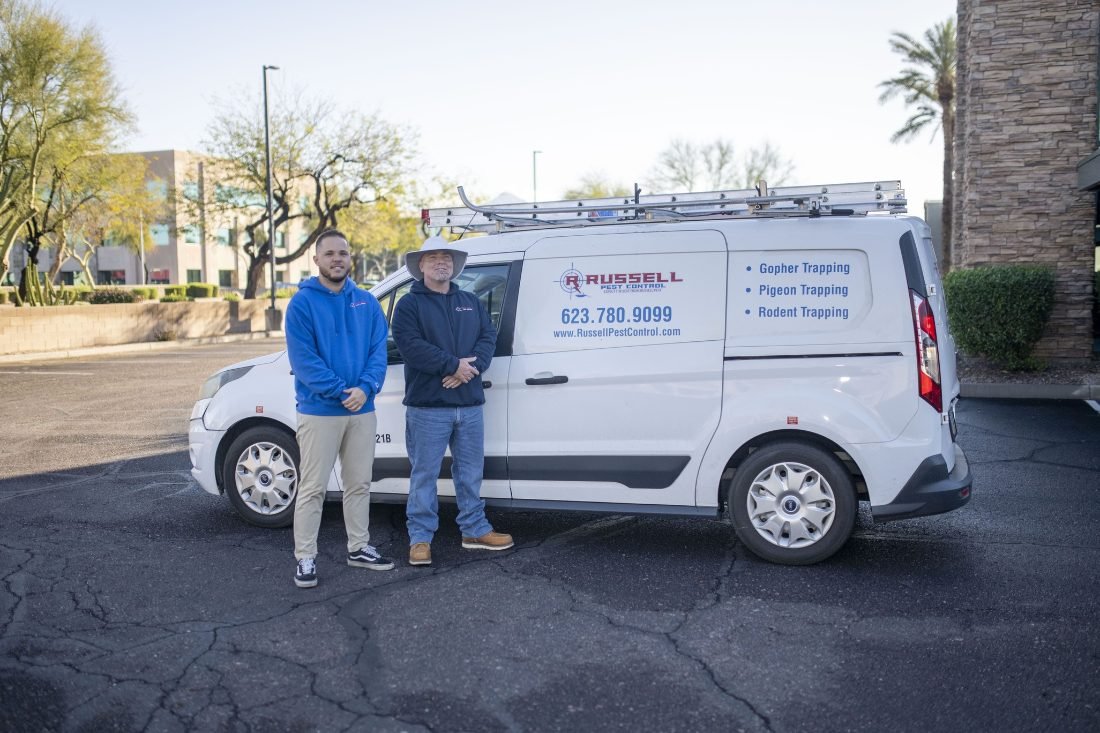
Thirty years of Arizona desert work, with a second generation on the routes. One call gets Steve, Steven Jr., or the office. Never a call center.
We'll point you at a free city number when the bees aren't on your property, because half of Mesa's published bee ladder is somebody else's bill.
No contracts and no initial fees on residential service, and a 15-day re-treat warranty if something comes back inside the window.
Arizona OPM License #I5321B, and a family company that's been answering its own phone in the Valley since 1996.
The Rest of the Mesa Playbook
Everything else we run in Mesa, in one place:
Scorpion Control and the Black Light Search
Rodent Control and Exclusion
All Mesa services: /mesa
Find Your Row on Mesa's List
If anyone is being stung, that's 9-1-1 and stop reading. Otherwise, take a picture from a safe distance and send it with your cross streets. We'll tell you which line of Mesa's list you're on, and whether the next call is ours or the city's.
Expect the best from Russell Pest, and have a bug-free day.
Hours
- Monday–Friday: 8:00 AM – 5:00 PM
- Same-day & emergency service available — after hours and weekends, owner-answered
(623) 780-9099 · Call or text · 6750 N 7th Ave, Phoenix, AZ 85013