
Scorpion Control in Glendale, AZ — Built for the Wall Behind the Wall
If your Glendale home sits within about thirteen hundred feet of the Loop 101, the barrier at the back of your lot was very likely built to hit a decibel number rather than to please anybody's eye. Glendale's development code requires it, sets the target, and requires an engineer or architect to certify the result. What that produces is a taller, denser, bermed and heavily planted structure running unbroken behind every property on the block, and it changes what a scorpion program on your address can actually accomplish.
A Barrier Designed Not to Have Gaps
The band is thirteen hundred feet deep, and it's written down
Glendale's Unified Development Code applies a set of freeway development standards to all residential development within 1,320 feet of the Agua Fria right-of-way boundary, measured from the freeway line, and the code says it covers single residences, multi-residences, and mobile home residences alike. The useful part for a homeowner is that this is a mappable line. Your address is either inside the band or it's not, and we can tell before we quote.
What the code actually requires to be built
The standard is a performance one. The sound attenuation plan must ensure that projected exterior noise on the property won't exceed 62 dBA and must be certified by an acoustical engineer or a registered architect. Then the code says how: attenuation improvements shall include all measures necessary to meet the standard, including freeway noise walls and earthen berms. Where that standard drove the design, what ends up behind a fence is heavier than a builder's theme wall and often has compacted soil bearing against it, which puts the harborage down at the soil-to-wall joint rather than up at a weep hole. We check rather than assume, because the band tells us what to expect and not what's there.
And the code requires planting on top of it
There is one more clause that matters more than it sounds. The landscape plan for any site subject to these standards must include additional landscape treatments to minimize the visual impact of the walls or berms. Note what that clause does and does not say. It requires the wall or the berm to be screened; it does not say to plant on top of a berm. But screening a long masonry run means landscape treatment along it, and landscape treatment in Glendale means irrigation. Planting, moist soil, and a masonry mass in a continuous line is our reading of what that produces, not the code's, and it is the combination that grows the crickets a bark scorpion follows.
Why that makes lot-by-lot work the wrong shape
A wall built to an acoustic model has few openings by design because openings leak sound. Long unbroken runs are what make it a corridor. The barrier doesn't stop at your side fence, and neither does what lives in it, so a perimeter treated to your property line is a treated segment in an untreated run. It still helps, and we still do it. But on a Glendale attenuation-band lot we say plainly at the estimate that the yard is the holding action and the building is the fix.
Year Three on a Freeway-Band Street
The pattern we hear most on these streets is a household that saw nothing for the first couple of years and now sees them indoors often enough to be counting. Nothing has changed about the house. What changed is that the planting the code required has matured, the irrigation has been running long enough to build a soil profile, and the insects living in that slope have reached the numbers that support a predator. The barrier did what it was designed to do for noise, and it did something nobody designed for on the pest side.
The version of this we like least is the one where somebody has already spent two seasons on quarterly yard treatment and is being told to spend a third. On a lot backing that band, the honest answer is that the yard is refilled from a source nobody on your street controls. The work that holds is at the building.
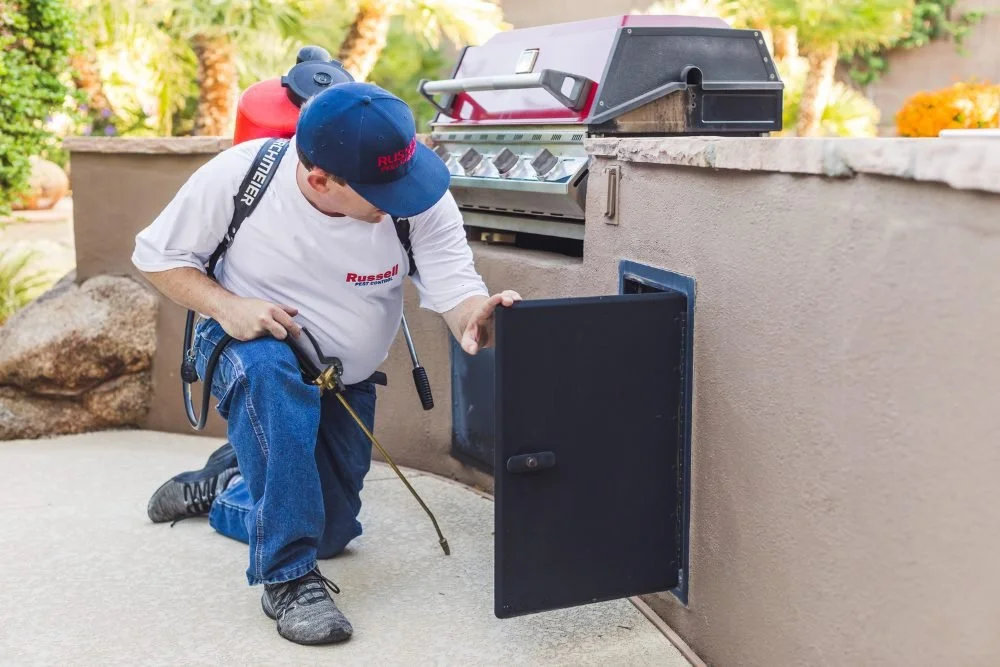
Eight Things We Do on a Band Property
Find out which side of the line you're on
Inside the band, the pressure is structural and continuous, and the quote says so. Outside it we quote an ordinary desert-perimeter program. Nobody gets sold the band package because the freeway is visible from their street.
Look at what's actually behind your wall
The code tells us what to expect, not what's there. Some stretches are masonry with a berm bearing against them, some are a builder's theme wall predating the standard. We walk it and tell you which you have.
Work the soil-to-wall joint
Where a berm bears against a wall, there's a seam at the bottom of it, usually buried under mature planting. That seam is the productive line, and it's the one most technicians never get to, because reaching it means going through the shrubs and not past them.
Work to the band, not to the parcel
The barrier and the planting on it were built to a decibel target, and they run the length of the corridor, so the thing that matters is where your address sits relative to the band rather than where your fence sits. We work the stretch of it that touches you, on the side we are allowed to be on.
Take down the food supply on your side
Crickets are what a bark scorpion is following, and the ones that matter are the ones that have crossed onto your ground. Granule work at the transition does more here than anything applied at the wall face. Gloves and closed shoes, and never reach into a pile you can't see into. The same harborage holds bark scorpions, and near open ground it holds snakes. If something has sat undisturbed for months, don't move it by hand. For a snake, that's a call to a licensed wildlife removal service or to Arizona Game and Fish; a bite is a 911 call. For anything else, leave it for us.
Aim the lights down and inward
Fixture aim, color temperature, and timer settings decide how much sits between the slope and your patio door after dark. The one we see most often is a bright fixture pointed outward at the barrier, which is a feeding station with a light on it.
Count the openings, then say what's worth repeating
The perimeter has to be redone. The building doesn't. That's the whole argument for putting the money into the envelope, and it needs a count first, which is what the survey is for. A bark scorpion gets through a gap around a sixteenth of an inch. Sweeps, thresholds, weep screed, slab joints, and utility penetrations are where a house actually leaks. When the list runs long, the work moves to a scoped Home Seal, with its own price and warranty.
Tell you what we're not reaching
The run of barrier next door isn't ours, and neither is the slope. We'll say where our work stops. On these blocks, a program that pretends otherwise is one you'll be disappointed in by August.
What Glendale Owners Call Us About
The calls that come off freeway-band streets
- One indoors at night, usually in a bathroom, a laundry or a hallway on the barrier side of the house
- A count that climbed over two or three summers with nothing about the house having changed
- Sightings concentrated along the single wall that faces the berm
- Activity that arrives after the HOA or the maintenance contractor has cut back the slope planting
- One household treating and the household next door not, on a run of wall they share
The openings every desert house has
- The stem wall and weep screed line, where the stucco meets the ground
- Garage thresholds and the gap under a roll-up door
- Irrigation and valve boxes, hose bib penetrations, and pool equipment pads
- Block wall voids, weep holes, and gate posts along the property line
What a berm lot adds
- The soil-to-wall joint at the base of the berm, usually hidden under mature planting
- Irrigation running on the slope, which keeps a moisture line against the structure year-round
- Retaining or transition walls where the engineered grade steps down to your flat yard
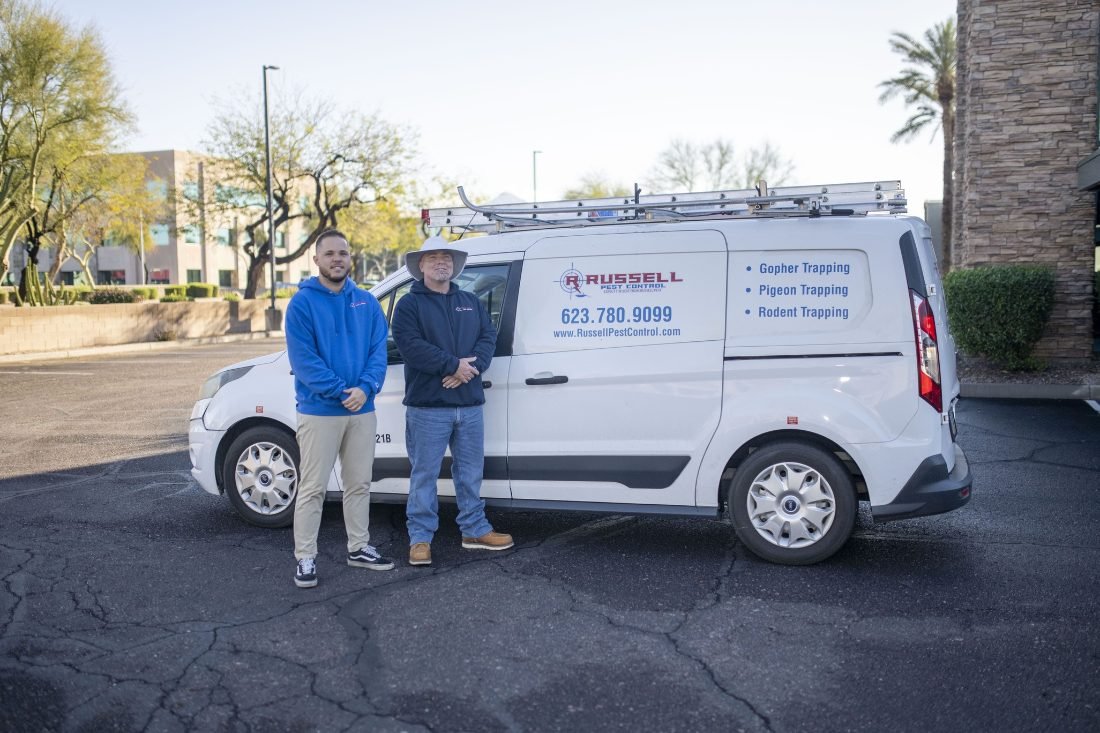
Why Freeway-Band Households Stay With Us
Thirty years of Arizona desert work, with a second generation on the routes. One call gets Steve, Steven Jr., or the office. Never a call center.
We'll tell you whether your address is inside the attenuation band before we quote, because it changes what we can honestly promise the yard work will do.
No contracts and no initial fees on residential service, and a 15-day re-treat warranty if something comes back inside the window.
Sealing is quoted as its own job with its own one to two year warranty, and on a band lot it's the part of the work that holds while the perimeter is being redone.
Arizona OPM License #I5321B, and a family company that's been answering its own phone in the Valley since 1996.
What Scorpion Service Costs in Glendale
Lot size, how much barrier frontage you carry, structure count, and the state of the slope planting are what move the number. We price it after we've walked it
The standing Russell terms apply here: no initial fees, no contracts, and a 15-day re-treat warranty
Black Light Scorpion Search: $125 per hour, after dark. We'll tell you what we expect your property to take before we start
Home Seal is quoted as its own job, typically $600 to $2,500 with a one to two year warranty depending on the work
Estimates are free. Attic and hive searches can carry a charge, waived if you hire us
What Else We Run in Glendale
Black Light Scorpion Search
After-dark ultraviolet mapping of what's on the surface and the routes it travels, billed at $125 per hour.
Home Seal and Scorpion Sealing
Structural exclusion to the 1/16-inch standard: sweeps, thresholds, weep screed, slab joints, and penetrations.
Rodent Control and Exclusion
Roof rats and packrats removed before anything gets sealed, then screened out at the roofline.
General Pest, Bee and Weed
Plans from monthly to quarterly, live bee relocation where a beekeeper can take the colony, and pre-emergent timed to both desert weed seasons.
All Glendale services: /glendale
What Freeway-Band Owners Ask Us
How do I know if I am inside the band?
The code measures from the Agua Fria right-of-way boundary, not from the traffic lanes. If you're close to the line, Glendale Planning can settle it, and that's the right place to ask. For our purposes, an approximate answer is usually enough, because the wall either runs behind your block or it does not.
Can we cut the planting back on the berm?
Usually not unilaterally, and that's a question for whoever owns and maintains the slope, which may be your HOA, the City, or the state. What we can tell you is that the code required the wall or berm to be screened, so a plan that depends on stripping the screening isn't a plan. We build around it instead.
My neighbor treats, and I do not. Does that help me?
A little, and less than you would hope. Their work stops at the fence and so does yours, and what lives in the barrier does not. What a neighbor's treatment buys you is a slightly longer gap before the next one crosses. That's worth having, and it isn't a plan.
Is a black-light search worth it here?
It's one of the better places to run one, because the population has a predictable geometry and the search shows you whether the activity is coming off the barrier line or from somewhere on your own lot that you would never have suspected. Scorpions fluoresce under ultraviolet light, so an after-dark pass maps what's on the surface that night and the routes it travels. It runs at $125 per hour.
Are stings here dangerous?
The Arizona bark scorpion is the only scorpion in the country considered medically significant. Reactions vary, and it isn't ours to assess. We're a pest company, not a clinic, so if someone is stung, the number you want is Poison Help at 1-800-222-1222, which routes to your county's poison center. For a young child or anyone having trouble breathing or swallowing, call 911. Keeping them outside is the part we own.
We're buying on one of these streets. What should we ask?
Ask how old the slope planting is, whether the previous owners ran a program, and whether anything has been sealed. Then walk it after dark with a UV light before you sign. A house in year one of that band is a different property in year eight.
Can you do same-day service in Glendale?
Often, yes. Call or text before noon, and same-day is realistic more often than not, and an indoor sighting is the kind of call we try hardest to fit in. After hours, the phone reaches Steve's cell for triage.
Do you treat termites in Glendale?
No, and we're straight about it. We'll identify termite signs honestly and refer you to a licensed termite specialist, then handle everything else on the property. Straight lanes, straight answers.
Inside the Band, or Outside It
Start with the question the code already answers: is your address inside the band or outside it? Inside, the pressure behind you is permanent, and the sensible money goes into the envelope. Outside, this is an ordinary Glendale yard, and we'll price it as one. Either way, we'd rather walk it than guess at it from a map.
Expect the best from Russell Pest, and have a bug-free day.
Hours
- Monday–Friday: 8:00 AM – 5:00 PM
- Same-day & emergency service available — after hours and weekends, owner-answered
(623) 780-9099 · Call or text · 6750 N 7th Ave, Phoenix, AZ 85013