
Rodent Control in Glendale, AZ — When the Food Source Isn't Yours to Fix
Most rodent advice starts with your bins. In Glendale, that advice meets a split nobody explains at the curb. The container is the City's property and the City replaces it, but the code says the City maintains it in good condition EXCEPT FOR CLEANING, and puts the cleaning squarely on you. Meanwhile, one part of the code says containers stay at the edge of the alley, and another says they come back to private property after collection. On an alley block, the first one is what you see. So the biggest food and moisture source on the block sits on shared ground, belongs to somebody else, and is yours to keep clean.
The Six Steps on an Alley-Served Property
Read the rear boundary before anything else
The first thing we want to know is what sits on the other side of your back wall and how it's serviced. A block with mechanized alley collection behaves differently from one whose containers are moved to the street frontage, and Glendale has both. That fact changes where the pressure comes from and what we should not waste your money on.
Identify what you actually have
Roof rats and packrats want different programs, and the wrong identification wastes a season. Roof rats travel high, along fence tops, canopy, and rooflines. Packrats build at ground level in stored material, engine bays, and pool equipment, and a midden is the tell. We work it out from the evidence on your property.
Trap and remove before anything gets closed
Sealing an animal inside a wall is how a rodent problem becomes a smell problem. Removal comes first, and closure follows. That's the order we work in, and we won't shortcut it to finish in one visit.
Close the building, and say which standard applies where
Then the openings, worked from the roofline down: vent screens, tile-line entries, gable and soffit gaps, utility penetrations, garage thresholds, and the gap under a roll-up door. Rodent exclusion works to a wider threshold than scorpion sealing does, and a scope should tell you which one applies on which part of the house. If somebody quotes you sealing without naming a gap size, ask.
Handle the harborage that's legally yours
Stored material, woodpiles, dense planting against the wall, anything undisturbed long enough to become a home. This is the part you control, and it decides whether the rear pressure has anywhere to land once it crosses. Gloves and closed shoes, and never reach into a pile you can't see into. The same harborage holds bark scorpions, and near open ground it holds snakes. If something has sat undisturbed for months, don't move it by hand. For a snake, that's a call to a licensed wildlife removal service or Arizona Game and Fish, and a bite is a 911 call. For anything else, leave it for us.
Tell you which half of the container problem is yours
If the container behind your property is split or lidless, that is the City's to replace, and a service request is the remedy. If it is filthy, the code makes that yours, and the City can charge your account if it ends up doing the job. We write down which of the two we found, because they are two different phone calls and most households make the wrong one.

What the Program Actually Does
Rodent work is removal plus exclusion, in that order, with the harborage and the food supply handled alongside. Sealing reduces how much gets in, which is what makes a treatment program hold. It doesn't replace treatment, and a quote implying otherwise is selling you something. Where a property needs both, we price them separately so you can see what you're buying.
One safety note before anyone clears anything. Maricopa County publishes the protocol for rodent droppings, and it matters. Rubber gloves on. Ventilate the area the night before you clean by opening doors and windows, and don't shortcut that step to the few minutes before you start. Never sweep or vacuum droppings dry. Spray the droppings, nests, and the area around them with a 10% bleach solution (1 part bleach to 9 parts water), and allow at least 15 minutes of contact time before removing anything. Wipe up with paper towels or a mop, double-bag it, and wash your gloved hands in disinfectant before the gloves come off, then wash your hands with soap and water once they are off. The county sets the onset window for illness at 1 to 5 weeks. If a flu-like illness shows up in the weeks after a clean-up, the standing public-health advice is to see a physician promptly, to mention the rodent exposure, and to treat difficulty breathing as urgent, because early diagnosis is what changes the outcome.
A Waste System You Are Not Allowed to Change
One lawful hauler, by ordinance
Glendale's code says residential properties shall use only the City's curbside solid waste services for the collection and disposal of garbage, trash, refuse, or other solid waste, and shall not use any third-party commercial solid waste service. There is a narrow exception for special arrangements made with the City by formal agreement, and the code separately preserves your right to haul your own load. What it does not leave you is a competing vendor to switch to when the service is not working. The escalation path is the City, and it is effectively the only one.
The City owns the container, and you clean it
The same chapter says containers the City provides remain City property and that the City will replace one damaged beyond use, lost or stolen, and that the City maintains them in good condition EXCEPT FOR CLEANING. Cleaning is the customer's responsibility: the code says the customer shall be responsible for maintaining the container in a safe and clean manner, allows the Administrator to order it done, and allows the City to place a fee on your account if it has to do it because you did not. Most households have this the wrong way round, and a fouled shared bin is a genuine rodent attractant sitting a few feet from the house.
The container doesn't go away between collections
The code says, flatly, that containers shall remain at the edge of the alley at locations designated by the Administrator, who the code defines as the city manager or a delegate. Another section in the same division states that containers are to remain on private property except on collection day. The two sit together unresolved, and on an alley block the practical answer is the first one. A bin that comes out on collection day is an event. A container standing at the alley edge is infrastructure. Exclusion on these blocks has to assume continuous rear pressure rather than a weekly spike, which changes the order in which we work the building.
And the piles are lawful for longer than you would guess
Glendale's bulk trash rule says an owner or occupant shall not place bulk trash out earlier than the Thursday of the week preceding the scheduled pick-up week. A code-compliant brush and furniture pile can therefore stand lawfully for more than a week before anything collects it. Add the on-route monthly loose trash collection the City includes in base service, and a Glendale block runs a recurring, dated cycle of material sitting out. None of that's anyone breaking a rule. It's the rhythm the program has to be timed against.
Why the alley is the shape it is
The City runs an Alley Access Control Program, and its own account of why the program exists names dumped material, interference with collection operations, and the difficulty of enforcement in a corridor with little traffic passing through it. That describes a low-traffic strip with accumulated material, running the length of the block on the far side of a wall you don't own. To a rodent, that's a corridor with food in it, and it's why the back of the house gets the attention here.
What Alley-Served Households Ask Us
Our alley bin is filthy. Whose job is that?
Yours, and this catches people out. The container is the City's property, and the City replaces a broken one, but the code says its maintenance duty stops short of cleaning and makes the customer responsible for keeping it clean. The City can order it done and bill your account if it does the job instead. Photograph a container that is split or lidless, and log a service request for it; a dirty one is a bucket of soapy water and a rodent attractant that you can remove yourself in 10 minutes.
Can we switch to a private hauler with a better container?
Not for residential service in Glendale. The code says residential properties shall only use the City's curbside services and shall not use a third-party commercial service. Anyone selling you a private residential bin should be able to explain how that squares with the ordinance.
Does my neighbor's pile behind the alley count as a violation?
Possibly not. The bulk trash window is wider than people assume, so a pile that looks wrong to you may be sitting inside it. If you think it's not, Glendale Code Compliance is who decides that, and it's worth knowing before a conversation over the fence goes badly.
Do I have roof rats or packrats?
Different animals, different programs. Roof rats travel high and leave droppings along beams, fence tops, and in the attic. Packrats build a midden at ground level against stored material or pool equipment. Send a photograph of what you found, and we can usually tell you before we arrive.
Something is nesting in the engine bay. Is that a rodent job?
Yes, and it's a common one on properties with stored vehicles or trailers. Rodent damage in an engine bay is usually wiring, and it often isn't obvious until something stops working.
Can you just seal it and skip the trapping?
No. Closing the building with animals still inside produces a smell you'll call us back about, so removal comes first, and closure follows. It means more than one visit, and we note that in the estimate.
Is exclusion the same standard as scorpion sealing?
No, and a scope should tell you which standard applies where. Rodent work uses a wider threshold than the sixteenth of an inch that scorpion sealing is built to. If somebody quotes you sealing without naming a gap size, ask.
We're on a street-collection block, not an alley. Does any of this apply?
Some of it. The single-hauler rule and the bulk trash timing apply citywide. The permanently stationed alley container does not, so pressure is more likely to come from the front and from the neighbors' cycle than from a corridor behind you. The program shifts accordingly, and is usually lighter.
How long does it take?
Removal is usually a few weeks of active work depending on the population, and the exclusion is a defined job with an end date. We won't quote a number of visits before seeing the property, because that number is set by how many openings the building has.
Do you use bait boxes?
Where they're the right tool and placed where they belong, yes. On a property with children, dogs, or livestock, we talk through placement first, and there are trapping-led programs where that's the better answer. Ask the technician on the day.
Can you do same-day service in Glendale?
Often, yes. Call or text before noon, and same-day is realistic more often than not, and an indoor sighting is the kind of call we try hardest to fit in. After hours, the phone reaches Steve's cell for triage.
Do you treat termites in Glendale?
No, and we're straight about it. We'll identify termite signs honestly and refer you to a licensed termite specialist, then handle everything else on the property. Straight lanes, straight answers.
What Glendale Households Call Us About
The calls that come off alley-served blocks
- Scratching overhead at night, usually starting on the alley side of the roof
- Droppings along a beam, a fence top or the top of a block wall
- A midden built against pool equipment, a stored trailer or a woodpile
- Chewed irrigation line, or wiring damage in a vehicle that has been sitting
- Activity that starts within a few days of a bulk trash cycle on the block
Where they get in
- Roof and tile-line entries, gable vents and soffit gaps
- Garage thresholds and the gap under a roll-up door
- Utility and plumbing penetrations through the exterior wall
- Block wall voids and gate posts along the rear boundary
What Else We Run in Glendale
Rodent Exclusion
The closure is half the job, quoted separately: roofline, vents, penetrations, and thresholds.
Scorpion Control and Black Light Search
Programs for the Loop 101 attenuation band and the rest of the city, with after-dark UV mapping at $125 per hour.
General Pest Control Plans
Monthly, bi-monthly or quarterly, with no contracts and a 15-day re-treat warranty.
Mosquito, Bee and Weed
Station-based mosquito work, live bee relocation where a beekeeper can take the colony, and pre-emergent timed to both desert weed seasons.
All Glendale services: /glendale
What Rodent Service Costs in Glendale
Population size, how many openings the building has, roof type, and whether there are outbuildings are what move the number. Removal and exclusion are quoted separately so you can see what you're paying for
The standing Russell terms apply here: no initial fees, no contracts, and a 15-day re-treat warranty
Black Light Scorpion Search: $125 per hour, after dark. We'll tell you what we expect your property to take before we start
Home Seal is quoted as its own job, typically $600 to $2,500 with a one to two year warranty depending on the work
Estimates are free. Attic and hive searches can carry a charge, waived if you hire us
Why Glendale Households Stay With Us
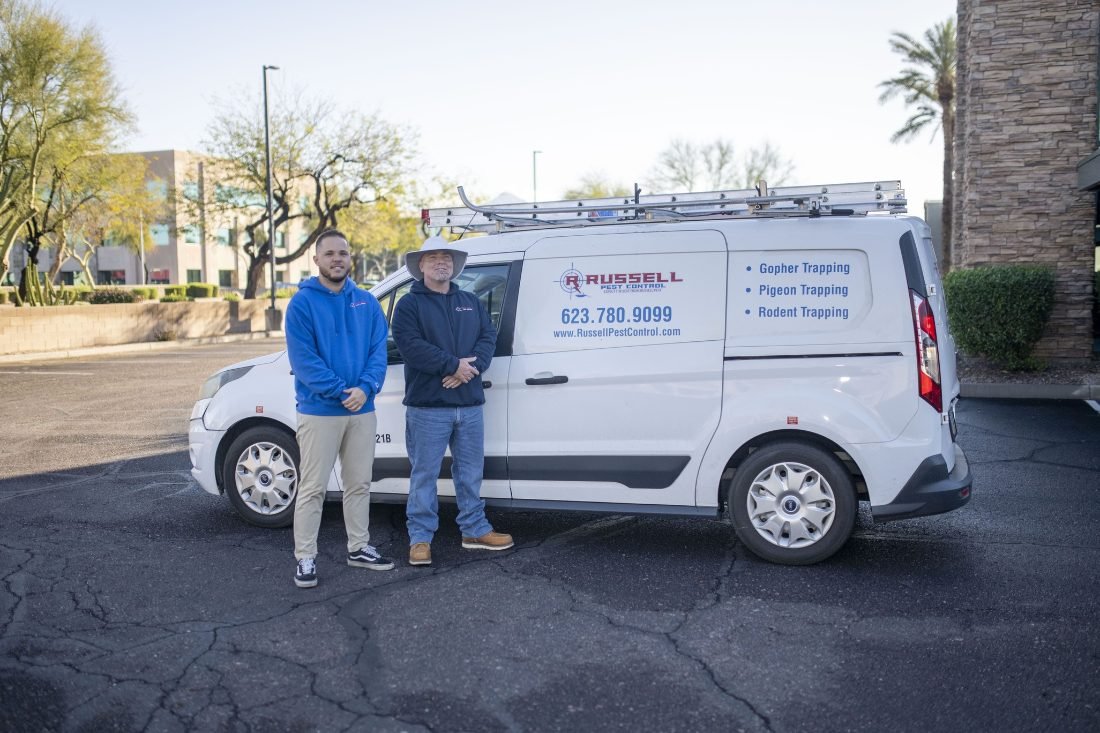
Thirty years of Arizona desert work, with a second generation on the routes. One call gets Steve, Steven Jr., or the office. Never a call center.
We separate what the City owes you from what the code puts on you, because on a Glendale alley block those are two different lists and most quotes never mention either.
Removal comes before closure, every time. Sealing a rodent inside a wall is the mistake that turns one problem into two, and we won't do it to finish a day early.
Start With the Building
On an alley-served Glendale block, the food source behind your wall isn't going anywhere, and no amount of yard work changes that. What you can change is how many entry points there are to the building, and that's a countable number we can put in front of you after an hour on the property.
Expect the best from Russell Pest, and have a bug-free day.
Hours
- Monday–Friday: 8:00 AM – 5:00 PM
- Same-day & emergency service available — after hours and weekends, owner-answered
(623) 780-9099 · Call or text · 6750 N 7th Ave, Phoenix, AZ 85013