
Home Seal in Glendale, AZ — Start With the Paperwork, Then the Gap
Two places on a Glendale house leak more than the rest: the joint where an addition meets the original building, and the line where the wall meets the ground. Glendale's building code has something to say about both. It requires a new addition's foundation to be tied into the existing footing, and it sets a minimum footing depth deeper than the model code does. Those requirements run forward, which means most Glendale additions were built before them, and how yours was built is exactly what nobody should assume. So we ask what's on file, and where nothing is, we survey the seam as unverified and record it that way.
The Two Seams the Code Already Describes
Glendale writes the addition seam into the code
Glendale writes a clause of its own on additions: the new foundation has to be tied to the existing one with dowel bars set into the old footing, at a stated size, length, and embedment. The town has carried that requirement through more than one code cycle, and it was already in force years before the current codes took effect. So it doesn't describe the addition on your house unless the work is recent, and that's exactly the point. It gives us a line to measure against. A joint built to that clause behaves one way. One built to an older standard, or without a permit, behaves another.
So the survey starts as a records question
Whether the footings were tied tells you where a seam will have opened. A doweled joint tends to hold at the footing and fail in the stucco above it, which is a surface repair. An untied one can separate at the slab edge, which is a different opening and a different price. Knowing which we're looking at before we get on our knees is worth the ten minutes it takes to ask.
The ground line sits deeper here than the model code assumes
Glendale's code also raises the minimum footing depth above the model figure and requires a soils report for new buildings, and has done for several code cycles. Again, it applies to what was built under it, not to what came before. What it tells a survey is that Glendale expects movement in its ground, and that on newer construction there may be a soils report to read when a slab edge has separated. On older stock there won't be, and we survey accordingly.
What that adds up to on a quote
It means a Glendale sealing scope is worth building in two passes: what the records say the building should be, then what the survey finds it is. Those two rarely match perfectly, and the gap between them is usually where the openings are. On an older house, the records may say very little, and that is its own finding rather than a dead end: where nothing was required to be tied, nothing was, and the seam sits where you would expect it. Where the building is the problem, sealing gets scoped and priced as its own job, separate from a service visit, so you can see exactly what it covers.
What a Glendale Survey Actually Counts
The openings every desert house has
- The stem wall and weep screed line, where the stucco meets the ground
- Garage thresholds and the gap under a roll-up door
- Irrigation and valve boxes, hose bib penetrations, and pool equipment pads
- Block wall voids, weep holes, and gate posts along the property line
What older and altered Glendale stock adds
- The addition-to-original seam, at the wall, at the roofline and along the slab edge
- Enclosed patios and converted garages, where an exterior wall became an interior one
- Re-stuccoed elevations where the weep screed was covered over instead of kept clear
- Original thresholds and door hardware that have been painted over more than once
- Utility penetrations added at different times by different trades
What we don't close
Vents, weep screed terminations and weep holes have a job to do. That principle runs through the whole job: an opening with a function keeps it and gets screened or detailed, and an opening with no remaining purpose gets closed properly.
The Five Steps of a Glendale Home Seal
Ask what's on file
Permits, plans, a soils report if one exists, and anything you have from an addition or a conversion. Plenty of owners have none of it, and that's fine. Where it exists, it shortens the survey and sharpens the scope.
Walk the envelope and count
Every opening gets found, measured and written down, working the ground line first and the roofline second. The walk and the written list are free either way, whoever ends up doing the work.
Read the seams as their own category
Addition joints, patio enclosures, and garage conversions get surveyed as their own category. They fail differently from the original envelope, and they're usually where the count concentrates.
Set the standard before the price
We seal to a sixteenth of an inch, because that's the gap a bark scorpion gets through. Rodent work uses a wider threshold and bee work is different again, so a scope should tell you which standard applies where. If somebody quotes you sealing without naming a gap size, ask.
Hand over the list and the terms
You get the finished list, what was closed, what was screened, what was left and why. One clarification on the badge above and the terms below: the 15-day re-treat warranty covers treatment service. Home Seal carries its own one to two year warranty, and the two are separate things.
Why Glendale Owners Have Us Do the Sealing
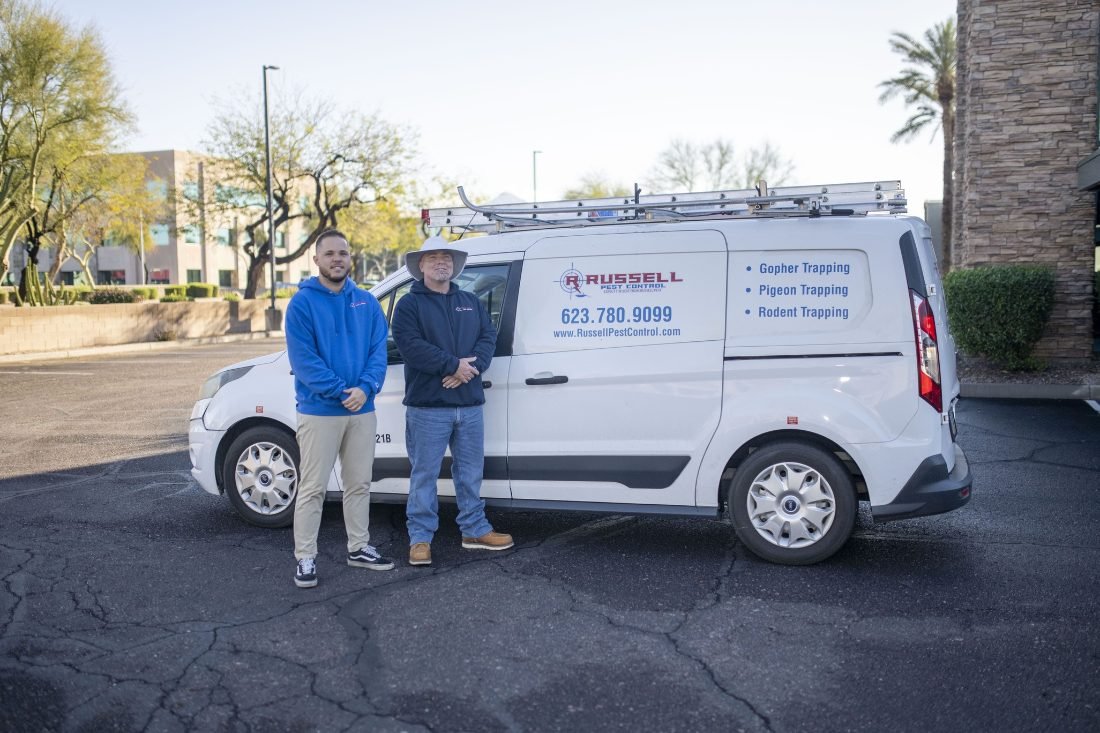
Thirty years of Arizona desert work, with a second generation on the routes. One call gets Steve, Steven Jr., or the office. Never a call center.
We ask for the records before we quote, because on a house with an addition the seam is where the count concentrates, and whether anyone can tell us how it was built changes the scope.
Arizona OPM License #I5321B, and a family company that's been answering its own phone in the Valley since 1996.
What Else We Run in Glendale
Scorpion Sealing
The same exclusion work scoped specifically against the bark scorpion gap.
Scorpion Control and Black Light Search
Programs for the Loop 101 attenuation band and the rest of the city, with after-dark UV mapping at $125 per hour.
Rodent Exclusion
The roofline half of the job, worked to the rodent standard.
General Pest and Mosquito
Plans from monthly to quarterly, and station-based mosquito work where the water is permanent.
Bee and Weed
Live bee relocation where a beekeeper can take the colony, and pre-emergent timed to both desert weed seasons.
All Glendale services: /glendale
What a Home Seal Costs in Glendale
The opening count is what sets the price, and additions, conversions and enclosed patios are what move the count. We survey before we quote, and the survey is free
The standing Russell terms apply here: no initial fees, no contracts, and a 15-day re-treat warranty
Black Light Scorpion Search: $125 per hour, after dark. We'll tell you what we expect your property to take before we start
Home Seal is quoted as its own job, typically $600 to $2,500 with a one to two year warranty depending on the work
Estimates are free. Attic and hive searches can carry a charge, waived if you hire us
What Glendale Owners Ask Us
We've an addition. Does that change the number?
Usually it raises it, and for a reason worth understanding. Two structures that settled on different schedules pull apart at the joint, so the seam is often where the count concentrates. It also means the work there tends to be the highest-value part of the job.
We don't have any paperwork for the addition. Is that a problem?
Not for us. It means we survey the seam as unverified and record it that way on the list, rather than assuming it was built to a standard we can't confirm. If you want to check, the City's records counter is where to go, not us.
Does sealing replace the treatment program?
Sealing reduces how much gets in, which is what makes a treatment program hold. It doesn't replace treatment, and a quote implying otherwise is selling you something. Where a property needs both, we price them separately so you can see what you're buying.
Can you do same-day service in Glendale?
Often, yes. Call or text before noon, and same-day is realistic more often than not, and an indoor sighting is the kind of call we try hardest to fit in. After hours, the phone reaches Steve's cell for triage.
Do you treat termites in Glendale?
No, and we're straight about it. We'll identify termite signs honestly and refer you to a licensed termite specialist, then handle everything else on the property. Straight lanes, straight answers.
Will sealing trap scorpions inside the house?
It's the most common worry we hear, and no: sealing is paired with treatment, and anything already inside is handled by the program, while the sealing stops the resupply. What you're closing is the route in, not the route out of your living room.
What wears a seal out over the years?
Sun, settling, and hardware: door sweeps wear thin, caulk lines open as the house moves, and repainting crews pull screens they don't put back. That's why the work carries a one-to-two-year warranty and why we recheck the pressure points instead of assuming the first pass holds forever.
Can you seal just one problem room?
We'll do it honestly, but we'll also tell you what partial sealing can and can't achieve: the room gets quieter, the house doesn't, because the routes run through the structure. The walk-through prices both options so you can choose with the full picture.
Get the Count Before You Get a Price
The records question is the one worth settling before anybody quotes: what was added, when, and whether a permit went with it. On a property with an addition or a converted garage, the openings cluster at the seams rather than spreading evenly, and a seam nobody can date is a seam we survey as unverified. The list is yours either way.
Expect the best from Russell Pest, and have a bug-free day.
Hours
- Monday–Friday: 8:00 AM – 5:00 PM
- Same-day & emergency service available — after hours and weekends, owner-answered
(623) 780-9099 · Call or text · 6750 N 7th Ave, Phoenix, AZ 85013