
Bee Removal in Glendale, AZ — First Question: Whose Bees Are These?
Glendale is unusual in that it files beekeeping inside its nuisance code and attaches a person to it. Keeping bees in the city requires certification through the City, and the code says the property is inspected before that certification is issued and the abutting property owners are notified afterward. So in Glendale, a colony can have a documented responsible person, and whether yours does changes who can authorize what happens next. That's the first thing we establish, and it takes a phone call.
The Three Steps on a Glendale Bee Call
Make the area safe, then leave it alone
People and pets come inside and stay inside, and the area stays clear until we arrive. Nothing about identification or attribution matters more than that, and none of it is worth standing outside for. If bees are attacking, the safety copy below is the part of this page to read first.
Establish what it is, and whose it is
Two questions, in that order. A cluster hanging on a branch or a fence for a day is a swarm in transit and it often moves on by itself, though not if it is over a doorway, a gate people have to use, a play area, or anywhere near somebody with a sting allergy or an animal that cannot be brought inside, in which case do not wait it out; bees going in and out of a fixed opening in a wall, a roof, a valve box or a shed are a resident colony with comb behind them. Then the Glendale-specific question: does anyone nearby keep bees? Because the City certifies keepers and notifies the abutting owners, a neighbor may hold written notice of an apiary and not have connected it to your problem. A managed hive belongs to someone with associated duties, and the code says it's unlawful to keep bees in a way that poses a hazard to public health, safety, and welfare. A feral colony in your wall is ours. Which of those you have decides who authorizes what happens next, and it costs a phone call to find out.
Remove, relocate where possible, and close the opening
Where a colony is accessible, healthy, and a beekeeper will take it, relocation is the better outcome, and we arrange it. It isn't always possible, and the estimate says which one you are getting rather than promising the better one and failing. Either way the cavity gets cleared, and the entry closed, because comb and honey left in a void draw the next swarm to the same opening and attract everything else that eats sugar.
The City Files Beekeeping Under Nuisances
Certification, not registration
The distinction matters, so here it is, plainly. What Glendale does is different and local: its code requires the person keeping bees in the city to be certified through the City, after an application, a demonstration, and an inspection of the property. That's a municipal certification of a keeper, and it exists only inside Glendale.
And the neighbors are told
The code goes a step further. Once a person is certified to keep bees on a lot in the city, the City notifies the owners of abutting properties of that certification. Which means that on a Glendale block, information about a nearby apiary may already be sitting in somebody's drawer. That notice is easy to file and forget, and a year later it may not register in anybody's mind as the problem with the wall.
Why any of this changes the job
Because attribution decides authorization. If the colony is in your wall, it's yours, and we get on with it. If foragers are working your yard from a hive next door, removing anything from your property solves nothing, and the conversation is with your neighbor or the City. And if a kept colony nearby is behaving badly, Glendale's code addresses hazardous keeping and Code Compliance is where that gets raised. We can't tell you how it will resolve or who ends up paying, and we wouldn't guess.
What Glendale Households Call Us About
The calls
- A ball of bees on a branch, a fence or a vehicle that appeared this morning
- Steady traffic in and out of one hole in a block wall, a roof tile line or a valve box
- Bees in an irrigation box or a water meter cover, found by whoever opened it
- A shed, a barbecue island or a pool equipment enclosure that has been quietly occupied
- Defensive behavior when a mower, blower or saw runs anywhere near the wall
Safety, before anything else
Bees actively attacking somebody is 9-1-1, and none of the rest of this page matters. Cover your head and face with clothing or your hands, get inside a building or a vehicle and shut the door, and if there's no shelter, run at least 240 yards, which the University of Arizona describes as two football fields, and keep going until you're inside. Don't swat, and don't jump into a pool: the same source says the bees will wait longer than you can hold your breath.
After the attack, scrape stingers out sideways and avoid pinching them. Call 9-1-1 for anyone stung many times, or for trouble breathing, swelling of the face or throat, or dizziness. Anyone with a known bee allergy uses their epinephrine and calls 9-1-1, and follows the plan their doctor gave them. We're a pest company, so the medical half stops there.
What Bee Work Costs in Glendale
A swarm on a branch and a colony inside a wall are different jobs at different prices. Access, height, how much has to be opened, and whether the cavity needs clearing are what move the number
The standing Russell terms apply here: no initial fees, no contracts, and a 15-day re-treat warranty
Black Light Scorpion Search: $125 per hour, after dark. We'll tell you what we expect your property to take before we start
Home Seal is quoted as its own job, typically $600 to $2,500 with a one to two year warranty, depending on the work
Estimates are free. Attic and hive searches can carry a charge, waived if you hire us
Why Glendale Households Call Us
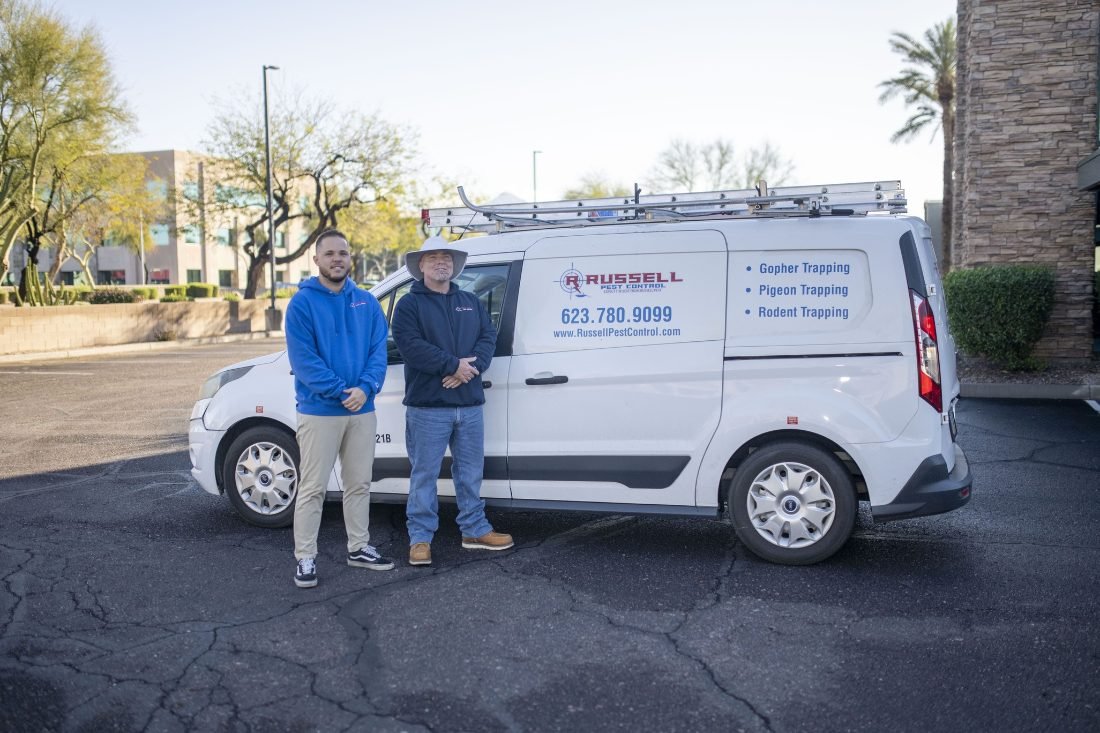
Thirty years of Arizona desert work, with a second generation on the routes. One call gets Steve, Steven Jr., or the office. Never a call center.
We establish whose colony it is before we quote, and where the answer is someone else's, we tell you that instead of billing you for work that wouldn't help.
No contracts and no initial fees on residential service, and a 15-day re-treat warranty if something comes back inside the window.
Live relocation wherever a beekeeper can take the colony, and a straight answer at the estimate when they cannot.
The cavity gets cleared, and the opening closed, so the same hole doesn't house the next one. The University of Arizona's guidance is to fill holes an eighth of an inch or larger in walls and in structures with voids inside, and to seal cracks and gaps in walls, rooflines and around foundations, and, in the same guidance, not to attempt to seal holes or fill voids if bees are actively moving in and out of one. Both halves matter and the order is not negotiable: empty first, closed second. Tree cavities are their own case: the same source says not to pack them with concrete, gravel, or sand, because that damages the tree and becomes a hazard if it ever comes down.
Arizona OPM License #I5321B, and a family company that's been answering its own phone in the Valley since 1996.
What Else We Run in Glendale
Wasp Control
Paper wasps and the rest, which behave differently from bees and get handled differently.
Home Seal
Closing the openings that let the next colony in, scoped and priced as its own job.
Scorpion Control and Black Light Search
Programs for the Loop 101 attenuation band and the rest of the city, with UV mapping at $125 per hour.
General Pest and Rodent
Plans from monthly to quarterly, and rodent removal with exclusion at the roofline.
Mosquito and Weed
Station-based mosquito work, and pre-emergent timed to both desert weed seasons.
All Glendale services: /glendale
What Glendale Households Ask Us
How do I find out if a neighbor is a certified keeper?
Ask the neighbors first, because the abutting owners are the ones the City notifies. Beyond that, it's a question for the City, and Glendale is the right place to put it.
Can you relocate them instead of killing them?
Where the colony is accessible, healthy, and a beekeeper will take it, yes, and that's the outcome we want. It depends on where they are and what condition they're in, and we'll tell you honestly at the estimate which one you have.
They are in a block wall. Can you just spray the hole?
No. Do not spray a colony with a hose or a garden product to see what happens. It produces the defensive reaction without solving anything, and it drives the bees further into the building. And it is the version of this that comes back: comb and honey left in a void draw the next swarm to the same opening and attract everything else that eats sugar, so the cavity has to be cleared and the entry closed. Anyone offering to solve a wall colony with a can should be asked what happens to the comb.
Are these Africanized bees?
The University of Arizona's position is that all wild honey bees in Arizona are considered Africanized to some extent, and that only genetic testing reveals the lineages in a particular colony. Every wild colony on a property here gets treated on that basis. There is no way to tell by looking. We treat every established colony as defensive and work accordingly, which is the only responsible default.
The colony is in a City-owned box or on City land. What then?
Then it isn't ours to work on, and you get pointed at the City instead of a quote.
Can you do same-day service in Glendale?
Often, yes. Call or text before noon, and same-day is realistic more often than not, and an indoor sighting is the kind of call we try hardest to fit in. After hours, the phone reaches Steve's cell for triage.
Do you treat termites in Glendale?
No, and we're straight about it. We'll identify termite signs honestly and refer you to a licensed termite specialist, then handle everything else on the property. Straight lanes, straight answers.
Will bees return to the same spot after removal?
They'll try — the scent of old comb and colony pheromones can advertise a cavity for years, which is why removal without cleanup and sealing is a temporary fix. Getting the comb out and closing the opening is what turns a removal into the last removal.
Call Before Anyone Goes Near It
Keep people and animals inside, leave the area alone, and call. On a Glendale property, the first thing worth establishing is whether the colony has an owner. That's a conversation, and it costs you nothing. Then we can tell you what the job actually is.
Expect the best from Russell Pest, and have a bug-free day.
Hours
- Monday–Friday: 8:00 AM – 5:00 PM
- Same-day & emergency service available — after hours and weekends, owner-answered
(623) 780-9099 · Call or text · 6750 N 7th Ave, Phoenix, AZ 85013