
Scorpion Control in Mesa, AZ — The Work That Lasts Gets Done in Winter
Book the sealing work between roughly December and February. That's the whole recommendation, and almost nobody follows it, because scorpions are a July problem in everyone's head and February is when nothing is happening. But the National Park Service records bark scorpions overwintering together in groups of up to 40, sheltering until evening temperatures rise above the low seventies. For a few months a year, they're concentrated, slow, and in places you can open up and get at. We've worked Valley properties since 1996, and on a Mesa house, the cold months are when the permanent work is easiest to do well.

A Summer Program and a Winter Program, and They Do Different Jobs
Summer service is about pressure. It keeps the exterior treated, holds the insect population down, and gets somebody out when there's one in a hallway at midnight. It's necessary, and it's reactive, and on a house that leaks, it will be necessary again next year.
Winter service is about the building. The animals are gathered up, so the harborage work actually finds something. Wall voids, material stacks, and the underside of anything that hasn't moved since fall are reachable. And the sealing gets finished before the warm season, so the house starts the year closed.
The service runs as a program. We work the harborage and the routes the animal actually travels, take down the insect population that feeds it, and keep the same technician on the property wherever the schedule allows, so that knowledge accumulates. Where the building is the problem, sealing gets scoped and priced as its own job, separate from a service visit. And where proof beats an opinion, the black-light search maps the population after dark at $125 per hour.
Why the Cold Months Are Worth Waiting For
They gather, and the Park Service put a number on it
Bark scorpions overwinter in aggregations. The National Park Service describes groups of up to forty individuals sheltering together through the cold months until evening temperatures consistently stay above the low seventies. That's the whole basis of the winter approach: for a stretch of the year the population isn't distributed across your property, it's stacked in a handful of places, and those places are findable.
The north edge is why some Mesa lots never get a break
Along Mesa's northern boundary, the ground on the other side is open river corridor, and the National Park Service notes that bark scorpions prefer riparian habitat, meaning the ground alongside water. On the northeast side, the open ground is preserve and forest. Neither of those is going anywhere, so on those addresses the question was never how to end the pressure. It's what you get done in the months when you have the advantage.
There's no schedule to watch, and we'd rather say so
People on the north edge ask us whether they can time service to the river. Salt River Project does announce significant releases into the bed, but there's no published release calendar to plan a year around, and we're not going to invent one. What is dependable is the temperature, and that's what the winter window runs on.
What that buys you in July
A house sealed in February meets the warm season already closed. That's the difference between a summer of treatment holding a line and a summer of treatment plus somebody finding one on the bathroom floor. It doesn't make the desert go away. It changes what gets in.
The Calls We Get From Mesa Properties
What owners describe
One practical note before the list below. The Arizona bark scorpion is the only scorpion in the country considered medically significant. Reactions vary, and it isn't ours to assess. We're a pest company, not a clinic, so if someone is stung, the number you want is Poison Help at 1-800-222-1222, which routes to your county's poison center. For a young child, or for anyone with trouble breathing or swallowing, call 911. Keeping them outside is the part we own.
- Sightings that stopped over the winter and came back with the first warm evenings
- Repeat activity along one wall or one side of the house and almost nowhere else
- Activity under a trailer, a shed, or equipment that's been parked all season
- One indoors at night, and nobody in the house sleeping well since
The openings every desert house has
- The stem wall and weep screed line, where the stucco meets the ground
- Garage thresholds and the gap under a roll-up door
- Irrigation and valve boxes, hose bib penetrations, and pool equipment pads
- Block wall voids, weep holes, and gate posts along the property line
And what a desert-edge lot adds to the list
- Stored trailers and long-parked equipment, which shelter the ground underneath them year-round
- Anything stacked flat between the boundary fence and the house, which turns a gap into a corridor
Six Things We Do in the Cold Season
Search first, while there's something to find
A black-light pass in the cold months answers a different question than one in July. Scorpions fluoresce under ultraviolet light, so an after-dark pass maps what's on the surface that night and the routes it travels. It runs at $125 per hour. On a winter pass, we're reading where the property holds them, which is what the sealing list gets built from.
Open up the harborage
Wall voids, block cores, stacked block, pallets, firewood, and long-parked equipment. This is the access we get once a year, and it's why the winter visit is longer than the summer one. We'll tell you which three things to move and why, and moving them is often the highest-value change on the property.
Work the low routes
Scorpions travel at ground level along edges, so wall bases, slab lines, curbing, and the seams where hard surface meets soil are where product does work. Broadcasting across an open landscape looks thorough and does far less.
Close the building before the season turns
This is the piece that has to land inside the window. A bark scorpion gets through a gap around a sixteenth of an inch. Sweeps, thresholds, weep screed, slab joints, and utility penetrations are where a house actually leaks. When the list runs long, the work moves to a scoped Home Seal, with its own price and warranty. Weep holes get screened rather than plugged, because they ventilate the wall cavity.
Cut the food supply for spring
A scorpion population lives on crickets, roaches, and whatever gathers under exterior lighting. Taking that down over the winter means the warm season starts from a lower base, and exterior lighting is the easiest thing an owner can change without us.
Set the summer program against what the winter found
The winter pass produces a map. Summer service then runs against that map, and the second winter's search tells you whether last year's work held. Two cycles is when most owners can see the difference for themselves.
What Scorpion Service Costs in Mesa
Boundary exposure, outbuildings, and the property's history are what move the number. We price it after we've walked it
The standing Russell terms apply here: no initial fees, no contracts, and a 15-day re-treat warranty
Black Light Scorpion Search: $125 per hour, after dark. We'll tell you what we expect your property to take before we start
Home Seal is quoted as its own job, typically $600 to $2,500 with a one to two year warranty depending on the work
Estimates are free. Attic and hive searches can carry a charge, waived if you hire us
Mesa Scorpion Questions, Answered Straight
It's July, and I found one indoors. Do I have to wait until winter?
No. Call now, and we'll deal with what's happening, because an indoor sighting isn't something anyone should sit on. We'll also book the structural work for the cold months, because that's when it goes in properly. Treat the two as separate decisions, and you get both.
When exactly does the window open and close?
It follows temperature rather than a date. The Park Service marks the end of the sheltering period at evening temperatures consistently staying above the low seventies, which in the Valley means the window is broadly the cold months, and it closes as spring evenings warm. We aim for December through February, and we book early because March is late.
Does a black-light search tell us anything a normal inspection can't?
Yes, and in the cold months it answers the question that matters: where on this property are they holding. A daytime walk gives you the openings. The night pass gives you the addresses.
We're renting. Is there anything worth doing ourselves?
Yes, and none of it needs a landlord's sign-off. Cut the exterior lighting back at night, keep the boundary side of the yard clear of anything stacked on the ground, and run a UV flashlight along the base of the perimeter wall after dark once a month to see what you're living with. Sealing and treatment are the owner's call, and we're happy to talk to them directly if you'd rather not be in the middle of it.
We back onto open desert. Is this ever going to end?
Not in the sense of the desert leaving. Preserve and river-corridor ground holds a permanent population, and it always will. What ends is the traffic getting inside, and that's a building question rather than a landscape one. On those, the honest measure isn't a finish line; it's how much smaller each year is than the last.
Can I do the sealing myself?
Some of it, and door sweeps and garage thresholds are a good weekend. The parts worth handing over are the ones where getting it wrong costs you: weep screed, slab joints, and anything at a utility penetration. Screening rather than plugging matters more than people expect, because a plugged weep hole traps moisture in the wall.
How long until it's under control?
Indoors moves first, usually quickly. Outdoors is a two-winter answer on a desert-edge lot: the first cold season maps it and closes the building, the second tells you what held. Anyone promising you a clear property by a fixed date is guessing.
Can you do same-day service in Mesa?
Often, yes. Call or text before noon, and same-day is realistic more often than not, and an indoor sighting is the kind of call we try hardest to fit in. After hours, the phone reaches Steve's cell for triage.
Do you treat termites in Mesa?
No, and we're straight about it. We'll identify termite signs honestly and refer you to a licensed termite specialist, then handle everything else on the property. Straight lanes, straight answers.
The Rest of the Mesa Playbook
Everything else we run in Mesa, in one place:
Home Seal and Scorpion Sealing
Rodent Control and Exclusion
Bee Removal and Wasp Control
All Mesa services: /mesa
Why Mesa Households Stay With Us
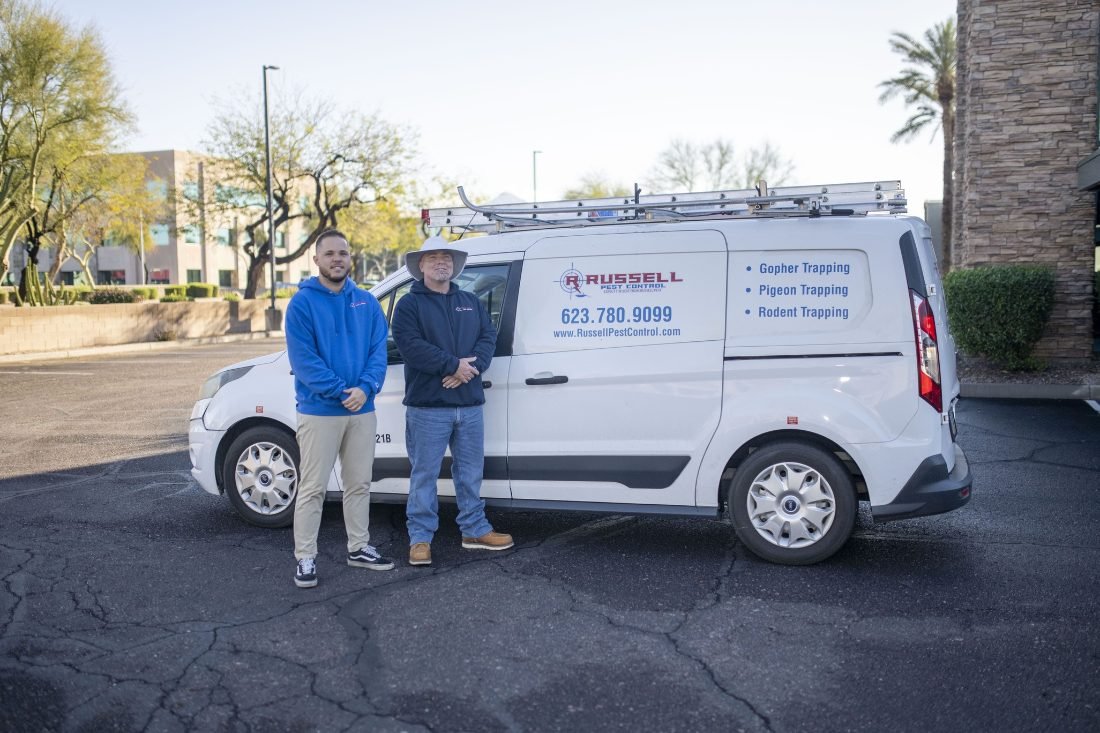
Thirty years of Arizona desert work, with a second generation on the routes. One call gets Steve, Steven Jr., or the office. Never a call center.
We book structural work into the cold months on purpose, and we'll say so even when you'd rather have it done in July.
No contracts and no initial fees on residential service, and a 15-day re-treat warranty if something comes back inside the window.
Arizona OPM License #I5321B, and a family company that's been answering its own phone in the Valley since 1996.
Book the Cold Season Now
The winter calendar fills up in November, and the work has to be finished before spring evenings warm up. If you've had a bad summer, this is the call that changes the next one. And if you've found one indoors tonight, call anyway, and we'll handle that first.
Expect the best from Russell Pest, and have a bug-free day.
Hours
- Monday–Friday: 8:00 AM – 5:00 PM
- Same-day & emergency service available — after hours and weekends, owner-answered
(623) 780-9099 · Call or text · 6750 N 7th Ave, Phoenix, AZ 85013