
Rodent Control in Gilbert, AZ — Four Numbers Instead of 'Tidy Up'
Every piece of rodent advice you have ever been given is a verb with no number attached. Tidy up. Trim back. Keep it clear. Nobody can act on that, so nobody does. The published guidance isn't vague at all: University of Arizona Extension says stack material at least a foot from any wall or fence and at least eighteen inches off the ground, prune shrubs so the ground underneath is clearly visible, and cut ground cover that grows over a foot high. Four measurements. We've worked Valley properties since 1996, and what you actually buy on a Gilbert rodent job is your own property scored against those numbers.
Why Nobody Has Ever Measured Your Back Yard
The front of your house already has a number
Out front, Gilbert is specific: litter and debris accumulation, open storage of personal items, and weeds over 10 inches are all prohibited. So the front of every house on your street is already held to a published measurement by someone other than you.
The back of it never got one
Behind the gate, the town says stored items aren't subject to enforcement, and rear-yard weeds aren't regulated unless there's a health or safety impact on the community. Gilbert Code Compliance is the one to judge whether something crosses that line, and its own examples include odor from waste and stagnant water. But the ten-inch number stops at the side gate, which is why the only measurement that half of your property will ever get is one you commission.
Meanwhile, the debris has nowhere convenient to go
Gilbert runs bulk pickup every five weeks, takes one single pile no bigger than ten feet by five by five, and asks that it go out no earlier than the Saturday before your collection week. Trimmings need to be under five feet long and a foot thick, and grass, leaves and weeds have to be bagged and tied. The town runs no separate green-waste collection, so trimmings ride the same five-week bulk cycle as everything else. Its published answer for the rest is home composting, and it has handed out repurposed trash containers from the Household Hazardous Waste Facility as compost bins, though the town's own recycling page currently lists them as unavailable. One caution the county adds, and it matters on a rodent page: compost bins are themselves rodent harborage. If composting is your answer to the five-week gap, the bin needs a secure lid and the same clearances as anything else you stack. None of that is a complaint about the town. It's just the reason a pile of palm trimmings sits somewhere for a while, and the somewhere is usually the back yard.
And the animal doesn't respect your property line either
University of Arizona guidance notes that roof rats may nest in a neighbor's yard and feed in yours. So a scored back yard next to an untended one is still worth doing: the numbers remove the reason to stay, and the building work removes the way in.

The Four Numbers, and Why They Work
One safety note before anyone clears anything. Maricopa County publishes the protocol for rodent droppings, and it matters. Rubber gloves on. Ventilate the area the night before you clean by opening doors and windows, and don't shortcut that step to the few minutes before you start. Never sweep or vacuum droppings dry. Spray the droppings, nests, and the area around them with a 10% bleach solution (1 part bleach to 9 parts water), and allow at least 15 minutes of contact time before removing anything. Wipe up with paper towels or a mop, double-bag it, and wash your gloved hands in disinfectant before the gloves come off, then wash your hands with soap and water once they are off. The county sets the onset window for illness at 1 to 5 weeks. If a flu-like illness shows up in the weeks after a clean-up, the standing public-health advice is to see a physician promptly, to mention the rodent exposure, and to treat difficulty breathing as urgent, because early diagnosis is what changes the outcome.
Gloves and closed shoes, and never reach into a pile you can't see into. The same harborage holds bark scorpions, and near open ground it holds snakes. If something has sat undisturbed for months, don't move it by hand. For a snake, that's a call to a licensed wildlife removal service or Arizona Game and Fish, and a bite is a 911 call. For anything else, leave it for us.
A foot off the wall. Eighteen inches off the ground. Ground visible under the shrubs. Ground cover under a foot. Those four are not housekeeping standards; they are clearance standards: each one removes a continuous covered route or a nesting void, and each one is checkable by somebody standing in the yard with a tape measure and no expertise at all.
That is the difference between advice and a job. Told to tidy up, an owner moves the obvious things and leaves the woodpile because it looks tidy. Told that the woodpile needs to be a foot off the wall and eighteen inches up, they either do it in an afternoon or they don't, and either way everybody knows where they stand.
Where the building is the problem, sealing gets scoped and priced as its own job, separate from a service visit, so you can see exactly what it covers.
Five Things We Do on a Gilbert Rodent Job
Walk the back half first
The front of the house tells us very little, because somebody has already been keeping it to a standard. We start at the side gate and work the perimeter: what's stacked, what's against a wall, what's off the ground and what isn't, and where the ground under the shrubs has stopped being visible.
Treat the fence line as a road
Roof rats travel along vines, branches, fences and utility wires, so the block wall between you and the neighbor is a route as much as a barrier. That changes where traps go: the extension guidance is to tie them securely to the stringer boards of a fence or along a horizontal support, off the ground and on the line the animal is already using.
Score the property, item by item
A foot off the wall. Eighteen inches off the ground. Ground visible under the shrubs. Ground cover under a foot. You get that list written down, with the specific items on your property named, and most owners clear it in a weekend without us.
Cut the climb where it matters
Where a tree or a structure gives roof access, the extension answer is a rat guard: sheet metal eighteen to twenty-four inches wide, and because the published vertical jump figures run from two feet, per Maricopa County, to over three, per University of Arizona Extension, it goes four feet above the soil to clear the higher of the two. Vents get covered too, with quarter-inch wire mesh on attic and foundation openings, and they get rechecked for rust on later visits.
Close the building
Openings half an inch or wider are sealed with mortar, steel or copper wool, or metal flashing, because those materials survive being chewed. A bark scorpion gets through a gap around a sixteenth of an inch. Sweeps, thresholds, weep screed, slab joints, and utility penetrations are where a house actually leaks. Where the list runs long, the work moves to a scoped Home Seal, with its own price and its own warranty.
What Gilbert Owners Describe
- Scratching or running overhead after dark, in the same stretch of ceiling
- Droppings on top of stored boxes in the garage or along a beam
- Chewed irrigation line, or drip tubing cut cleanly through
- A neighbor's yard you can see over the wall, and a suspicion about it
- Something running the top of the block wall at dusk
The openings every desert house has
- The stem wall and weep screed line, where the stucco meets the ground
- Garage thresholds and the gap under a roll-up door
- Irrigation and valve boxes, hose bib penetrations, and pool equipment pads
- Block wall voids, weep holes, and gate posts along the property line
What Rodent Work Costs in Gilbert
How much harborage is on the property, whether roof access needs cutting, and how much of the exclusion list is structural are what move the number. We price it after we've walked it
The standing Russell terms apply here: no initial fees, no contracts, and a 15-day re-treat warranty
Black Light Scorpion Search: $125 per hour, after dark. We'll tell you what we expect your property to take before we start
Home Seal is quoted as its own job, typically $600 to $2,500 with a one to two year warranty depending on the work
Estimates are free. Attic and hive searches can carry a charge, waived if you hire us
Gilbert Rodent Questions, Answered Straight
Can I report my neighbor's backyard?
Mostly no, and it's worth understanding why before you spend the afternoon on it. Gilbert's published position is that rear-yard storage isn't subject to enforcement and rear-yard weeds aren't regulated unless there's a health or safety impact on the community. So a messy backyard on its own generally isn't a code matter. What we'd suggest instead: a conversation, if you can have one, and, meanwhile, a program on your side of the wall that assumes traffic, because the extension guidance says these animals routinely feed on one property and nest on another.
Do I need you to come back and re-score it?
No. That's rather the point of using numbers: once you have the list, you can check your own work with a tape measure and so can we on a routine visit. Most owners clear the whole thing themselves and we never re-measure it. The items we should handle are the roofline and the building, not the woodpile.
Gilbert has no separate green-waste pickup. What do I do for five weeks?
This is the constraint nobody plans for, and it's the reason the numbers matter more in Gilbert than in a town with weekly green waste. Bulk comes every five weeks; the town takes one pile no bigger than ten feet by five feet by five feet, and grass, leaves, and weeds have to be bagged and tied. So material is going to be stored, and storage is exactly what the four numbers are for: a rack or a pair of pallets, a foot clear of any wall, eighteen inches up, and the pile goes out no earlier than the Saturday before your week.
Do we have to take out the shrubs along our back wall?
No. The extension guidance is to prune them so the ground underneath is clearly visible. That single change removes the covered runway while leaving the planting, and it usually takes one afternoon with a pair of loppers.
Do traps go on the ground?
Some, but the productive ones usually don't. These animals live and travel above ground level, so the guidance is to secure traps to fence stringer boards and horizontal supports on the routes they're already using. A trap on the patio is convenient for us and irrelevant to the rat.
We have a tree touching the roof. Cut it down?
Not necessarily. Clearance is what matters, and where a trunk is the climb, a rat guard is the published answer: sheet metal a foot and a half to two feet wide, fitted four feet up, because the published jump figures top out over three feet. Trim for clearance, guard the climb, and keep the tree.
Why eighteen inches and not twelve?
Because it's the published figure, and using somebody else's number beats inventing one. University of Arizona Extension sets stacked material at a foot from the wall and eighteen inches off the ground; where sources disagree, as they do on how high these animals jump, we opt for the more demanding figure and say so.
Can you do same-day service in Gilbert?
Often, yes. Call or text before noon, and same-day is realistic more often than not, and an indoor sighting is the kind of call we try hardest to fit in. After hours, the phone reaches Steve's cell for triage.
Do you treat termites in Gilbert?
No, and we're straight about it. We'll identify termite signs honestly and refer you to a licensed termite specialist, then handle everything else on the property. Straight lanes, straight answers.
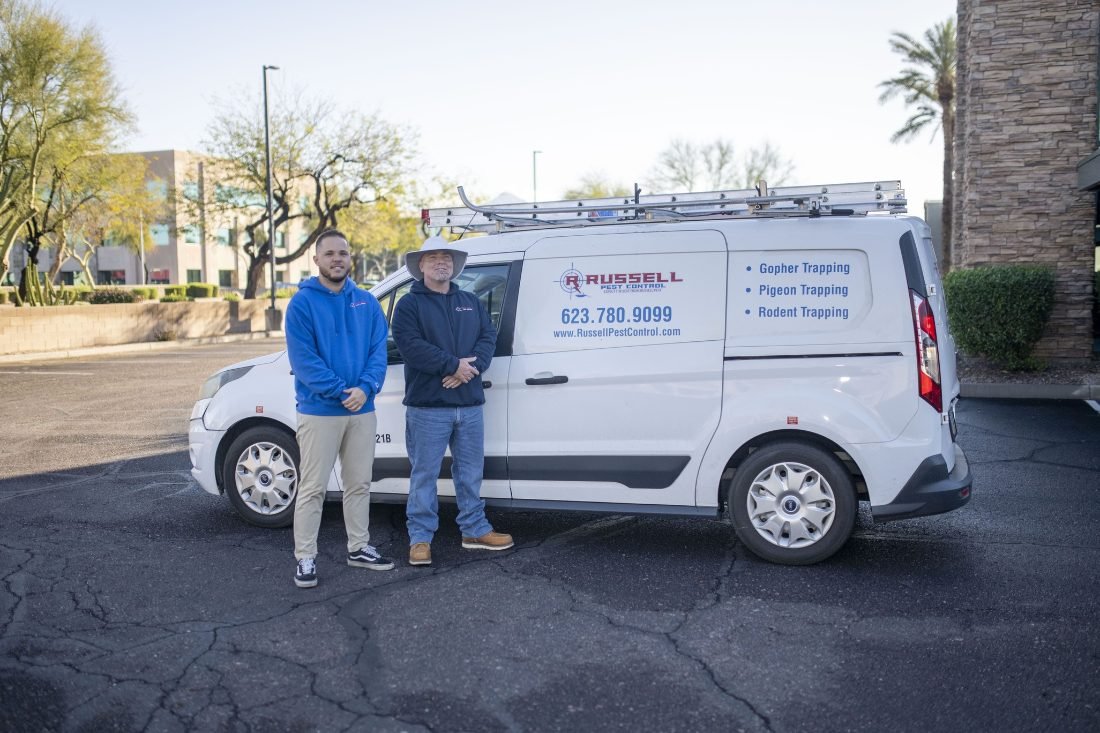
Why Gilbert Households Stay With Us
Thirty years of Arizona desert work, with a second generation on the routes. One call gets Steve, Steven Jr., or the office. Never a call center.
You get the harborage list with a measurement against every item, and most of it is yours to clear without paying anybody.
We put traps where the animal travels, not where they're easy to service, which means fences and rooflines.
No contracts and no initial fees on residential service, and a 15-day re-treat warranty if something comes back inside the window.
Arizona OPM License #I5321B, and a family company that's been answering its own phone in the Valley since 1996.
The Rest of the Gilbert Playbook
Everything else we run in Gilbert, in one place:
Rodent Exclusion and Proofing
Home Seal and Scorpion Sealing
Scorpion Control and the Black Light Search
View Fence and Snake Screening
All Gilbert services: /gilbert
Ask for the Measurements
Book the walk, and you get your property scored against the four numbers, item by item, with locations. Clear what you want to clear yourself, and we'll take the roofline and the building.
Expect the best from Russell Pest, and have a bug-free day.
Hours
- Monday–Friday: 8:00 AM – 5:00 PM
- Same-day & emergency service available — after hours and weekends, owner-answered
(623) 780-9099 · Call or text · 6750 N 7th Ave, Phoenix, AZ 85013