
Bee Removal in Gilbert, AZ — Most of Those Bees Don't Live Here
The most common bee call we get from Gilbert is a pool with too many bees on it, and the most common honest answer is that there's nothing to remove. University of Arizona guidance puts it plainly: most honey bees you see in the landscape are foraging bees from established colonies, out looking for water, nectar, or something sweet. They're commuting. The colony they came from might be a long way off and might belong to no one's property in particular, and spraying the visitors doesn't affect it. The first thing worth settling is whether you have residents or traffic.

Two Different Situations, One of Which We Charge For
A colony is bees living inside something on your property, and that's a job. There's a cavity, there's comb, there's brood, and getting it out is structural work that ends with the opening closed. If that's what you have, we'll scope it and price it.
Traffic is bees arriving, doing something, and leaving. Around water, it can look alarming and involve a lot of bees, and it's still not a colony. What fixes it is changing the water, not treating the bees, and if that's your situation, the money belongs with a plumber, or nowhere.
Telling the two apart takes a photograph, and we'd rather do that on the phone than send a truck to look at a pool. One thing holds either way. The University of Arizona's position is that all wild honey bees in Arizona are, to some extent, Africanized, and that only genetic testing can reveal the lineages in a particular colony. Every wild colony on a property here gets treated on that basis.
A Town That Publishes How Much Water It Puts on the Ground
The numbers Gilbert reports
Gilbert has used 100% of its reclaimed water since 1986. In 2020, it reports 2.9 billion gallons of reclaimed water used in place of drinking water for landscape irrigation, and it says it has recharged an average of 3 billion gallons a year over the past decade at four recharge facilities. That water is delivered to HOAs, golf courses, schools, parks and other community facilities for irrigation.
What that means for a foraging bee
Water in a desert is a destination. A town that irrigates common areas at that scale, on top of the pools and yards of a town this size, is a town with a very large number of places for a forager to drink. That doesn't mean Gilbert has more colonies than anywhere else, and we're not going to claim it does, because nobody publishes that. What it means is that a Gilbert household is more likely to see foraging bees even when there is nothing on their property at all.
How much water a colony actually wants
A peer-reviewed study published in 2025 measured colony water collection directly and recorded up to 1.4 liters collected in a single day, with collection climbing sharply once the daily maximum exceeded about 31.5 degrees Celsius (roughly 89 degrees Fahrenheit). That work was done in France under semi-field conditions rather than in Arizona, so treat it as the shape of the behavior rather than a local measurement. The shape is the useful part: on hot days, a colony sends out many bees for water, and in July, a Gilbert pool is the best water for a long way.
Reading Your Own Situation Before You Call
This is traffic
- Bees at the pool edge, the skimmer, or a wet patch of decking, busiest in the heat of the day
- Bees at a bird bath, a pet bowl, a dripping bib, or a damp spot under an emitter
- Numbers that rise through the afternoon and are gone by evening
- No single point they're going in and out of
This is a colony
- A steady line going in and out of one opening, day after day, including early morning
- A wall, eave, roof tile, chimney, utility box or irrigation box as the destination
- A stain, a smell, or a damp patch on a ceiling below the traffic
- A hive somebody sprayed once, quiet for a while, and now busy again
And this is an emergency
Bees actively attacking somebody is 9-1-1, and none of the rest of this page matters. Cover your head and face with clothing or your hands, get inside a building or a vehicle and shut the door, and if there's no shelter, run at least 240 yards, which the University of Arizona describes as two football fields, and keep going until you're inside. Don't swat, and don't jump into a pool: the same source says the bees will wait longer than you can hold your breath.
After the attack, scrape stingers out sideways and avoid pinching them. Call 9-1-1 if anyone is stung many times, or has trouble breathing, swelling of the face or throat, or dizziness. Anyone with a known bee allergy uses their epinephrine and calls 9-1-1, and follows the plan their doctor gave them. We're a pest company, so the medical half stops there.
Six Things We Do About Bees in Gilbert
Settle traffic or colony on the phone
A photograph and two questions usually do it: is there one opening they're all using, and are they still at it first thing in the morning? Traffic is a daytime, heat-driven pattern with no single door. A colony has a door.
For traffic, go through the water
The University of Arizona's own list is a maintenance list: repair leaks in outdoor taps and irrigation promptly, keep an eye on bird baths and pet bowls and consider moving them, and screen rainspouts, chimneys and water meter boxes. On a Gilbert lot we'd add checking the emitters, because a failed one makes a permanent wet patch that is functionally a drinking station.
Decide whether to move the water or accept it
Sometimes the answer is to give them a better option further from the patio rather than to take away the one they're using, because a pool isn't going anywhere. That's a conversation about where people sit. That's often the honest answer even though it isn't billable.
For a colony, open it, remove the comb, then close it
University of Arizona guidance states that bees and comb should be removed by professionals using proper protective equipment, and that no one should try to seal a hole or fill a void while bees are moving in and out of it. Comb left inside keeps working against you, so removal and repair are one job.
Talk about relocation before the wall is open
Where a colony is reachable, and a beekeeper will take it, that's worth asking for, and it's worth asking whether it's realistic here. Once a wall has to come apart or the situation has become a safety problem, the options narrow, which is the argument for calling early.
Close the cavities nothing has moved into yet
The dull half. Seal gaps in walls, rooflines and around foundations, screen the openings that have to stay open, and deal with an empty cavity before something moves into it. The University of Arizona's guidance is to fill holes an eighth of an inch or larger in walls and in structures with voids inside, and to seal cracks and gaps in walls, rooflines and around foundations, and, in the same guidance, not to attempt to seal holes or fill voids if bees are actively moving in and out of one. Both halves matter and the order is not negotiable: empty first, closed second. Tree cavities are their own case: the same source says not to pack them with concrete, gravel, or sand, because that damages the tree and becomes a hazard if it ever comes down.
Gilbert Bee Questions, Answered Straight
There are dozens of bees on our pool every afternoon. Do we need bee removal?
Almost certainly not. That's the single most common bee call we get from Gilbert, and the answer is usually that you're watching foragers collect water. There's nothing on your property to remove, and treating them would kill visitors while the colony carries on somewhere you'll never find. Check for a single opening they're using; if there isn't one, this is traffic.
Can we make them go somewhere else?
Sometimes, partly. You can remove the easy alternatives you don't need, like a birdbath near the seating area or a leaking bib, and make the pool less attractive at the edges by keeping the coping dry where you can. What you can't do is out-compete a swimming pool in July. Managing where people sit is often more effective than managing where bees drink.
Should we just spray them?
No, and we won't do it. Killing foragers at a water source doesn't reduce the colony, has to be repeated forever, and takes out pollinators doing nothing wrong. An actual colony in a structure is a different conversation.
Why is it worse in July?
Because colonies collect much more water in heat. The 2025 study recorded collection rising sharply above a daily maximum of about 31.5 degrees Celsius, which the Valley clears comfortably from late spring onward. It's a heat response, and it says nothing about your property.
Bees are in our irrigation valve box. Is that a colony?
It can be, and it's worth looking at properly before anyone lifts the lid. A box with a steady stream in and out at the same point, morning and evening, is a colony. In the afternoon, a box that's damp inside, with bees around the edges, is water. Photograph it from a few feet back and send it before anyone opens anything.
Our HOA irrigates the greenbelt behind us. Is that the source?
It's a water source, and Gilbert does deliver reclaimed water to HOAs and community facilities for irrigation. But a water source isn't a colony, and it isn't anybody's fault. The practical question is still whether bees are living in something on your property. If they aren't, the greenbelt isn't a problem to solve; it's just why you see bees.
Someone sprayed a hive here last year. Why are they back?
Then there is still comb in the cavity, and that is the issue to address. Removal and repair go together here for that reason.
Can you do same-day service in Gilbert?
Often, yes. Call or text before noon, and same-day is realistic more often than not, and an indoor sighting is the kind of call we try hardest to fit in. After hours, the phone reaches Steve's cell for triage.
Do you treat termites in Gilbert?
No, and we're straight about it. We'll honestly identify termite signs, refer you to a licensed termite specialist, and handle everything else on the property. Straight lanes, straight answers.
What Bee Work Costs in Gilbert
If it's traffic at a water source, there's nothing to buy, and we'll say so on the phone
For a colony, access, height, and whether a wall or roof has to be opened are what move the number. The removal and the planned repair are quoted together up front, and anything genuinely hidden behind the wall gets priced before we go further
The standing Russell terms apply here: no initial fees, no contracts, and a 15-day re-treat warranty
Black Light Scorpion Search: $125 per hour, after dark. We'll tell you what we expect your property to take before we start
Home Seal is quoted as its own job, typically $600 to $2,500 with a one to two year warranty depending on the work
Estimates are free. Attic and hive searches can carry a charge, waived if you hire us
The Rest of the Gilbert Playbook
Everything else we run in Gilbert, in one place:
Scorpion Control and the Black Light Search
Rodent Control and Exclusion
All Gilbert services: /gilbert
Why Gilbert Households Stay With Us
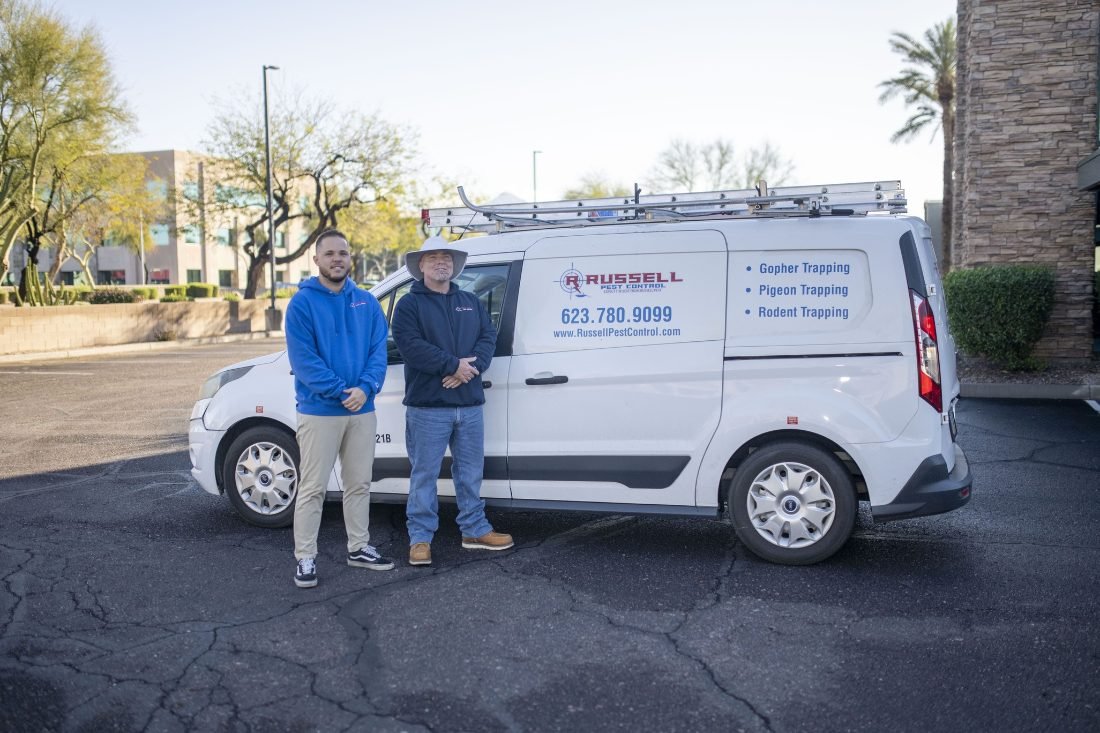
Thirty years of Arizona desert work, with a second generation on the routes. One call gets Steve, Steven Jr., or the office. Never a call center.
We'll tell you on the phone when there's nothing to remove, which on Gilbert bee calls is most of the time.
We won't spray foragers at a water source, because it doesn't work and it kills pollinators for nothing.
No contracts and no initial fees on residential service, and a 15-day re-treat warranty if something comes back inside the window.
Arizona OPM License #I5321B, and a family company that's been answering its own phone in the Valley since 1996.
One Photograph Settles It
If anyone is being stung, that's 9-1-1 and stop reading. Otherwise, photograph what you're seeing from a safe distance, note whether they're all using one opening, and send it with your cross streets. You'll have an answer on whether it's a colony or a commute.
Expect the best from Russell Pest, and have a bug-free day.
Hours
- Monday–Friday: 8:00 AM – 5:00 PM
- Same-day & emergency service available — after hours and weekends, owner-answered
(623) 780-9099 · Call or text · 6750 N 7th Ave, Phoenix, AZ 85013