
View Fence & Snake Screening in Fountain Hills — Removal Ends at Your Back Fence
The Fountain Hills Fire Department will come out for a rattlesnake in your immediate area, and on its website, the Town says plainly what happens next: most likely, the snake goes over your back fence. There are two sound reasons for that, and both of them hold up. Neither of them changes what matters: the removal ends tonight's problem and leaves the route exactly where it was, and the ground line at your boundary is the only thing on the property that changes the odds.
The Town Publishes Where the Snake Goes
Fountain Hills publishes what it does about rattlesnakes, which is unusual, and the sequence runs from a Town web page to a state rule to the research without a gap in it.
The Town says what it will do, and where the animal ends up
The Fire Department's own page says it will remove a snake only if it is a rattlesnake and only if it is in your immediate area, meaning near a door, a car, or inside a house or garage. It then says the animal can be moved out of that area and that it will most likely be dropped over your back fence. It adds that moving it more than a hundred yards or so can leave the snake disoriented and kill it. It also says bull, gopher, and king snakes are not a danger to people, so a call about one of those will not bring anybody out.
There is a state rule underneath that, and it points the same way
Arizona's wildlife rules govern where captured wildlife may be let go. The relevant clause requires release in the same geographic area where the animal was originally captured and, separately, an ecologically appropriate time of year and suitable habitat. A public safety employee on official duty is exempt from holding the license those rules attach to, which is how a fire crew can do the work at all. In short, a crew driving a rattlesnake miles into the desert would be doing the thing the rules were written to prevent.
And the research says they come back
The numbers are specific, and they are not all from Arizona, so the sources come with them. A radiotelemetry study at Montezuma Castle National Monument in the Verde Valley, roughly sixty miles north of here, followed western diamondbacks moved two kilometers from where they were found. More than half returned to the areas they had been displaced from within two years, and the authors also reported poor survival among the relocated snakes. In a Canadian study of a different species, western rattlesnakes were moved 500 meters from where they were caught, and 12 of 14 returned at least once to the general area they had been taken from, on average within about 20 days. Neither study was done here, and neither is about your yard. Together they describe an animal that knows where it lives.
Which leaves exactly one variable on the property
Nobody in that sequence is doing anything wrong. The crew follows a sensible practice for good reasons, the rule protects the animal, and the household got the immediate problem solved. What survives all of it is the route: a strip of ground a few inches deep along a boundary, and the one part of the whole business that belongs to the homeowner and can be altered. That reading of the sequence is ours. The Town has not drawn that conclusion anywhere, and that is also why a screening job is worth pricing at all.
What a Screening Job Actually Involves
Ask where the last one was
Households remember this with real precision, down to the paver: where it was, what time of day, what it was under, whether the Fire Department came. Three or four sightings plotted on a lot usually resolve into a line, and the line is what we fit mesh to.
Work the ground line, because the fence has almost nothing to do with it
The opening under a boundary changes every few feet due to settlement, scour where water crosses, and the drop at a pilaster footing. We measure the gap along the whole run and note where it is worst, because the two worst feet on a boundary are the whole job, and the other two hundred are trim.
Fit mesh to a published specification, and tell you what it is
University of Arizona Health Sciences publishes the number we work to, in its own guidance on snake-proofing an Arizona backyard, and the wording is worth having in front of you: snake-proof fencing is the gold standard, and it involves installing fine mesh wire with openings no larger than a quarter inch and burying it a few inches into the ground so snakes cannot slip underneath. Two numbers, both checkable, and a spec you can hold any contractor to, including us.
Bury the edge, which is the step that gets skipped
Mesh stapled to the bottom rail and left sitting on the dirt is a screen for about one monsoon. The buried edge is what makes the barrier continuous, and doing it properly means knowing what is under the soil first, which here is often an irrigation line and sometimes rock at four inches. Where we cannot get depth, we note that in the report.
Close the low openings on the building while we are at it
A screened boundary and an open garage door sweep are jobs that only look finished. Door sweeps, the gap under a side gate, and the openings at grade around the building all get listed. Where the building is the problem, sealing gets scoped and priced as its own job, separate from a service visit, so you can see exactly what it covers.
Say where the barrier stops, in writing
The run we fitted is screened. A neighbor's run is not, an unfenced boundary is not, and a gate left standing open is a hole in whatever we built. We write the limits on the report because a household that knows where the barrier ends behaves differently in the dark. If a rattlesnake is at the door or in the garage, that is a call for the Fountain Hills Fire Department's non-emergency line, not a job to attempt with a shovel. A bite is a 9-1-1 call. Do not reach or step where you cannot see, and do not try to move the animal.
Twice in One Spring, Same Corner of the Yard
A household calls in April, the Fire Department comes, the snake goes over the back fence, and everyone is relieved. In June, it happens again, in the same corner, and this time the call to us has an edge to it.
We cannot tell you it was the same animal. Nobody can, and any company that says otherwise is selling you a story. What we can tell you is that the corner was exactly as it had been: a scoured channel under the boundary where water crossed, about the width of a fist, there through both visits. The second call was evidence that the route was still open, and that's something you can fix in an afternoon.
What Fountain Hills Households Ask Us
There is one in our garage right now. Can you come?
No. Waiting on us would cost you time you do not have. Removing venomous snakes sits outside what an Arizona pest license covers and outside what we are equipped for. For a rattlesnake at a door, a car, or inside the house or garage, the Fountain Hills Fire Department's non-emergency line is the call. A bite is a 9-1-1 call. Keep people and pets back, keep it in sight from a distance if you safely can, and leave it alone.
The Fire Department handles it for free. What am I screening for?
For the next one, the research is the reason. The Arizona study at Montezuma Castle found that more than half of the relocated rattlesnakes returned to their original areas within two years, and the Canadian work, on a different rattlesnake species, found that most returned within weeks after a much shorter move. A removal solves the animal at your door this evening. It does not close the way it came.
What does a screened run honestly change?
It closes the ground line along the length we fitted, very often the length the sightings sit on. It does not make a property snake-free, and that limit belongs in the quote. If two of your boundaries are open desert and the third is now screened, you have closed one route and kept two, and the report says which is which.
What mesh do you use, and why a quarter inch?
Because that is the number the University of Arizona Health Sciences publishes in its backyard guidance: fine mesh wire with openings no larger than a quarter inch, buried a few inches into the ground. We did not invent it, which is exactly why it is worth quoting to you. Ask anybody bidding a screening job what opening size they are fitting and how deep they are burying it.
Do the repellents at the hardware store work?
University of Arizona Health Sciences publishes that products claiming to repel snakes, including ultrasonic devices, powders and home remedies, are largely ineffective, and that there is no strong evidence behind them. The Town's own snake page is gentler and says that products like Snake Away and moth balls are reported to work by some people and not by others. We follow UA Health Sciences on this one, and you should know the two sources differ so you can weigh it yourself.
Our fence looks fine. Is the gap really the problem?
Stand at one end and look along the base at eye level to the dirt. Do it in daylight, stay on your feet, and do not put a hand anywhere you cannot see into. The places where the ground has pulled away from the bottom rail are rarely where you would expect: wash crossings, the low side of a driveway, and the ground beside a gate post. Two or three on a run is ordinary.
Can you do same-day service in Fountain Hills?
Often, yes. Call or text before noon, and same-day is realistic more often than not, and an indoor sighting is the kind of call we try hardest to fit in. After hours, the phone reaches Steve's cell for triage.
Do you treat termites in Fountain Hills?
No, and we're straight about it. We'll identify termite signs honestly and refer you to a licensed termite specialist, then handle everything else on the property. Straight lanes, straight answers.
What Else We Run in Fountain Hills
Scorpion Control and Black Light Search
Ground-level work with after-dark ultraviolet mapping quoted by the hour.
Home Seal and Scorpion Sealing
Whole-house exclusion scoped, priced, and warrantied as its own job.
Rodent Control and Exclusion
Removal before anything gets closed, then screening at the roofline and the ground line.
General Pest Control Plans
Monthly, bi-monthly or quarterly, with no contracts and a 15-day re-treat warranty.
Bee, Wasp, Mosquito and Weed
Live relocation where a beekeeper can take a colony, station-based mosquito work, and pre-emergent timed to both desert weed seasons.
Commercial and Property Management
Documented programs for buildings, food service, hospitality, and multi-tenant sites.
All Fountain Hills services: /fountain-hills
What Screening Costs in Fountain Hills
One clarification on the badge above and the terms below: the 15-day re-treat warranty covers treatment service. Home Seal carries its own one to two year warranty, and the two are separate things.
The run gets measured before it gets quoted, and four things come off that walk: the length, the gates in it, how far the ground has pulled away at the worst points, and whether the edge can be buried to depth for the whole length or only part of it
The standing Russell terms apply here: no initial fees, no contracts, and a 15-day re-treat warranty
Black Light Scorpion Search: $125 per hour, after dark. We'll tell you what we expect your property to take before we start
Home Seal is quoted as its own job, typically $600 to $2,500 with a one to two year warranty depending on the work
Estimates are free. Attic and hive searches can carry a charge, waived if you hire us
Why Fountain Hills Households Call Us for the Boundary
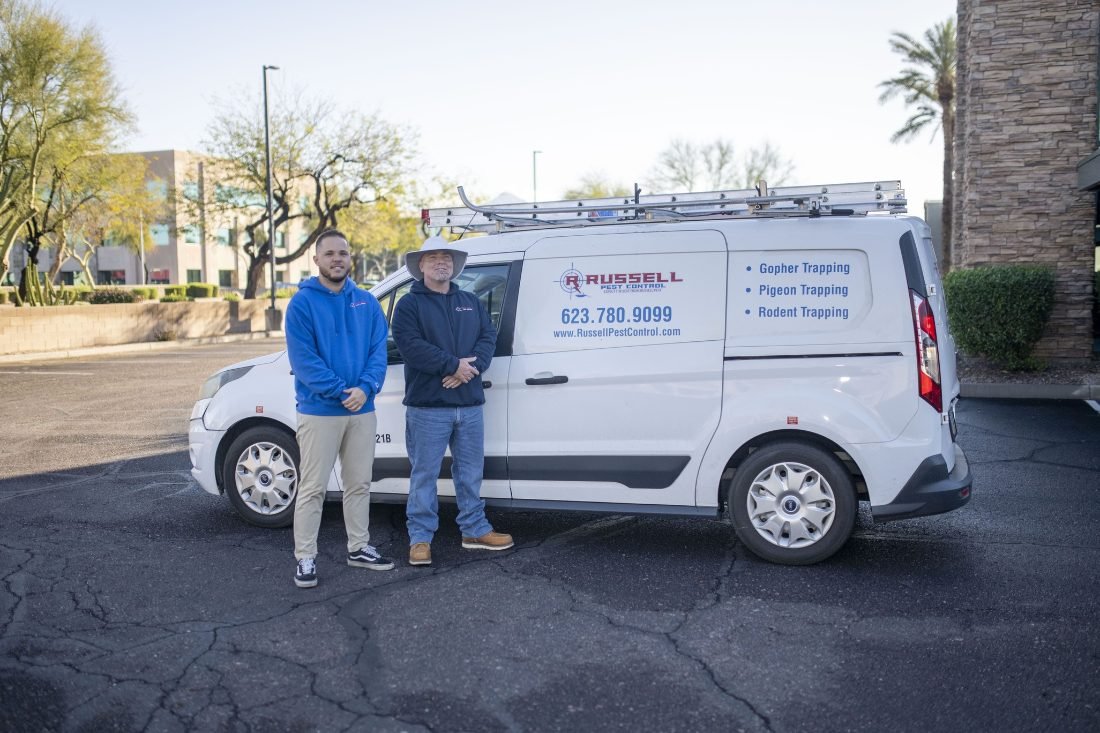
Thirty years of Arizona desert work, with a second generation on the routes. One call gets Steve, Steven Jr., or the office. Never a call center.
We fit to a published specification, and we name it, so you can hold the work to a number we did not set.
We price the run after measuring it, because a screening quote given over the phone is a guess about ground nobody has looked at.
We are straight that screening closes a route and does not clear a property, which is the sentence most screening quotes leave out.
We do not remove snakes, and we will say so in the first thirty seconds of the call, then tell you who does.
Arizona OPM License #I5321B, and a family company that's been answering its own phone in the Valley since 1996.
Walk the Base of the Fence
Take a phone and walk your boundary in daylight, on your feet, looking along the base at eye level to the dirt. Where the ground has pulled away, note how far in the only units that matter out there: a finger, a hand, a fist. Three of those written down is enough for us to tell you on the phone whether this is likely a morning of work or a day of it, and whether your money belongs at the boundary at all. The number itself comes after we have measured the run ourselves. The walk and the written list are free either way, whoever ends up doing the work.
Expect the best from Russell Pest, and have a bug-free day.
Hours
- Monday–Friday: 8:00 AM – 5:00 PM
- Same-day & emergency service available — after hours and weekends, owner-answered
(623) 780-9099 · Call or text · 6750 N 7th Ave, Phoenix, AZ 85013