
Rodent Control in Chandler, AZ — You Own the Alley to the Middle
Chandler publishes something most residents have never read. The city has roughly 139 miles of alleys, and city code requires residents to maintain their alley from their property line to the centerline. Not to the wall. To the middle. If your house backs onto one, there's a strip of ground behind your block wall that the city says is yours to maintain, and that you probably haven't walked this year. It is also, from a rat's point of view, the best road in the neighborhood. That strip is where we start.
The City Publishes the Standard, and It Is a Rodent Checklist
What the code asks of you
Chandler describes its alleys as corridors used for trash collection and utility work that also give access to emergency and non-emergency vehicles, and it points to city code section 30-18(L)(2) for the maintenance duty from your property line to the centerline. That's the legal shape of it. The useful shape is the inspection checklist the city publishes alongside it.
The checklist, read as a pest document
The city asks that the alley be free of overgrown grass, weeds, and dead vegetation. That trees and bushes be trimmed back for free access, with fifteen feet of clearance from the ground and nothing encroaching into the center. That trash, litter, and loose debris sit inside receptacles. And that property fences and brick walls be structurally sound with no signs of deterioration. Read that list again with rodents in mind. Ground cover, overhead routes, exposed food, and holes in a wall. Chandler wrote it for access and appearance. Reading it as a pest document is ours, so weigh it as reasoning.
What the alley can't do for you
Two limits worth knowing before you plan around it. Bulk items are not collected in the alley at all, so a pile of landscape debris put out back has no scheduled pickup. And the containers back there are a heavier class: Chandler's code allows 200 pounds in a curbside container and 600 in an alley container, which tells you something about what accumulates there. The city also requires garbage to be bagged and tied and says plainly that this reduces unsanitary conditions, including the breeding of flies, odors, and spillage.
And the walls that line it
An alley is a corridor with block walls on both sides, and Maricopa County's own figures explain why that matters. Maricopa County puts a roof rat's jump at two feet straight up and four feet horizontally, and notes the horizontal distance doubles when the jump starts from a height. University of Arizona Extension puts the vertical figure higher, at over three feet; we scope to whichever is higher. From the top of a block wall, that's a considerable reach onto whatever is next.
What Chandler Owners Describe
- Something running the top of the block wall at dusk
- Scratching overhead after dark, in the same stretch of ceiling
- Droppings along a beam or on top of stored boxes in the garage
- Chewed drip line, or wiring insulation stripped in a roof space
- An alley behind the house that nobody has been down in a while
The openings every desert house has
- The stem wall and weep screed line, where the stucco meets the ground
- Garage thresholds and the gap under a roll-up door
- Irrigation and valve boxes, hose bib penetrations, and pool equipment pads
- Block wall voids, weep holes, and gate posts along the property line
One reassurance, because people ask
Maricopa County states that roof rats across the county continue to be tested for tularemia, hantavirus, and plague, and that all tests to date have been negative. That isn't a reason to live with them, and it is a reason not to lie awake about it.

Half a Corridor Is Still Worth Doing
One safety note before anyone clears anything. Maricopa County publishes the protocol for rodent droppings, and it matters. Rubber gloves on. Ventilate the area the night before you clean by opening doors and windows, and don't shortcut that step to the few minutes before you start. Never sweep or vacuum droppings dry. Spray the droppings, the nests, and the area around them with a ten percent bleach solution, one part bleach to nine parts water, and give it at least fifteen minutes of contact time before you remove anything. Wipe up with paper towels or a mop, double-bag it, and wash your gloved hands in disinfectant before the gloves come off, then wash your hands with soap and water once they are off. The county sets the onset window for illness at 1 to 5 weeks. If a flu-like illness shows up in the weeks after a clean-up, the standing public-health advice is to see a physician promptly, to mention the rodent exposure, and to treat difficulty breathing as urgent, because early diagnosis is what changes the outcome.
Gloves and closed shoes, and never reach into a pile you can't see into. The same harborage holds bark scorpions, and near open ground it holds snakes. If something has sat undisturbed for months, don't move it by hand. For a snake, that's a call to a licensed wildlife removal service or to Arizona Game and Fish; a bite is a 911 call. For anything else, leave it for us.
The obvious objection to an alley program is that you control half the corridor and your neighbor controls the other half. That's true, and it's less of a problem than it sounds. Clearing your half removes the continuous cover that makes the alley a road, and clearing it makes the remaining harborage visible enough that a conversation with a neighbor has something specific in it.
The other half of the work is your building, and you control that half completely. Exclusion is what actually ends the problem; the alley work is what stops your address being the convenient one.
Where the building is the problem, sealing gets scoped and priced as its own job, separate from a service visit, so you can see exactly what it covers.
Five Things We Do on a Chandler Alley Property
Walk the alley, not just the yard
We go through the gate and down the corridor, on both sides of the centerline, because the picture is meaningless from inside the wall. What we're reading is continuity: how far a rat can travel behind your house without ever being exposed.
Score your half against the city's own list
Overgrowth, clearance, debris outside containers, wall condition. You get the list back marked against the checklist Chandler already publishes, which means the pest fix and the code standard are the same afternoon's work.
Read the wall as a launch point
Where a wall top runs unbroken past your roofline, or a tree canopy meets it, that's an access route as much as a boundary. The county's jump figures make the geometry concrete, and the fix is usually clearance.
Screen with something they can't chew
For openings and vents, Maricopa County recommends stucco diamond mesh from a building supplier, and describes it memorably: for the rat, that mesh is like biting into small razor blades. It's the difference between a repair that lasts and one that gets reopened.
Close the building and set traps on the routes
Traps go where the animal already travels, above ground level and along the lines it uses, and the building gets closed behind them. A bark scorpion gets through a gap around a sixteenth of an inch. Sweeps, thresholds, weep screed, slab joints, and utility penetrations are where a house actually leaks. Where the list runs long, the work moves to a scoped Home Seal, with its own price and its own warranty.
What Rodent Work Costs in Chandler
Whether there's an alley, how much of the corridor is in play, and how much of the exclusion list is structural are what move the number. We price it after we've walked it
The standing Russell terms apply here: no initial fees, no contracts, and a 15-day re-treat warranty
Black Light Scorpion Search: $125 per hour, after dark. We'll tell you what we expect your property to take before we start
Home Seal is quoted as its own job, typically $600 to $2,500 with a one to two year warranty depending on the work
Estimates are free. Attic and hive searches can carry a charge, waived if you hire us
The Rest of the Chandler Playbook
Everything else we run in Chandler, in one place:
Rodent Exclusion and Proofing
Home Seal and Scorpion Sealing
Scorpion Control and the Black Light Search
View Fence and Snake Screening
All Chandler services: /chandler
Chandler Rodent Questions, Answered Straight
Do I really have to maintain the alley?
Chandler's published position is that city code requires residents to maintain their alley from their property line to the centerline. So yes, and the more useful framing is that it gives you standing to deal with the ground behind your wall.
My neighbor's half is a mess. What now?
A conversation first, and it goes better when you can point at the city's own checklist. Overgrown vegetation, debris outside containers, clearance, wall condition: those are Chandler's words, not yours. If that goes nowhere, the city runs code enforcement and takes reports, including anonymously. We'd try the conversation twice before that.
Does clearing only my half actually help?
Yes, meaningfully. What makes an alley a highway is continuous cover, and breaking it changes the economics for the animal even when the neighbor does nothing. It also makes anything left obvious, which is a better starting point for a conversation than a general complaint.
Where do I put the palm trimmings, then?
Not in the alley, and that catches people. Chandler doesn't collect bulk items from the alley at all, so anything put back there stays until somebody moves it. Bulk goes to the curb by appointment, and in the meantime, the pile should be off the ground and away from any wall.
Is a block wall a barrier or not?
Not really. Maricopa County puts the jump at two feet vertically and four feet horizontally, doubling the horizontal reach from a height, and the University of Arizona Extension puts the vertical figure over three feet. A wall top is both a launch point and a road, which is why clearance around it matters more than its height.
What should we screen vents with?
Maricopa County recommends stucco diamond mesh available from building suppliers, and puts it vividly: to a rat, that mesh is like biting into small razor blades. Plastic, wood, and light screen get chewed through and give you a repair you'll do twice.
Should I worry about disease?
Less than you might fear. The county states that roof rats across Maricopa County continue to be tested for tularemia, hantavirus and plague, and that all tests to date have been negative. Handle droppings per the county protocol above anyway, and take any questions about illness to a doctor. That testing statement is a rolling one: treat it as what the county published, not as a permanent finding.
We don't have an alley. Is this page relevant?
Partly. Chandler has around 139 miles of alleys, which is a lot and is nowhere near all of it, so plenty of Chandler homes have no alley at all. If that's you, the corridor argument doesn't apply, and the building work does. Send us your cross streets, and we'll tell you which one you're in.
Can the city clear it for me?
No, and that's the trade. Chandler maintains alleys as public corridors for collection and access, and places the responsibility for vegetation and debris on the adjoining residents. What the city offers is the standard and the enforcement route; the clearing is yours or ours.
Can you do same-day service in Chandler?
Often, yes. Call or text before noon, and same-day is realistic more often than not, and an indoor sighting is the kind of call we try hardest to fit in. After hours, the phone reaches Steve's cell for triage.
Do you treat termites in Chandler?
No, and we're straight about it. We'll honestly identify termite signs, refer you to a licensed termite specialist, and handle everything else on the property. Straight lanes, straight answers.
Why Chandler Households Stay With Us
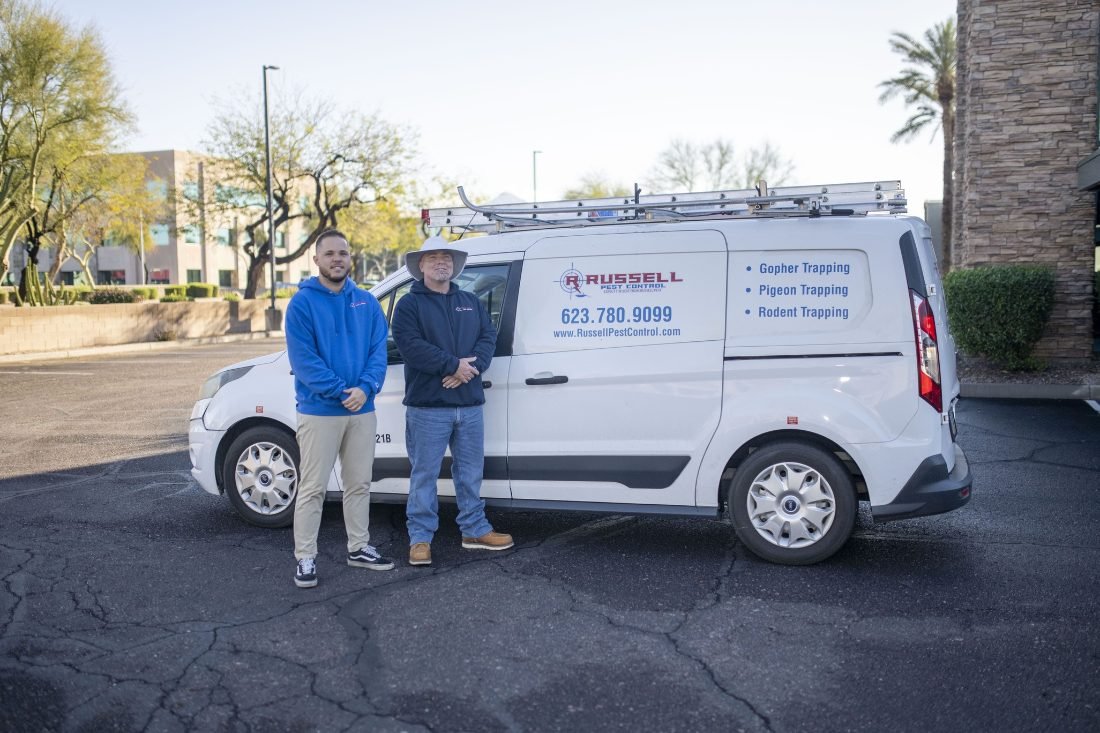
Thirty years of Arizona desert work, with a second generation on the routes. One call gets Steve, Steven Jr., or the office. Never a call center.
We walk the alley instead of guessing at it from inside the wall, and you get your half scored against the city's own checklist.
No contracts and no initial fees on residential service, and a 15-day re-treat warranty if something comes back inside the window.
Arizona OPM License #I5321B, and a family company that's been answering its own phone in the Valley since 1996.
Go Through the Back Gate
Walk your alley this weekend and look at it as a corridor, which is what it is. Photograph what you find, send it with your cross streets, and we'll tell you what's harborage, what's a wall repair, and what's the building.
Expect the best from Russell Pest, and have a bug-free day.
Hours
- Monday–Friday: 8:00 AM – 5:00 PM
- Same-day & emergency service available — after hours and weekends, owner-answered
(623) 780-9099 · Call or text · 6750 N 7th Ave, Phoenix, AZ 85013