
Bee Removal in Chandler, AZ — Put the Leaf Blower Down First
The Chandler Fire Department's published advice on bees is four words long: leave bees alone, and they'll leave you alone. Then it names what breaks that, and the list is domestic rather than dramatic. Bees are sensitive to noise, such as power equipment and barking dogs, and may attack pets or people in the area. Which means most of the bee emergencies we get called to in Chandler didn't start with the bees. They started with a Saturday morning and a trimmer. We've worked Valley bee calls since 1996, and the most useful thing we can tell a Chandler homeowner is what not to do this weekend.
What Sets Them Off, and Where They Are When It Happens
The triggers Chandler and the University of Arizona name
- Power equipment running near the colony: blowers, trimmers, mowers, chain saws
- A dog barking at the entrance, which puts the dog at risk first
- Vibration through the structure itself, from a ladder, a saw, or roof work
- Somebody deciding to spray it themselves
The places we find them in Chandler
- Wall voids and eaves, reached through a gap nobody had noticed
- Roof tile and chimneys
- Irrigation valve boxes and utility boxes at ground level, which is where a mower meets them
- Water meter boxes at the property edge
And the caution Chandler adds
The city's own guidance is to use the same care around air conditioners, coolers, electrical boxes and water meters. Those are exactly the things a homeowner or a contractor approaches without thinking, which is the whole problem: the equipment that needs servicing and the cavity a colony chose are frequently the same object.

Two Jobs, and the Order Matters
The first job is not making it worse, and it's free. If there's an established colony on your property and nobody is being stung, the correct immediate action is to stop working near it, keep pets and children away from that side of the house, and tell whoever cuts your grass. That buys you the time to handle the second job properly.
The second job is removal, and it's structural. There's a cavity, there's comb, and getting it out ends with the opening closed. University of Arizona guidance states that honey bees should be removed by experienced professionals, and that once a colony is removed from a void, the interior must be cleaned out completely and the entry points sealed, or a new swarm will move into the same space. The University of Arizona's guidance is to fill holes an eighth of an inch or larger in walls and in structures with voids inside, and to seal cracks and gaps in walls, rooflines and around foundations, and, in the same guidance, not to attempt to seal holes or fill voids if bees are actively moving in and out of one. Both halves matter and the order is not negotiable: empty first, closed second. Tree cavities are their own case: the same source says not to pack them with concrete, gravel, or sand, because that damages the tree and becomes a hazard if it ever comes down.
Chandler's own instruction sits between the two: do not try to remove the bees yourself, and do not call 9-1-1 unless the bees are attacking and someone is in a life-threatening situation. That rule is about the bees. It does not override the medical reasons to call, which are set out below and apply whether or not an attack is still ongoing.
The City Has Written Down What Provokes Them
Chandler Fire's position, in its own words
The fire department advises residents to leave bees alone, and they'll leave you alone, notes that bees are sensitive to noise such as power equipment and barking dogs and may attack pets or people in the area, and asks residents to take the necessary precautions to prevent disturbing them. It's a short piece of guidance that names a cause most people would never have guessed.
The 24-hour rule for a cluster that just appeared
Chandler adds that a swarm of bees will generally stay at a location for an average of 24 hours and advises contacting a beekeeper or exterminator if they appear to be staying longer. That average is Chandler's; the suggestion to wait is ours. For most households, a cluster that arrived this morning can be left alone for a day, provided nobody has to walk past it. Don't wait it out if it's over a doorway, a gate or a play area, if anyone in the house has a sting allergy, if you have pets that can't be kept in, or if trades are due on site. In any of those, call now.
Why the advice is that blunt
The University of Arizona states that all wild honey bees in Arizona are Africanized to some extent. That's why the response advice everywhere in this state assumes the worst case, and it's why 'they've been there for months and never bothered anyone' isn't the reassurance it sounds like. A colony that has been tolerant is a colony nobody has provoked yet.
What to do if it does go wrong
Cover your head and face with clothing or your hands, get inside a building or a vehicle and shut the door, and if there's no shelter, run at least 240 yards, which the University of Arizona describes as two football fields, and keep going until you're inside. Don't swat, and don't jump into a pool: the same source says the bees will wait longer than you can hold your breath. After the attack, scrape stingers out sideways and avoid pinching them. Call 9-1-1 if anyone is stung many times, or has trouble breathing, swelling of the face or throat, or dizziness. Anyone with a known bee allergy uses their epinephrine and calls 9-1-1, and follows the plan their doctor gave them. We're a pest company, so the medical half stops there.
Six Things We Do on a Chandler Bee Call
Tell you what to stop doing, on the phone
Before anything else. Which side of the house to leave alone, what not to run near it, and who else needs telling. That costs nothing, and it's the part that prevents the emergency.
Warn the people you'd forget to warn
Landscapers, pool service, the HOA's contractor, anyone doing roof or solar work, and whoever walks the dog. Every one of them arrives with exactly the equipment Chandler's guidance names, and none of them knows what's above the eave.
Establish whether it's a cluster or a colony
A cluster that arrived today usually moves on inside a day. A steady line in and out of one opening, morning and evening, is established and isn't going anywhere. A photograph from a safe distance settles it.
Work when they're least active, in proper equipment
Timing and protective gear are most of the safety margin, and neither is something to improvise. This is the point at which the job stops being advice and starts being work.
Open it, take the comb, then close it
Removal and repair are a single job, and we scope them together, because a comb left in a cavity keeps the address in circulation.
Book it around the trades, not around us
If a roof, a solar install, a repaint or a pool resurfacing is scheduled, that date drives ours rather than the other way round. Getting a colony out three weeks before a crew arrives is routine; getting it out the morning a crew has already started is not. Where the building is the problem, sealing gets scoped and priced as its own job, separate from a service visit, so you can see exactly what it covers.
Chandler Bee Questions, Answered Straight
They've been in the eaves for months and never bothered us. Do we have to do anything?
You have to decide, and the honest input is this: a colony nobody has provoked isn't the same as a colony that won't react. Chandler Fire's guidance lists power equipment and barking dogs as things that set them off, and those eventually arrive on most properties, often with someone you hired. Tolerating it is a legitimate choice as long as everyone who comes to your house knows it's there.
Can I mow or blow near them if I'm quick?
We'd rather you didn't, and neither would the fire department. Noise from power equipment is the first thing their guidance names. If the colony is anywhere near where you need to work, that's the reason to book the removal rather than to work around it.
A ball of bees appeared in our tree this morning. What now?
Chandler's guidance is that a swarm generally lasts about 24 hours, and to call someone if it looks like it's staying longer. So keep people and pets clear, don't disturb it, and give it a day. If it's over a doorway, a gate, or a play area, don't wait the day out.
Bees are in our water meter box. Is that ours?
Possibly not, and it's worth checking before you pay anyone. Chandler publishes that where bees have made a home in a City-owned water meter, a City-owned water valve box, other City-owned utility boxes, or around a fire hydrant, the City will take responsibility for removal, and it describes that as the only instance in which it removes non-threatening bees on private property. The Water Distribution Division can confirm whether a given box is City-owned. For bees in a city park, Chandler directs residents to its Parks Division.
Should I call 9-1-1?
For the bees, only if they're attacking and someone is in a life-threatening situation, which is Chandler's own wording: an established colony that isn't attacking anyone needs a private removal rather than an emergency call. For a person, the threshold is different, and it doesn't depend on whether the attack is still happening. Many stings, trouble breathing, swelling of the face or throat, dizziness, or a known allergy all mean 9-1-1.
Our dog keeps barking at them. Does that matter?
Then move the dog, and take it seriously. Chandler's guidance identifies barking dogs and power equipment as provocations, and pets are usually stung the worst because they can't get away and they don't stop. Keep that side of the yard off limits until the colony is dealt with.
Someone sprayed them last year, and now they're back. Why?
Because the comb stayed. It is also why spraying it yourself is the worst of both outcomes: you get the defensive reaction without solving the reoccupation.
Can we have them relocated?
It depends almost entirely on how early you ask. A colony nobody has disturbed, in a place a beekeeper can reach, is the best case there is. The same colony, after someone has run a blower on it for 10 minutes, is defensive, and the same colony behind a wall a crew has already opened is a safety job. Ask before anything happens near it, and the option is usually still there.
We're having solar or a roof done next month. Does that change anything?
It changes the timing, and this is the version of the call we'd most like to get earlier. Roof and solar work is exactly the vibration and noise Chandler's guidance warns about, delivered by people who have no idea the colony is there. Deal with the bees first, and tell the contractor either way.
Can you do same-day service in Chandler?
Often, yes. Call or text before noon, and same-day is realistic more often than not, and an indoor sighting is the kind of call we try hardest to fit in. After hours, the phone reaches Steve's cell for triage.
Do you treat termites in Chandler?
No, and we're straight about it. We'll identify termite signs honestly and refer you to a licensed termite specialist, then handle everything else on the property. Straight lanes, straight answers.
What Bee Work Costs in Chandler
Access, height, and whether a wall or roof has to be opened are what move the number. The removal and the planned repair are quoted together up front, and anything genuinely hidden behind the wall gets priced before we go further
If the bees are in a City-owned box, we'll say so and point you at the city rather than quoting you
The standing Russell terms apply here: no initial fees, no contracts, and a 15-day re-treat warranty
Black Light Scorpion Search: $125 per hour, after dark. We'll tell you what we expect your property to take before we start
Home Seal is quoted as its own job, typically $600 to $2,500 with a one to two year warranty depending on the work
Estimates are free. Attic and hive searches can carry a charge, waived if you hire us
Why Chandler Households Stay With Us
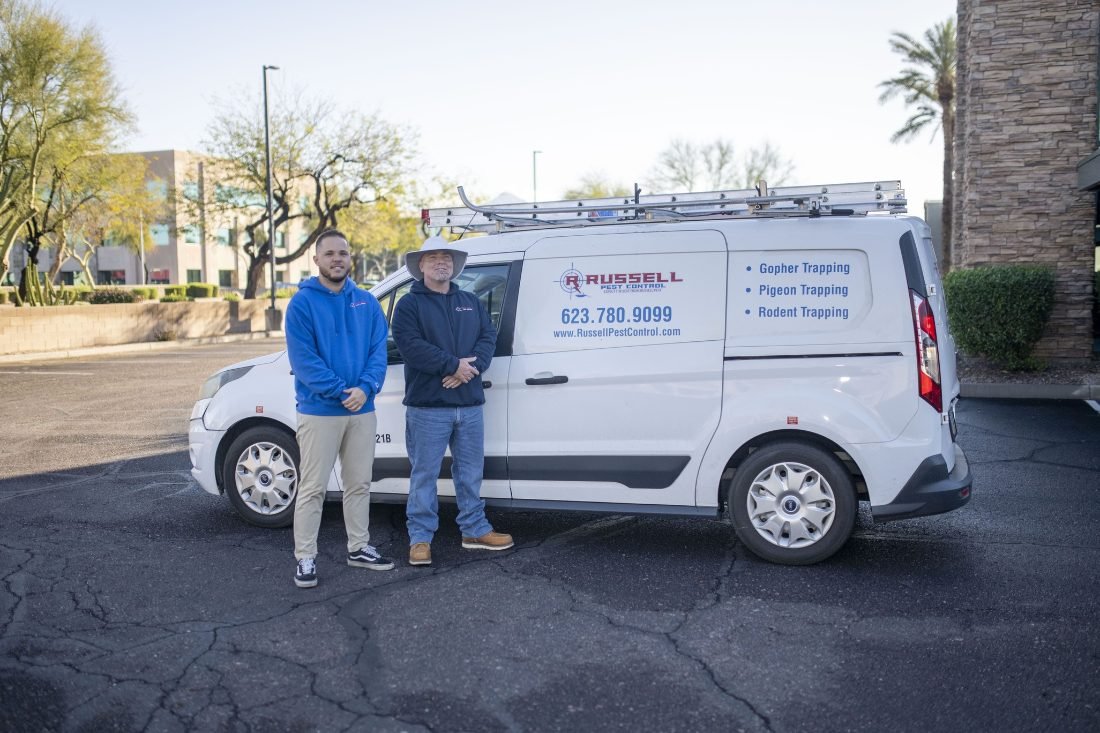
Thirty years of Arizona desert work, with a second generation on the routes. One call gets Steve, Steven Jr., or the office. Never a call center.
The first thing you get on the phone is what to stop doing, which costs nothing and prevents most of the emergencies we're called to.
We check whether a box belongs to the city before we quote you for it.
No contracts and no initial fees on residential service, and a 15-day re-treat warranty if something comes back inside the window.
Arizona OPM License #I5321B, and a family company that's been answering its own phone in the Valley since 1996.
The Rest of the Chandler Playbook
Everything else we run in Chandler, in one place:
Scorpion Control and the Black Light Search
Rodent Control and Exclusion
All Chandler services: /chandler
Tell the Landscaper Before You Call Us
If anyone is being stung, that's 9-1-1 and stop reading. Otherwise: nobody runs power equipment on that side of the house, the dog stays in, and whoever cuts your grass gets told today. Then send us a photograph from a safe distance with your cross streets.
Expect the best from Russell Pest, and have a bug-free day.
Hours
- Monday–Friday: 8:00 AM – 5:00 PM
- Same-day & emergency service available — after hours and weekends, owner-answered
(623) 780-9099 · Call or text · 6750 N 7th Ave, Phoenix, AZ 85013