
Rodent Control in Cave Creek — The Twelve Feet You Are Not Allowed to Clear
Ask almost anyone what to do about packrats and the first answer is to clear the boundary. On a Desert Rural parcel in Cave Creek, the Zoning Ordinance got there first. It requires a twelve-foot band of native habitat measured inward from every property line, requires it to stay undisturbed, and requires it to be replanted if somebody cleared it before you got there. The band is on your land; it is yours to maintain, and it is not yours to remove.
The Town Requires the Habitat and Names It That
Most towns regulate what you may build. Cave Creek regulates what has to stay and uses the word "habitat" in doing so.
Twelve feet inward from every property line
The Zoning Ordinance requires that parcels in the Desert Rural zones include a Native Habitat Corridor twelve feet wide, measured inward from all property lines, left in an undisturbed natural state. If a previous owner disturbed it, the ordinance requires revegetation and names the Town's own landscaping guidelines for which plants may be used. The exceptions are narrow: an approved driveway, utility service lines, boundary markers at spacing, trails, and street addressing.
A corral fence can never stand inside the corridor
In the same zones, all fences, corral fences included, are set back a minimum of twelve feet from any property line. The corridor occupies exactly that outer twelve feet, so a corral fence built to the minimum stands on the corridor's inner edge, and one set further in stands further inside again. Either way, the unclearable band of native desert lies outside the fence, between it and the property line, and nobody drew it there for pest reasons.
Twelve feet is inside the animal's working radius
A Forest Service species review of the white-throated woodrat, the packrat of this desert, records that at McDowell Mountain Regional Park the animals gathered about thirty percent of their house-building material within roughly thirty-three feet of the shelter. It also records that houses are frequently maintained by successive generations, that rocks are preferred over the base of a plant because they hold temperature better, and that horse dung appears among the construction materials in surveyed houses. Thirty-three feet takes in the whole corridor and a good deal of ground inside it.
What the job becomes on a parcel like this
Read the ordinance, and you will find nothing in it about rodents at all. It is a habitat provision, and it says so. The reason it is being read on a rodent page is that a woodrat gathers from a radius, and somebody had to be the one to lay one measurement over the other. Doing that turns the first visit into a permissions question before it is a treatment question: what is in the band, which of it we are allowed to touch, and what has to be written down and left. On a conventional lot, a technician decides where to work. Here the deliverable is partly a record of what may not be worked at all, because a household that clears the band on somebody's advice inherits a revegetation obligation that the somebody does not pay for.
Five Steps, Beginning With a Measurement
Put the corridor edge on the ground first
Twelve feet from the property line, all the way round. We walk it and mark it, because every finding after that is described as inside or outside that line, and a report that does not say which is a report nobody can act on.
Survey the corridor without touching it
Photographs, locations, and a count. Houses, the rock jumbles they prefer, the multi-stemmed low plants they build under. We write down what is there, and we leave it there, and we say plainly which of it we are not going to be allowed to remove.
Work the ground between the corridor and the buildings
This is the part of the property where a program has room, and on a large lot it is most of it. Stations, harborage reduction where it is permitted, and the routes from the corridor to the structures, which are shorter and more obvious than people expect once somebody has drawn the line.
Nothing gets sealed until the structure is empty
Trapping and removal run first and exclusion follows, because sealing a structure with animals inside it produces a worse problem in a wall cavity. Exclusion is a separate, scoped job with its own warranty, and it happens after, never instead. Rodent exclusion works to a wider threshold than scorpion sealing does, and a scope should tell you which one applies where.
Record which findings the ordinance protects
Where a finding falls within the corridor, the report notes that and explains why we left it. That matters twice over: it is the honest record of what was and was not done, and it is what a household needs if anybody ever asks them why the boundary looks the way it does. One safety note before anyone clears anything. Maricopa County publishes the protocol for rodent droppings, and it matters. Rubber gloves on. Ventilate the area the night before you clean by opening doors and windows, and don't shortcut that step to the few minutes before you start. Never sweep or vacuum droppings dry. Spray the droppings, nests, and the area around them with a 10% bleach solution (1 part bleach to 9 parts water), and allow at least 15 minutes of contact time before removing anything. Wipe up with paper towels or a mop, double-bag it, and wash your gloved hands in disinfectant before the gloves come off, then wash your hands with soap and water once they are off. The county puts the onset window for illness at one to five weeks. If a flu-like illness shows up in the weeks after a clean-up, the standing public-health advice is to see a physician promptly, to mention the rodent exposure, and to treat difficulty breathing as urgent, because early diagnosis is what changes the outcome.
The Boundary Somebody Cleared
The call usually comes after the clearing, not before it. A household has had a bad season on a Desert Rural parcel, put a crew on the perimeter, taken it back to dirt, and watched the problem behave oddly afterward.
Then two things happen. The first is that the ground comes back, because desert ground does, and it comes back as the fast opportunistic growth that follows disturbance, which is not what was there before. The second is that somebody mentions the ordinance, and the household discovers that revegetating a cleared corridor is now their obligation and their expense, to a plant list the Town names. The least painful version of that story is the one where somebody checks the line before the crew arrives, which takes about ten minutes.
What Rodent Work Costs in Cave Creek
One clarification on the badge above and the terms below: the 15-day re-treat warranty covers treatment service. Home Seal carries its own one to two year warranty, and the two are separate things.
Removal and exclusion are quoted separately, because one is a program and the other is a defined job
Parcel size, how many structures are on it, how much of the property sits between the corridor edge and the buildings, and how much activity there is when we arrive are what move the number. Large-lot work takes longer than tract work, and the quote should say so before the invoice does
The standing Russell terms apply here: no initial fees, no contracts, and a 15-day re-treat warranty
Black Light Scorpion Search: $125 per hour, after dark. We'll tell you what we expect your property to take before we start
Home Seal is quoted as its own job, typically $600 to $2,500 with a one to two year warranty depending on the work
Estimates are free. Attic and hive searches can carry a charge, waived if you hire us
Why Cave Creek Households Stay With Us
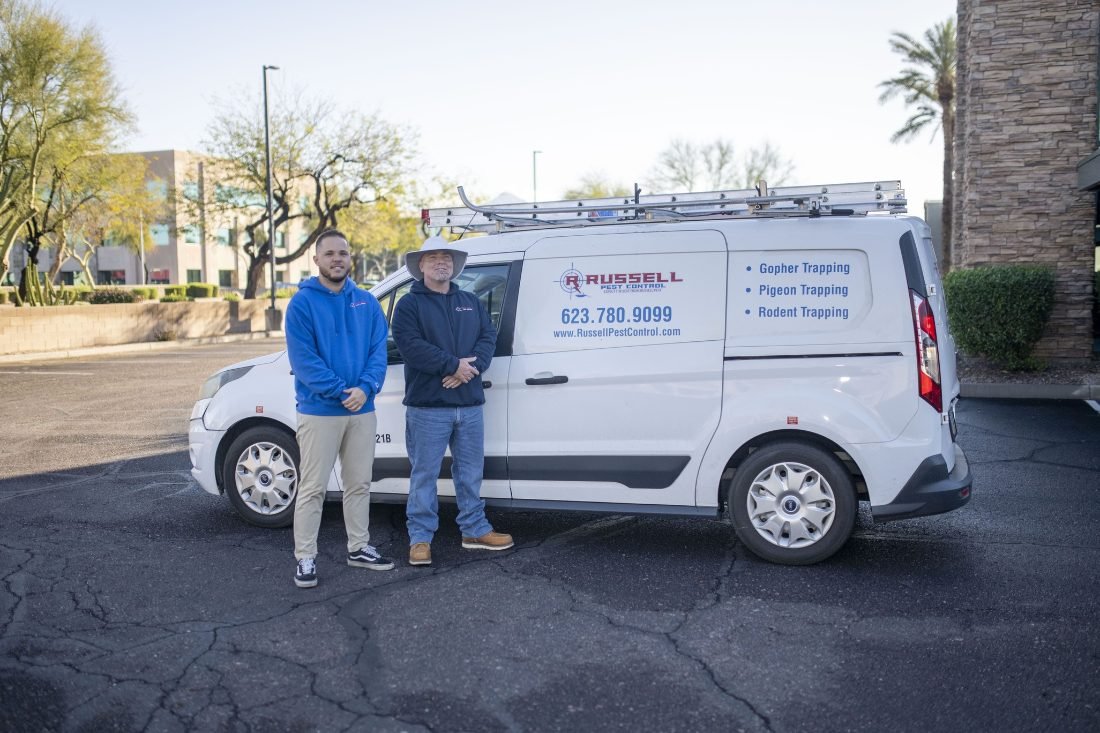
Thirty years of Arizona desert work, with a second generation on the routes. One call gets Steve, Steven Jr., or the office. Never a call center.
We find the corridor edge before we quote anything, because a program priced against a boundary somebody is not allowed to touch is a program priced against nothing.
We refuse to recommend clearing that would put a household on the wrong side of their own zoning, and we will say when a question belongs with the Town.
We will not close a cavity we have not first emptied, whatever the schedule says, because an animal sealed in becomes a wall problem.
Arizona OPM License #I5321B, and a family company that's been answering its own phone in the Valley since 1996.
What Else We Run in Cave Creek
Scorpion Control and Black Light Search
Ground-level work with after-dark ultraviolet mapping quoted by the hour.
Bee Removal and Wasp
Live relocation where a beekeeper can take a colony, and a survey that starts at the water on the property.
Home Seal and Scorpion Sealing
Whole-house exclusion scoped, priced, and warrantied as its own job, across every structure on the parcel.
View Fence and Snake Screening
Screening at the ground line for the yards where a lot meets open desert.
General Pest Control Plans
Monthly, bi-monthly or quarterly, with no contracts and a 15-day re-treat warranty.
Mosquito and Weed
Station-based mosquito work, and pre-emergent timed to both desert weed seasons across acreage.
Commercial and Property Management
Documented programs for buildings, food service, hospitality, and multi-tenant sites.
All Cave Creek services: /cave-creek
What Cave Creek Households Ask Us
Can we clear the twelve feet if the rodent problem is bad enough?
That is a Town question rather than a pest one, and it is worth asking before anybody brings equipment in. What we can tell you is that the ordinance designates the corridor as undisturbed and places revegetation on the owner where it has been disturbed. Development Services is where that conversation belongs.
Does the corridor apply to our lot?
It is written for the Desert Rural zones, so the answer depends on how your parcel is zoned, which the Town can confirm over the phone. We ask because it changes what we are allowed to do. It does not change what we charge.
So is a big lot worse for rodents?
Different, and slower to survey. A large parcel gives an animal more places to be and gives a program more room to work in, and the honest version of that is that the first visit takes longer here than it would on a tract lot.
How far from the buildings should manure sit?
Further from the structures than most people put it, and further from the corridor than most people put it. Cave Creek does write a manure setback and a fly-control program into its ordinance, and both bind Commercial Ranches only, which are a special use on five contiguous acres or more. On a private ranch, there is no Town setback to work to, so siting is a decision somebody makes for convenience, and we will give you ours in writing along with everything else.
We found a built structure inside the twelve feet. What happens to it?
A packrat house. What happens to it turns entirely on which side of the corridor edge it sits on, and the report will say which. Removing the animal and leaving the house standing leaves a furnished address on the property, so if we are not allowed to take it apart the report says that too.
Is trapping safe around livestock?
Yes, with placement chosen for a property where animals live. Tell us what is on the parcel and where it moves, and the plan is built around that.
Can you do same-day service in Cave Creek?
Often, yes. Call or text before noon, and same-day is realistic more often than not, and an indoor sighting is the kind of call we try hardest to fit in. After hours the phone reaches Steve's cell for triage.
Do you treat termites in Cave Creek?
No, and we're straight about it. We'll identify termite signs honestly and refer you to a licensed termite specialist, then handle everything else on the property. Straight lanes, straight answers.
We Will Not Quote You a Perimeter Here
On a Desert Rural parcel, a perimeter program is a program priced against ground the ordinance has already spoken for, and that is better said on the phone than on the invoice. What gets quoted instead is three things: a survey of the corridor, a program for the ground inside it, and an exclusion scope for the buildings. The walk and the written list are free either way, whoever ends up doing the work.
Expect the best from Russell Pest, and have a bug-free day.
Hours
- Monday–Friday: 8:00 AM – 5:00 PM
- Same-day & emergency service available — after hours and weekends, owner-answered
(623) 780-9099 · Call or text · 6750 N 7th Ave, Phoenix, AZ 85013