
Bee Removal in Cave Creek — Out Here, the Water Sets the Ceiling
There is an upper limit on how many honey bee colonies the ground around a Cave Creek property can carry, and in the Sonoran Desert, the thing that sets it is water. Arizona Game and Fish trapped bees at increasing distances from wildlife water in southwestern Arizona and found honey bees most abundant near the water, with abundance thinning quickly away from it. That work was done at wildlife tanks in the southwest of the state and nobody has run it on a paddock in Cave Creek. What follows is what we do with it anyway.
How a Bee Call Actually Runs Here
Is anybody in danger right now?
Before anything else, and if bees are actively attacking somebody, it is 9-1-1 and none of the rest of this page matters. Otherwise: where the activity is, how close it is to a door, a paddock, a pen or a walkway, and whether anyone on the property has a known reaction. That answer changes the order of everything below. Cover your head and face with clothing or your hands, get inside a building or a vehicle and shut the door, and if there's no shelter, run at least 240 yards, which the University of Arizona describes as two football fields, and keep going until you're inside. Don't swat, and don't jump into a pool: the same source says the bees will wait longer than you can hold your breath. After the attack, scrape stingers out sideways and avoid pinching them. Call 9-1-1 for anyone stung many times, or for trouble breathing, swelling of the face or throat, or dizziness. Anyone with a known bee allergy uses their epinephrine and calls 9-1-1, and follows the plan their doctor gave them. We're a pest company, so the medical half stops there.
Find out whether it is a colony or something passing through
This decides the job, and it is a question of what the bees are doing, and never of how many there are. We will ask for a photograph from a safe distance before anybody drives out, because that alone answers it most of the time.
Walk every water source on the parcel and write them down
Trough and float valve, drip emitters and their end caps, hose bibs, the evaporative cooler bleed line, the pool waterline and its backwash point, the fountain, the dog bowl, the bird bath, and any place the ground stays damp with no obvious reason. It takes twenty minutes, and it is what the report is built on.
Deal with the colony, and be honest about which way that goes
Where a beekeeper can take a colony, relocation is the better outcome, and it gets recommended as one. Where the location, the temperament, or the risk to people and animals rules it out, removal is done as removal, and which of the two you are getting is settled out loud, with the reason, before anything is opened.
The hole gets closed, and only after it is empty
The University of Arizona's own guidance is to fill holes an eighth of an inch or larger in trees near structures and anywhere else bees cannot be tolerated, and, in the same document, not to attempt to seal holes or fill voids if bees are actively moving in and out of one. Both halves matter and the order is not negotiable: empty first, closed second.
Hand back the water list with the report
Which sources are leaking, which are simply open, and which of them we would fix first. Nobody is being asked to take a trough away from a horse. What we are saying is that a float valve that seeps is doing something a bird bath is not, and it is the quickest thing on the list to put right.

What Bee Work Covers
Bee work is an assessment, a decision about relocation, the removal itself, and then the closure of whatever the colony was living in. Closure is quoted here as part of the job, and the water list goes out with the report.
Every Dependable Drop Here Arrived Through a Pipe
Two things the Town of Cave Creek publishes about its own water supply do more to explain a bee problem on a large parcel than anything about the flowering season.
The Town has no working wells, so the water is imported
The Town's own water FAQ says Cave Creek is currently ninety-five percent dependent on Colorado River water delivered by the Central Arizona Project, that the raw water is pumped through a twelve-mile pipeline to the Town's treatment plant, and that the Town does not currently have active wells to supplement it. Its 2022 drought plan states that the wells the Town owns have not been used for years due to local aquifer conditions. Natural standing water in this landscape is close to nonexistent for most of the year, and the groundwater beneath it is not being drawn on either.
About forty percent of that imported water goes back outdoors
The same drought plan reports that summer peak demand is almost double winter demand, and that comparing the two seasons gives the Town an estimate of roughly forty percent of its overall supply going to outdoor use. Nearly nine-tenths of what it delivers goes to residential customers. Put those together, and the dependable water in Cave Creek is water that came up a pipeline and was then put out, by somebody, on a residential parcel.
The measurement, and where it comes from
Arizona Game and Fish ran bee traps at varying distances from wildlife water developments in southwestern Arizona across a year. They reported that honey bees showed a strong relationship with water, were most abundant near water sources, and declined rapidly with increasing distance from them, whereas native bees showed no such pattern. The same report notes that adding man-made water sources is believed to have increased honey bee abundance in southwestern desert country.
The Park Service states it as a condition of survival
Its Saguaro National Park material says that honey bees must live close to water, which they use to maintain temperature and humidity inside the colony, and advises caution around any water source. That is a condition of running a colony in a hot, dry place, and it does not relax in a good year.
A horse property sits in an unusual position
Not a worse position, and nobody is arguing for fewer animals. It is an argument for knowing which of the water on a parcel is doing work nobody asked it to do. A trough a horse drinks from is not the problem. A float valve seeping into the ground beside it, twelve months a year, is a different object, and on a parcel where the water is imported and metered, it is also costing somebody money before it costs them anything else.
What Comes With Living Here
The University of Arizona's position on wild colonies in this state is blunt: all wild honey bees in Arizona are Africanized to some extent. That is a statewide finding rather than a Cave Creek one, and treating every wild colony accordingly is the standard of care for everything below.
Where colonies settle on a property like this
- Cavities in the desert itself, including holes in saguaros, rock crevices and abandoned burrows, which is where a colony lives when it is not in a structure
- On a building, the tell is one opening with steady two-way traffic through it, which is a different thing from a lot of bees in the air nearby
One thing worth knowing about horses specifically
A Forest Service safety publication advises against using lemon or citrus-based fly-control products on a horse, because those scents have been known to provoke an attack, and warns that an animal that is penned or tied cannot get away from bees. That is a five-second decision at the feed store with a real consequence attached, and almost nobody has heard it.
What Bee Work Costs in Cave Creek
One clarification on the badge above and the terms below: the 15-day re-treat warranty covers treatment service. Home Seal carries its own one to two year warranty, and the two are separate things.
Where the colony is, what has to be opened to reach it, how much comb and honey is in there, and whether relocation is possible are what move the number. A photograph sent by text answers most of that before anybody drives out
The standing Russell terms apply here: no initial fees, no contracts, and a 15-day re-treat warranty
Black Light Scorpion Search: $125 per hour, after dark. We'll tell you what we expect your property to take before we start
Home Seal is quoted as its own job, typically $600 to $2,500 with a one to two year warranty depending on the work
Estimates are free. Attic and hive searches can carry a charge, waived if you hire us
What Cave Creek Households Ask Us
Do we have to get rid of the trough?
No, and anybody telling you to is not thinking about your animals. Water an animal drinks is water that has a job. What we are looking for is water doing something nobody intended, which is usually a leak, an overflow, or a seep, and that is a repair you can make without giving anything up.
Is that really the reason we keep getting bees?
It is one of the reasons, and overstating it would be easy and wrong. Colonies need a cavity, and they need water, and in this landscape the cavity is easy to find, and the water is not. Removing your leak does not clear the desert. It removes one of the things that made your particular corner of it workable.
How far away could the colony be?
Further than most people assume, which is why the useful question is not where the colony sits but what your own parcel supplies that lets one exist within range at all. We are not going to give you a distance figure we cannot stand behind, and anyone quoting you a precise figure is guessing.
There is a swarm hanging in a tree. Is that urgent?
Keep people and animals well back from it and send us a photograph from a safe distance. Nobody should be walking up for a better description, and nothing should be sprayed at it. What we do next depends on where it is and what is around it.
Is relocation actually on the table here?
Sometimes, and it is the outcome we prefer. It depends on where the colony is, what has to be opened to reach it, and whether a beekeeper can take that particular colony. We will tell you which way it is going before we start, and a removal gets called a removal.
Is the closure quoted separately?
No. Closing whatever the colony was living in is quoted with the removal here, not added afterward. The water list is the part of the report worth reading twice.
What size hole do they need?
Smaller than people expect. The University of Arizona's guidance is to fill holes 1/8 inch or larger in trees near structures and anywhere bees cannot be tolerated, and it also says not to seal anything bees are actively using. Look before you fill, every time.
Who do we call in Cave Creek, actually?
For a colony or swarm on private property, a licensed company. The animal and nuisance chapters of the Cave Creek Town Code carry no bee provision at all, and Maricopa County states in writing that its vector division is not an emergency responder and that a swarm still present after a day should be referred to a pest control company. If someone is being stung or having a reaction, that is a 9-1-1 call, not a pest call.
Do you charge to come and look?
Send a photograph by text first, and it settles most calls at no charge. Where a physical assessment is needed, that and its price are agreed before anybody comes out, and where a search of an attic or a wall cavity is involved, it can carry a charge which is waived if you hire us.
What should nobody on the property be doing?
Two things. Do not spray a colony with a hose or a garden product to see what happens, and do not seal an active entrance. Both turn a manageable situation into an emergency, and the second one moves the bees further into the building.
Can you do same-day service in Cave Creek?
Often, yes. Call or text before noon, and same-day is realistic more often than not, and an indoor sighting is the kind of call we try hardest to fit in. After hours, the phone reaches Steve's cell for triage.
Do you treat termites in Cave Creek?
No, and we're straight about it. We'll identify termite signs honestly and refer you to a licensed termite specialist, then handle everything else on the property. Straight lanes, straight answers.
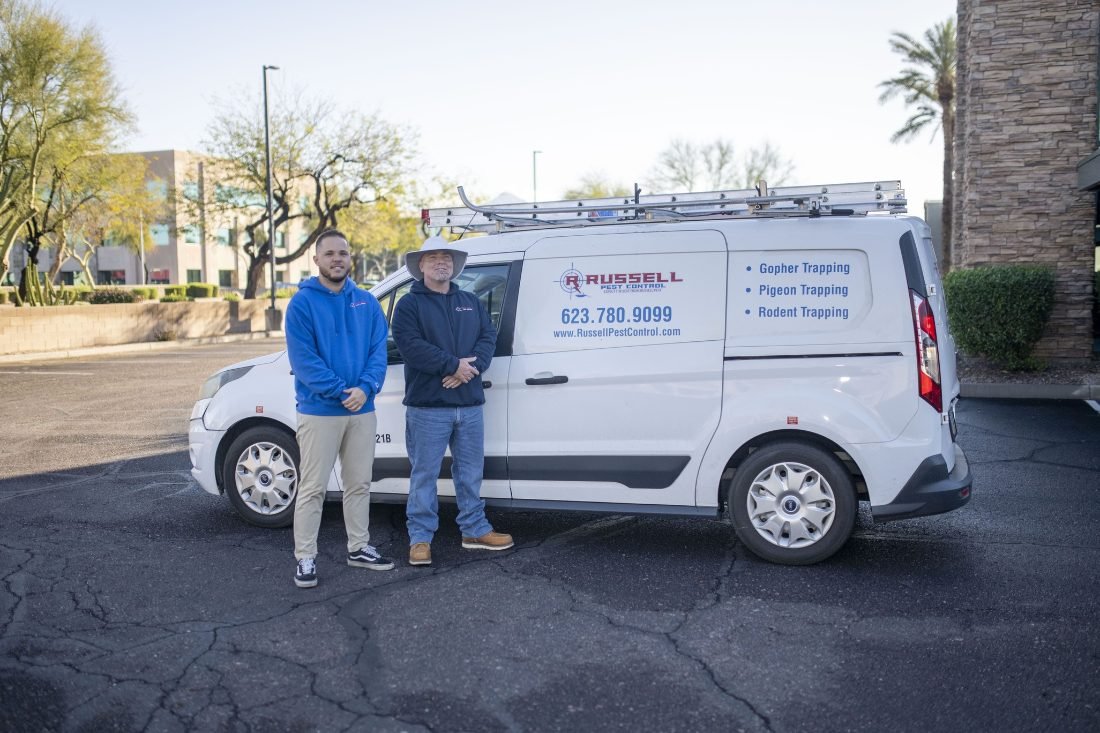
Why Cave Creek Households Call Us for Bees
Thirty years of Arizona desert work, with a second generation on the routes. One call gets Steve, Steven Jr., or the office. Never a call center.
We walk the water on a bee job and hand you the list, because the colony is this week's problem and the water is next year's.
We say which outcome you are getting, relocation or removal, before anything is opened, and we do not call one of them the other.
Arizona OPM License #I5321B, and a family company that's been answering its own phone in the Valley since 1996.
What Else We Run in Cave Creek
Scorpion Control and Black Light Search
Ground-level work with after-dark ultraviolet mapping quoted by the hour.
Rodent Control and Exclusion
Removal before anything gets closed, worked around the twelve-foot habitat corridor the Town requires on Desert Rural parcels.
Home Seal and Scorpion Sealing
Whole-house exclusion scoped, priced, and warrantied as its own job, across every structure on the parcel.
View Fence and Snake Screening
Screening at the ground line for the yards where a lot meets open desert.
General Pest Control Plans
Monthly, bi-monthly or quarterly, with no contracts and a 15-day re-treat warranty.
Mosquito and Weed
Station-based mosquito work, and pre-emergent timed to both desert weed seasons across acreage.
Commercial and Property Management
Documented programs for buildings, food service, hospitality, and multi-tenant sites.
All Cave Creek services: /cave-creek
Your Float Valve, and the Ground Under It
Not the trough, the valve, and the ground underneath it. If it is damp there on a day nobody filled anything, you have found the most reliable water source on the property, and you found it in about a minute. That is worth knowing, whoever ends up doing the work.
Expect the best from Russell Pest, and have a bug-free day.
Hours
- Monday–Friday: 8:00 AM – 5:00 PM
- Same-day & emergency service available — after hours and weekends, owner-answered
(623) 780-9099 · Call or text · 6750 N 7th Ave, Phoenix, AZ 85013