
Rodent Control in Arcadia — The System Down There Has No Inspector
Under Arcadia there was once a second water system, older than most of the houses now standing on it, and by the water company's own account the part reaching private land belonged to the member. Some came out with the rebuilds. Whether any is still under your particular lot is a question nobody has answered, because nothing in the life of a house has ever made anybody check.
Inventory First, Then Accountability
An inventory, which is not the same thing as a walk
Every cover at grade gets found, photographed, and written down before anybody forms an opinion. Irrigation boxes, diversion boxes, the meter, the clean-out, and the ones behind planting that take a rake to find. The total runs higher than people guess.
A name against each one
This is the step nobody else does. For each cover we ask who maintains what is under it, and most answer easily: a utility, the city, the association, the household. The interesting ones answer only in principle, because the water company has published where its responsibility ends, leaving the owner holding whatever lies beyond that line.
Which of the unnamed ones runs anywhere near the house
A run that crosses open lawn and stops well clear of the building gets written down and goes no further. What decides the rest is where it travels: under or beside the structure, and whether anything about it opens into a wall or a slab edge. Plenty do not. The ones that do are the finding.
Removal, keyed to the map the inventory produced
Doing the covers first means the trapping is not guesswork, because the routes are drawn before anything is set. Traps go on them and get checked on a schedule. Bait put down and abandoned on a property with voids under it is how a household ends up with a smell and nothing to open. Gloves and closed shoes, and never reach into a pile you can't see into. The same harborage holds bark scorpions, and near open ground it holds snakes. If something has sat undisturbed for months, don't move it by hand. For a snake, that's a call to a licensed wildlife removal service or Arizona Game and Fish, and a bite is a 911 call. For anything else, leave it for us.
What gets closed, and what stays underground
Once the building is empty, the roofline entries, vent screens, door gaps, and ground-level penetrations get dealt with, including anything an old system left open where the inventory found one. The buried network itself never gets sealed, and a quote offering that is one to walk away from. Rodent exclusion works to a wider threshold than scorpion sealing does, and a scope should tell you which one applies where.
One Buried System With Nobody Assigned to It
Think about what is under a house and who answers for it. Gas has an operator. Water has a utility, as far as the meter. The sewer lateral has a city department at one end, and a homeowner at the other, and a sale or a backup eventually forces somebody to look. Each has a name, a number, and an event that triggers an inspection.
The irrigation network has a name too, and it is the member's
Arcadia Water Company is an Arizona nonprofit, incorporated in 1919, to furnish irrigation water to its members and no one else. In its own published description, it owns the wells, a pumping plant, the reservoir, the main distribution lines, the main diversion boxes, and a number of laterals. Sub-distribution onto members' land it assigns to the members or their association. The line stops short of the house, and what lies past it is the owner's.
Who this describes
A membership, not a zip code. Land inside the water district carries the water right, conditioned on the membership fee and the company's rules, and the district does not stop at a city line. Most of Arcadia is in Phoenix, and the part east of 64th Street is in Scottsdale, and the company's own outage notices have needed Scottsdale approvals to dig in Camelback Road.
It was built for a different Arcadia
A City of Phoenix-adopted plan records that by 1924, crews had laid 15 miles of underground concrete pipe through the area. The neighborhood association has published what became of it: as housing stock was regenerated, new houses were built by blading the property, taking out not only trees but the berms, valves, and landscaping that controlled the water, and, in its words, often removing the water lines themselves. Often is doing real work in that sentence. What comes out is what the machine reached.
Which leaves an asset with no inspection attached to it
Buried, maintained by no utility, carrying nothing, attached to no routine that would ever cause anybody to open it. That is not true of anything else under a house, and it is why a survey on a lot with irrigation history starts at the ground and works up.
What a disused run looks like from the routes
A dry buried line and a long-shut valve box are close to ideal shelter: covered, temperature-stable, undisturbed for years, connected to somewhere else. A live system floods often enough that nothing settles in it; a retired one never does. None of the sources above mention rodents, so that step is ours, and better said aloud than left to pass as somebody's published finding.
Every Visit So Far Has Gone to the Roof
A household that bought recently, inherited whatever is under the property, and has had somebody out more than once. Traps keep catching, and the problem keeps restarting, and every visit has gone to the roof, which on almost every other lot in the Valley is the correct first instinct.
What changes it is a cover behind the planting that nobody has been under, in enough leaf litter that grass has grown across the edge. Dry concrete pipe, running off toward the property line. Not an answer on its own, and the piece the earlier visits never had.
What Arcadia Households Ask Us
How would I even know if there's an old pipe under my lot?
Usually you cannot, and that is the point. There is no drawing to send for and nothing in a normal purchase file that would carry it. It is one of the very few things about a house that stays unknown until somebody goes and finds out.
Should we dig it up?
Almost never, and it is not our call. Buried concrete pipe on your property is a landscaping and plumbing question first. We would close the openings that reach a structure: a much smaller job, and the part that matters.
Is this the water company's problem?
Not according to the way the company describes its own system. It owns the mains, the major diversion boxes and some laterals; sub-distribution onto member land it puts with the members or their association. Worth knowing before anybody calls anybody, and they are the ones to confirm it for your lot.
Our lot is still irrigated. Are we in scope here?
Less of it, and that is good news. A line still taking water is disturbed too often for anything to settle in. What we look at is whatever was valved off or abandoned in place while the rest kept running.
The droppings are at ground level, not in the attic. Does that matter?
Droppings along beams and in the attic mean something moving high. Sticks and collected material heaped at ground level is a packrat midden. Different programs, so send a photograph.
Could we skip the trapping and go straight to sealing?
No, and it is the one request we turn down flat. Sealing an occupied building relocates the problem into a cavity instead of ending it, and on a property with voids under it that may be a cavity nobody can reach. Removal comes first, every time.
How many weeks are we talking about?
Removal is a few weeks of checked traps, so one visit will not do it. Exclusion is a separate, scoped job with its own warranty, and it happens after, never instead. Where the building is the problem, sealing gets scoped and priced as its own job, separate from a service visit, so you can see exactly what it covers.
Who clears the nesting material once it is over?
Where the access allows, insulation and nesting material come out with the job, and where a space needs more, you hear it before we start. Read the county protocol on this page first if you are thinking of going up there yourself.
Our neighbors have the same thing. Does that change the approach?
Not ours, and what happens past your wall is not something we will describe or speculate about. Exclusion earns its price here for that reason: it is the one part of the answer that does not depend on anybody else.
We're about to re-landscape. Is that the moment to deal with this?
The best moment you will get. Machinery is on site, and the ground is open, so anything abandoned down there can be dealt with while it is visible. Ask whoever does the work to photograph what they find before it goes back under.
Can you do same-day service in Camelback East?
Often, yes. Call or text before noon, and same-day is realistic more often than not, and an indoor sighting is the kind of call we try hardest to fit in. After hours, the phone reaches Steve's cell for triage.
Do you treat termites in Camelback East?
No, and we're straight about it. We'll identify termite signs honestly and refer you to a licensed termite specialist, then handle everything else on the property. Straight lanes, straight answers.

What Rodent Work Covers
Rodent work is removal plus exclusion, in that order, with the harborage and the food supply handled alongside. On a lot here, the exclusion half can run longer, because a disused system, where the inventory finds one, has usually left ground-level openings of its own. Sealing reduces how much gets in, which is what makes a treatment program hold. It doesn't replace treatment, and a quote implying otherwise is selling you something. Where a property needs both, we price them separately so you can see what you're buying.
One safety note before anyone clears anything. Maricopa County publishes the protocol for rodent droppings, and it matters. Rubber gloves on. Ventilate the area the night before you clean by opening doors and windows, and don't shortcut that step to the few minutes before you start. Never sweep or vacuum droppings dry. Spray the droppings, nests, and the area around them with a 10% bleach solution (1 part bleach to 9 parts water), and allow at least 15 minutes of contact time before removing anything. Wipe up with paper towels or a mop, double-bag it, and wash your gloved hands in disinfectant before the gloves come off, then wash your hands with soap and water once they are off. The county puts the onset window for illness at one to five weeks. If a flu-like illness shows up in the weeks after a clean-up, the standing public-health advice is to see a physician promptly, to mention the rodent exposure, and to treat difficulty breathing as urgent, because early diagnosis is what changes the outcome.
Why Arcadia Households Stay With Us
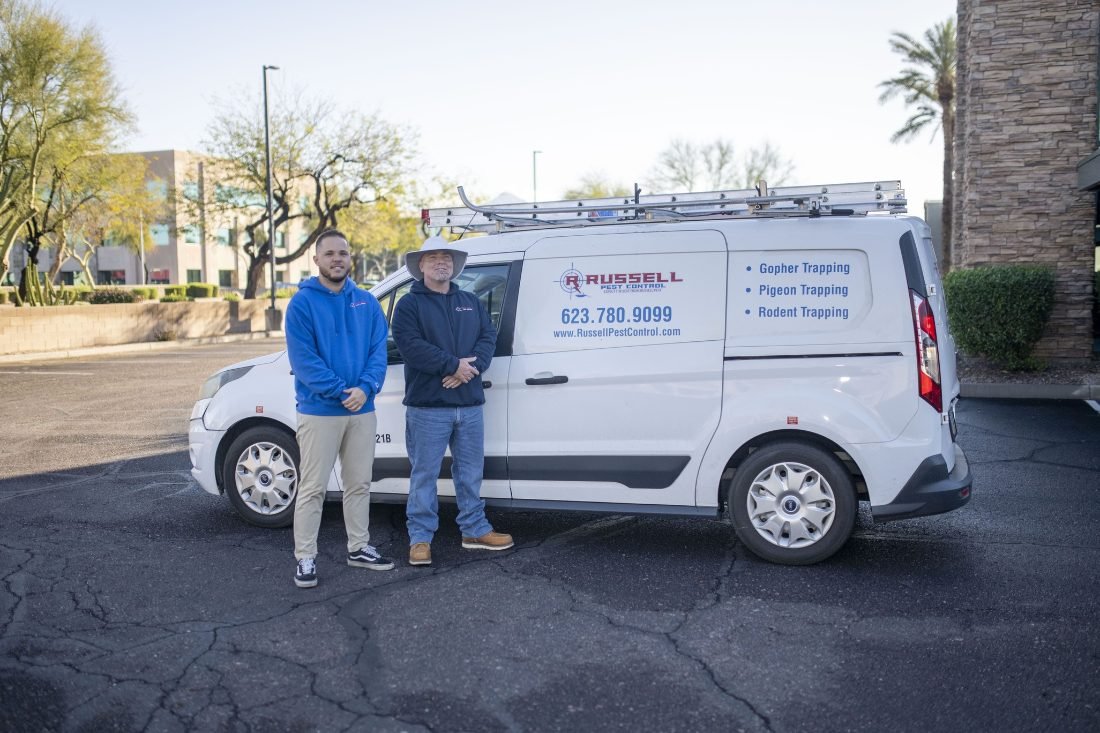
Thirty years of Arizona desert work, with a second generation on the routes. One call gets Steve, Steven Jr., or the office. Never a call center.
We ask who is responsible for every buried thing on the property, and say plainly which of them is you.
No contracts and no initial fees on residential service, and a 15-day re-treat warranty if something comes back inside the window.
We work the ground line before the roofline on a lot with irrigation history, which is the reverse of the usual order and the reason we find things a roof-first visit does not.
Arizona OPM License #I5321B, and a family company that's been answering its own phone in the Valley since 1996.
What Rodent Work Costs in Arcadia
One clarification on the badge above and the terms below: the 15-day re-treat warranty covers treatment service. Home Seal carries its own one to two year warranty, and the two are separate things.
Which animal you have, roof pitch and attic access, lot size, and how many ground-level openings the inventory finds are what move the number. Removal and exclusion are quoted separately, because one is a program and the other is a defined job
The standing Russell terms apply here: no initial fees, no contracts, and a 15-day re-treat warranty
Black Light Scorpion Search: $125 per hour, after dark. We'll tell you what we expect your property to take before we start
Home Seal is quoted as its own job, typically $600 to $2,500 with a one to two year warranty depending on the work
Estimates are free. Attic and hive searches can carry a charge, waived if you hire us
What Else We Run in Camelback East
Rodent Exclusion and Home Seal
Roofline screening and whole-house sealing, each scoped and priced as its own job.
Scorpion Control and Black Light Search
An after-dark pass that counts what is on the surface and maps the routes it travels.
General Pest Control Plans
Monthly, bi-monthly, or quarterly, with no contracts and a 15-day re-treat warranty.
Mosquito Control
Source reduction on your own water plus a serviced station program for the adults resting on it.
Bee, Wasp and Weed
Live relocation where a beekeeper can take the colony, and pre-emergent timed to both desert weed seasons.
Commercial and Property Management
Documented programs for buildings, food service, tower associations, and multi-tenant sites.
All Camelback East services: /camelback-east
How Much of Your Own Lot Can You Explain?
Ten minutes in your own yard, putting a name to every cover at grade. Gloves and closed shoes if you are moving planting, and leave any lid shut for years for us to lift. Whatever is left over is the thing to tell us, and it says more about an Arcadia property than any account of the sightings will. The walk and the written list are free either way, whoever ends up doing the work.
Expect the best from Russell Pest, and have a bug-free day.
Hours
- Monday–Friday: 8:00 AM – 5:00 PM
- Same-day & emergency service available — after hours and weekends, owner-answered
(623) 780-9099 · Call or text · 6750 N 7th Ave, Phoenix, AZ 85013