
Mosquito Control in Arcadia — Find Where the Water Stops Crossing
A share of the water that stands on an Arcadia lot fell on Camelback Mountain, ran south, and was only ever passing through on its way to the canal. That makes a property here two things at once: a source, like any lot in the Valley, and a route. Routes do not breed mosquitoes. Blocked routes do, which is a different thing to go looking for.
What Arcadia Households Call Us About
The calls
West Nile, at its actual size
Here's the honest shape of it. Maricopa County had an exceptional year in 2021 with 1,487 human cases reported, and the largest outbreak before that was 355 cases in 2004. Those are counts of diagnosed illness rather than of infection, and most infections are never diagnosed at all: about eighty percent of people infected never develop symptoms, and CDC analysis puts roughly thirty to seventy milder cases against every severe case identified. The true number of infections in an outbreak year runs far above the reported count. There's no vaccine and no specific treatment, so prevention is the whole game, and anyone who feels unwell after mosquito exposure should speak to their own doctor. Maricopa County Public Health publishes the current figures.
Two things you control that no yard treatment can: an EPA-registered repellent, and long sleeves at dawn and dusk. We're a pest company, so the medical half is short, and it isn't ours. For the small share who do get seriously ill, the CDC is direct, and we'll quote it rather than paraphrase it: seek immediate medical attention for high fever, neck stiffness, muscle weakness, confusion, or tremors. If that is what you are seeing, get medical help now. Anything short of that is still a question for a clinician and not for us.
Follow It Downhill Until Something Stops It
Settle which way the ground actually falls
Not the direction you assume, and on a lot that has been re-landscaped or rebuilt, often no longer the direction the original builder set. A hose and ten minutes settles it, and everything after depends on the answer.
Walk the fall line to the first obstruction
From wherever water enters, downhill, until something interrupts it. A property wall, a raised patio slab, a bed built up against a fence, the lip of a driveway apron. That first interruption is where a route turns into a pond, and on a walled lot there is almost always one.
The obstruction is the finding
This is the part worth taking away even if you never hire anybody. The standing water is the symptom; whatever is holding it up is the finding, and the two are rarely in the same place. A wet corner that is new to an old lot means something changed upstream of it, and that is usually easier to deal with than the corner.
Count the containers anyway, because they are still real
The pot draining into its own tray, the bin lid that fills, the sagging shade sail, the pool cover holding an inch in July. None of it has anything to do with the mountain, and all of it still breeds. Gloves and closed shoes, and never reach into a pile you can't see into. The same harborage holds bark scorpions, and near open ground it holds snakes. If something has sat undisturbed for months, don't move it by hand. For a snake, that's a call to a licensed wildlife removal service or Arizona Game and Fish, and a bite is a 911 call. For anything else, leave it for us.
Where they wait it out between eleven and four
Nothing on the route tells you this, so it gets walked separately: the deepest, coolest, most sheltered planting on the property, which under Arcadia's older landscaping covers more of the lot than people expect. Stations go there.
Service the stations, and re-read after weather
Stations get checked and refilled on a cadence, and the route gets read again after anything substantial has fallen, because the one thing that does change is what people build, plant, and pave across it.
The Water Crossing This Lot Started on a Mountain
Most of the Valley is flat enough that a lot only answers for the water landing on it. This strip is different, and the City has described why.
The shape of the land, in the City's own sentence
A City of Phoenix plan adopted in June 1999 puts it plainly: stormwater runoff in the Arcadia area flows south from Camelback Mountain to the Arizona Canal, occasionally flooding streets and, in years past, homes. The same plan records that before remedial measures taken since 1972, water ponded on the north bank of the canal, which is what happens at the bottom of a slope when it runs out of anywhere to go. The slope is still the slope.
Most of the fix still exists as a drawing
The Flood Control District of Maricopa County completed its Arcadia Area Drainage Project study in 1997. That study, and the Metro Area Drainage Master Plan that followed, recommended a series of storm drains to reduce flooding caused by mountain runoff ponding against the canal. At the District's last published update, the project was in engineering and design, and the county budget materials describe the later phases as likely to require future bond elections.
What that does to a lot standing on the path
None of those documents mentions mosquitoes, and we are not going to imply that they do: the step from a drainage record to a pest program is Russell's, and it is worth saying so before we take it. The first phase, an outfall at the Old Cross Cut Canal, was built and completed in 2012, and county materials describe it as providing an outfall for storm drains still to come along Camelback Road and Lafayette Boulevard. The drains that would actually collect water north of the canal are still in engineering and design, and the county budget materials describe those later phases as likely to require future bond elections. So nothing published gives this strip of ground a date after which the transit stops. It is a permanent feature of the ground, and a permanent feature is worth understanding once rather than being surprised by it twice a summer.
None of which is about your particular house
It describes a strip of ground between a mountain and a canal, and even there what happens on any lot is decided by that lot's grade and its walls. The useful question stays small: after wet weather, is the standing water continuous with a boundary, or sitting on its own in the middle of your ground?
What we are not saying
The 1999 plan mentions a hundred-year floodplain designation, and we raise it only to say we are not applying it to you: the plan attaches it to conditions before remedial measures taken since 1972, and we have not checked what applies to your parcel. Nothing here says you live in one. What we can do is walk your ground and read the water on it.
What Arcadia Households Ask Us
Our lot slopes. Is that automatically bad?
The opposite, usually. Ground that sheds cleanly is the best case there is, because water that keeps moving never completes anything. Trouble comes from ground that receives and holds, so a slope matters only where something across it stops the water leaving.
How would I tell whether water is crossing us or starting here?
Look at the shape of the wet ground after weather. Water that arrived from elsewhere usually leaves a band continuous with a boundary, a wall or a gateway. Water the property made itself tends to sit in isolated patches with dry ground around them, and that is the smaller job by a wide margin.
We turned the irrigation off. Why did nothing change?
Then it was not the thing to change, and the irrigation question belongs on the Camelback East hub rather than here. What we handle is the water that arrives without anybody scheduling it, and a valve has no effect on whatever is stopping that at the low end of your ground.
Our street floods and the neighbors' doesn't. Is that us?
Possibly not, and street drainage is not ours to assess or to fix. Worth separating is the water in the street from the water inside your wall, because only the second is something anybody can quote for.
Does the canal have anything to do with it?
Not as a breeding site, so far as we know, and we have not measured it. Moving water in a lined channel is poor ground for it. What the canal marks on this page is the bottom of a slope, which is topography rather than a claim about the water in it.
Can we just wall it out, or regrade the whole thing?
Carefully, and with somebody qualified. Changing where surface water goes affects whoever is downhill of you, which makes it a civil question rather than a pest one. A landscape contractor or a civil engineer is the right first call, and our sketch is useful to hand them.
We took a lid off, and there was water underneath. Now what?
Work out which kind it is first. A box on the route fills from outside when it rains and empties slowly, which is a grade problem. A box off the route that is wet in June is fed by something leaking above it, which is a plumber's job. If the lid has been down for years, photograph it and leave the lifting to us.
How much of this is actually within our control?
More than most households assume, and less than a program is sometimes sold as covering. What you control is what your ground produces and what shelters on it by day, and on a route lot the first is largely a question of what is in the way. Arrivals from elsewhere are nobody's to control.
Can you do same-day service in Camelback East?
Often, yes. Call or text before noon, and same-day is realistic more often than not, and an indoor sighting is the kind of call we try hardest to fit in. After hours, the phone reaches Steve's cell for triage.
Do you treat termites in Camelback East?
No, and we're straight about it. We'll identify termite signs honestly and refer you to a licensed termite specialist, then handle everything else on the property. Straight lanes, straight answers.

What Mosquito Work Covers
Reading and reducing what stands on your own ground, plus a serviced station program for the adults sheltering on it through the day.
The first half is the walk, the route sketch and the container list, and some of what it finds is a landscaper's job. The second is where a treatment reaches, and that half stays a service for as long as the planting does.
What Mosquito Work Costs in Arcadia
One clarification on the badge above and the terms below: the 15-day re-treat warranty covers treatment service. Home Seal carries its own one to two year warranty, and the two are separate things.
Lot size, planting and canopy, how much standing water the walk finds, and whether you want a serviced season or a single visit are what move the number. The route sketch and the written list come with the walk
The standing Russell terms apply here: no initial fees, no contracts, and a 15-day re-treat warranty
Black Light Scorpion Search: $125 per hour, after dark. We'll tell you what we expect your property to take before we start
Home Seal is quoted as its own job, typically $600 to $2,500 with a one to two year warranty depending on the work
Estimates are free. Attic and hive searches can carry a charge, waived if you hire us
What Else We Run in Camelback East
General Pest Control Plans
Monthly, bi-monthly or quarterly, with no contracts and a 15-day re-treat warranty.
Rodent Control and Exclusion
Removal before anything gets closed, then screening at the roofline and the ground line.
Scorpion Control and Black Light Search
An after-dark pass that counts what is on the surface and maps the routes it travels.
Bee, Wasp and Weed
Live relocation where a beekeeper can take the colony, and pre-emergent timed to both desert weed seasons.
Commercial and Property Management
Documented programs for buildings, food service, tower associations, and multi-tenant sites.
All Camelback East services: /camelback-east
Why Arcadia Households Stay With Us
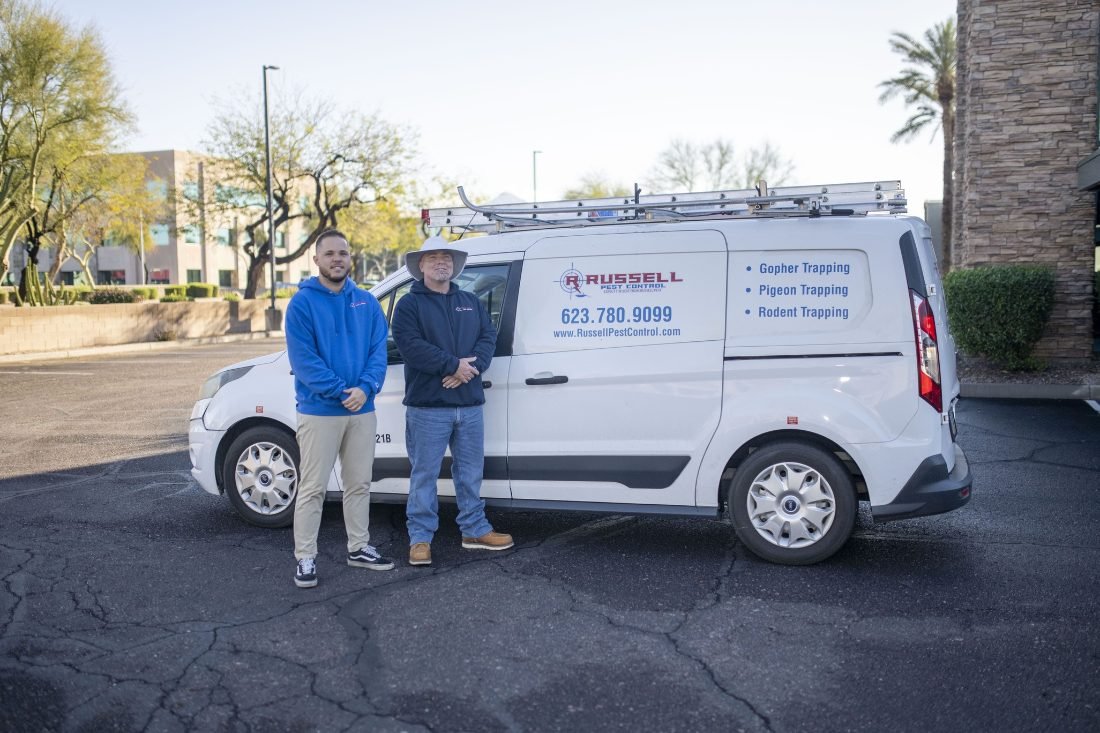
Thirty years of Arizona desert work, with a second generation on the routes. One call gets Steve, Steven Jr., or the office. Never a call center.
We map the route water takes across a property, not only where it ends up, because on this ground the second is explained by the first.
No contracts and no initial fees on residential service, and a 15-day re-treat warranty if something comes back inside the window.
We look for what stopped working, because a wet corner that is new to an old lot is usually something that used to pass water and no longer does.
We keep the same technician on a property wherever the schedule allows, because reading a lot's water is knowledge that accumulates rather than a checklist.
We leave the route drawn on paper, which stays true for as long as your grade does.
Arizona OPM License #I5321B, and a family company that's been answering its own phone in the Valley since 1996.
The Exit Is the Part Nobody Has Checked
Most people can say where water arrives on their property. Almost nobody can say where it leaves. That one answer reorganizes everything else on this page; it takes a single walk, and you keep the drawing whether or not you buy anything. The walk and the written list are free either way, whoever ends up doing the work.
Expect the best from Russell Pest, and have a bug-free day.
Hours
- Monday–Friday: 8:00 AM – 5:00 PM
- Same-day & emergency service available — after hours and weekends, owner-answered
(623) 780-9099 · Call or text · 6750 N 7th Ave, Phoenix, AZ 85013