
Scorpion Control in Ahwatukee — The Desert Between the Houses Has an Owner
A household calls in August. Three in the house in two weeks, one in a bathroom at two in the morning, and the question is always the same: where are they coming from? On a lot backing one of Ahwatukee's greenbelt channels, the answer is a short walk away, and it is not the desert everybody pictures. It is planted, permanently vegetated ground running between the subdivisions, not around them, and across much of the original village it belongs to the homeowners association and is maintained from the assessments households pay.
What Ahwatukee Households Call Us About
The calls
- One indoors at night, and nobody in the house sleeping well since
- A household that has lived here twenty years and never had one until this summer
- A back gate onto the greenbelt that the children use and the parents have stopped liking
- Somebody who moved from a mid-block lot to a channel lot and noticed the difference immediately
- A landscaper's crew who cleared the bank and found more than they expected
- An owner who wants to know what the association's maintenance does and does not cover
What a sting actually means
The Arizona bark scorpion is the only scorpion in the country considered medically significant. Reactions vary, and it isn't ours to assess. We're a pest company, not a clinic, so if someone is stung, the number you want is Poison Help at 1-800-222-1222, which routes to your county's poison center. For a young child, or for anyone with trouble breathing or swallowing, call 911.
Where they get in
- The stem wall and weep screed line, where the stucco meets the ground
- Garage thresholds and the gap under a roll-up door
- Irrigation and valve boxes, hose bib penetrations, and pool equipment pads
- Block wall voids, weep holes, and gate posts along the property line
- The gap where a patio slab has separated from the house
The harborage on your side
On a greenbelt lot, the harborage question is about the strip before the wall: what has been stacked there, what has grown closed at the base, and what got pushed to the fence line because that was the tidy place for it. Gloves and closed shoes, and never reach into a pile you can't see into. The same harborage holds bark scorpions, and near open ground it holds snakes. If something has sat undisturbed for months, don't move it by hand. For a snake, that's a call to a licensed wildlife removal service or Arizona Game and Fish, and a bite is a 911 call. For anything else, leave it for us.
Work to the Property Line
Establish where your ground stops
On a channel lot, this is the first question, and it is not obvious from the back gate. The wall may sit on the line, inside it, or short of it, and the bank beyond may be association ground your assessment maintains. Everything after that is bounded by the line, and it goes on the paperwork before anything gets treated.
Work the strip you own hard
Whatever sits between the patio and the wall is the part of the corridor you can change. Trimmings stacked at the fence line, planting closed at the base, a woodpile against the block. That is where a program earns its money, because it is the only stretch of the corridor anyone has given us permission to touch, and it is where the crickets a scorpion follows are easiest to take down.
Map it after dark
A pass across your own ground after dark tells you how much of what you have lives there and how much arrives each night. Scorpions fluoresce under ultraviolet light, so an after-dark pass maps what's on the surface that night and the routes it travels. It runs at $125 per hour.
Close the building
Every opening the walk listed is closed to a stated standard and written down. With permanent planted ground on one side, sealing is the part of the job that keeps working when nothing else changes. A bark scorpion gets through a gap around a sixteenth of an inch. Sweeps, thresholds, weep screed, slab joints, and utility penetrations are where a house actually leaks. Where the list runs long, the work moves to a scoped Home Seal, with its own price and its own warranty.
The Strip Nobody Realizes They Control
The far side of the wall is the association's, and it is on a schedule. Your side of it is a strip of ground two or three feet wide that appears on no schedule at all, and it is the only stretch of that boundary anybody has asked your permission about.
What that strip does determines whether the corridor stops at the wall or carries on past it. The pressure beyond the wall is a constant you are already paying an assessment to have managed. The strip is the variable; it is yours, and it is the cheapest thing on the property to change.
What Ahwatukee Households Ask Us
Who actually owns the channel behind my house?
In much of the original village, it's the Ahwatukee Board of Management that publishes that its assessments maintain roughly 106 acres of drainage channel and common area. Not every part of Ahwatukee sits under that arrangement, and plenty of homes are also in a sub-association with its own documents. Yours will name the owner of the ground behind you, and it's worth knowing which one you're in before you assume anything about who maintains it.
So the maintenance is already paid for?
The drainage maintenance is outside assessments. What that budget buys is a channel that carries water and a bank that is safe to walk, which is not the same as ground managed for what lives in it.
Can you treat the channel itself?
Only with the association's instruction, and then the association is the customer. A homeowner can't authorize work on common area, and we won't put product on ground that isn't the customer's. Your side of the wall is a different matter and is part of your service.
Does the association's maintenance help with any of this?
Incidentally, at best. Clearing and grading a channel does move material that scorpions were living in, so a maintenance pass can quiet a stretch for a while. It isn't aimed at that and isn't scheduled around it, so it isn't something to plan a season on.
Is it worse than being on the preserve edge?
Different rather than worse. Preserve-edge pressure comes from the open desert, which dries out for most of the year. Channel pressure comes from planted, maintained ground with a prey population living in it, close to the wall, and it has no quiet season. Both respond to the same program; where you put it changes.
Is the black-light search worth it here?
On a channel-backing lot, usually. What it tells you is how much of what you have is living on your ground and how much walked in that night, and those two answers lead to different programs. It's the thing we'd want to know before quoting a heavier cadence.
We're not on a channel at all. Does this apply?
Less of it. If your lot is mid-block with houses on all four sides, your pressure arrives over fences rather than out of a corridor, and the program is simpler. We'd tell you that on the walk and price it accordingly.
Can you do same-day service in Ahwatukee?
Often, yes. Call or text before noon, and same-day is realistic more often than not, and an indoor sighting is the kind of call we try hardest to fit in. After hours, the phone reaches Steve's cell for triage.
Do you treat termites in Ahwatukee?
No, and we're straight about it. We'll honestly identify termite signs, refer you to a licensed termite specialist, and handle everything else on the property. Straight lanes, straight answers.
A Hundred Acres With a Line Item
The planned community these subdivisions belong to was built out from 1971 onward on ground that sheds a great deal of water off the mountain, and the drainage was incorporated into the plan rather than added afterward. What came out of that is a network of channels and greenbelt threading between the subdivisions. The association describes what it maintains as greenbelt and desert channels, kept up for drainage and for safety.
Privately owned, and not city ground
That's the part most households don't know. The association owns the main channel and the common ground either side of it, and its published figure for what it maintains runs to roughly 106 acres of greenbelt and desert channel. Drainage maintenance and upkeep is a line item in the budget, and every owner in it pays toward that.
Which changes what your lot actually is
A house backing that network is a different object from a mid-block house with a nice outlook. It has planted, permanently vegetated ground on the far side of one wall, maintained to a drainage standard and no other, running on past the next house and the one after that. For a bark scorpion that is a corridor with food in it, and the wall is the only thing between the two.
What Scorpion Work Costs in Ahwatukee
One clarification on the badge above and the terms below: the 15-day re-treat warranty covers treatment service. Home Seal carries its own one to two year warranty, and the two are separate things.
Lot size, how much of your perimeter faces greenbelt or channel, how much harborage is on the property, and what the walk turns into on the sealing list are what move the number. Channel on two sides is more perimeter than channel on one, and the quote will say so
The standing Russell terms apply here: no initial fees, no contracts, and a 15-day re-treat warranty
Black Light Scorpion Search: $125 per hour, after dark. We'll tell you what we expect your property to take before we start
Home Seal is quoted as its own job, typically $600 to $2,500 with a one to two year warranty depending on the work
Estimates are free. Attic and hive searches can carry a charge, waived if you hire us
What Else We Run in Ahwatukee
Black Light Scorpion Search and Sealing
A counted survey after dark, and the sealing list that comes out of it.
General Pest Control Plans
Monthly, bi-monthly, or quarterly, with no contracts and a 15-day re-treat warranty.
Rodent Control and Exclusion
Removal before anything gets sealed, then screening at the roofline and the ground line.
View Fence and Snake Screening
For the yards where an Ahwatukee lot meets open ground or a channel bank.
Mosquito, Bee and Weed
Station-based mosquito work, live bee relocation where a beekeeper can take the colony, and pre-emergent timed to both desert weed seasons.
Commercial and Property Management
Documented programs for buildings, food service, and association common areas.
All Ahwatukee services: /ahwatukee
Why Ahwatukee Households Stay With Us
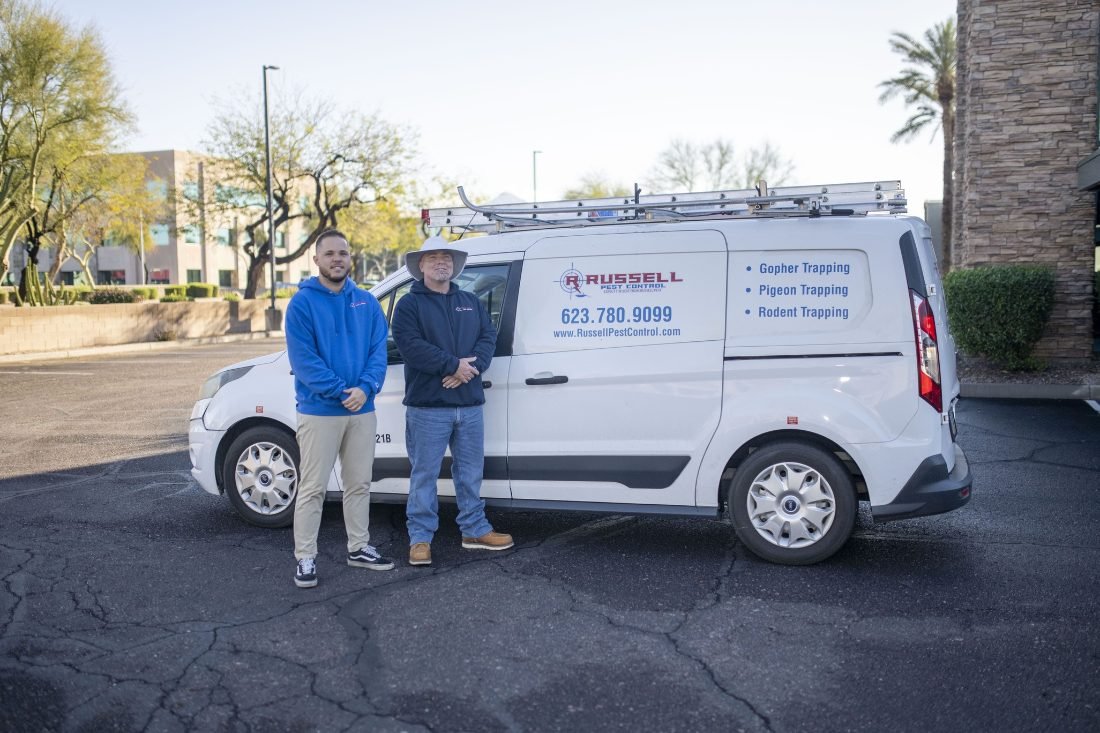
Thirty years of Arizona desert work, with a second generation on the routes. One call gets Steve, Steven Jr., or the office. Never a call center.
We treat the channel-facing wall as a different job from the street-facing one, because on these lots it is.
No contracts and no initial fees on residential service, and a 15-day re-treat warranty if something comes back inside the window.
We put the property line on the paperwork before we treat anything, so you know exactly what you bought.
Arizona OPM License #I5321B, and a family company that's been answering its own phone in the Valley since 1996.
Decide What Kind of Problem This Is
There is a decision here, and it is yours. The ground on the far side of that wall is permanent; it is maintained for drainage and not for pests, and nobody is going to change either of those things. You can treat that as a seasonal problem and buy a program when a bad summer arrives, or you can treat it as a condition of the lot and keep a light one running. We will tell you what each looks like and what it costs. The second works better, and we would rather say so now than let you find out over two summers. The walk and the written list are free either way, whoever ends up doing the work.
Expect the best from Russell Pest, and have a bug-free day.
Hours
- Monday–Friday: 8:00 AM – 5:00 PM
- Same-day & emergency service available — after hours and weekends, owner-answered
(623) 780-9099 · Call or text · 6750 N 7th Ave, Phoenix, AZ 85013