
Rodent Control in Ahwatukee — Where Do the Rules Say to Put Things?
Where is your irrigation tubing? Where is the groundcover fabric, the air conditioning unit, the trailer? Across much of Ahwatukee, those answers rhyme, because the association's rulebook is enforced by what can be seen from the street, and it has quietly told a whole village where to put things. Undisturbed is what makes harborage. Buried, screened, and out of view is a fair description of undisturbed.
What Rodent Work Covers
Rodent work is removal plus exclusion, in that order, with the harborage and the food supply handled alongside. Sealing reduces how much gets in, which is what makes a treatment program hold. It doesn't replace treatment, and a quote implying otherwise is selling you something. Where a property needs both, we price them separately so you can see what you're buying.
One safety note before anyone clears anything. Maricopa County publishes the protocol for rodent droppings, and it matters. Rubber gloves on. Ventilate the area the night before you clean by opening doors and windows, and don't shortcut that step to the few minutes before you start. Never sweep or vacuum droppings dry. Spray the droppings, nests, and the area around them with a 10% bleach solution (1 part bleach to 9 parts water), and allow at least 15 minutes of contact time before removing anything. Wipe up with paper towels or a mop, double-bag it, and wash your gloved hands in disinfectant before the gloves come off, then wash your hands with soap and water once they are off. The county sets the onset window for illness at 1 to 5 weeks. If a flu-like illness shows up in the weeks after a clean-up, the standing public-health advice is to see a physician promptly, to mention the rodent exposure, and to treat difficulty breathing as urgent, because early diagnosis is what changes the outcome.
A Rulebook Written in the Language of Sight
The Ahwatukee Board of Management's rules on stored vehicles set one test, and the test is visibility. Recreational and utility vehicles are not to be parked at a lot in view of the streets or neighboring lots, with a narrow exception of no more than forty-eight hours, for loading and unloading only. The architectural guidelines then close the assumption a homeowner would draw from that, and note that approving an oversized gate is not approving the storage of such a vehicle behind it.
The same test runs through the whole document
Once you notice the standard, you find it everywhere. Irrigation tubing and soaker hoses are to be buried so they are not visible from the streets or neighboring lots. Groundcover fabric is to be kept invisible too, and plant debris removed from view. A mini-split air conditioner visible from the street may be approved if it is screened, and the guidelines require screening or substantial plants that screen year-round.
Which relocates a great deal and removes almost none of it
The trailer goes behind the wall return. The tubing goes under the granite. The equipment goes behind a planting chosen to stay dense year-round. Each is a good answer to the rule and a quiet answer to a survey, because the one condition that turns an object into harborage is being left alone, and a thing put where nobody looks at it is left alone. That last step is ours, not the association's, which has said no word about pests anywhere in these rules and would be entitled to say so.
So the survey starts behind the sightline
The useful list on these lots is not a list of clutter. It is a list of compliance: everything the household put somewhere specific because a rule required it, plus everything that later drifted to the same places because those were where things went. What a survey cannot do on these streets is read the front of a lot and conclude anything about the back of it.
Whose lot these rules govern
The Board of Management's rules reach residential lots that do not have a sub-association. Plenty of Ahwatukee homes are also in a sub-association, whose own guidelines then take precedence. So the document that governs your lot may not be the one governing the street behind you, and it is worth knowing which you have.
Survey Behind the Sightline
Work out which animal you have
Sticks, cactus joints and collected hardware heaped at ground level is a packrat midden. Droppings along a beam or a fence top mean something that moves above the ground. A photograph usually settles it before anybody drives out.
Go through the screened items one at a time
The screen planting first, because nobody thinks of it as an object and the rules asked for it by name. Then the equipment, then the wall returns. Whatever is behind the gate goes last because it needs to be unlocked and is the one the household already knows about.
Trap where they already travel
Traps go on the runs the animal is already using, and they get checked rather than left. Bait on its own inside a building gives you something dying in a place nobody can reach, and a smell is a worse problem than the one you started with.
Take the food down
Fallen fruit, pet food off the patio overnight, bird seed contained. Gloves and closed shoes, and never reach into a pile you can't see into. The same harborage holds bark scorpions, and near open ground it holds snakes. If something has sat undisturbed for months, don't move it by hand. For a snake, that's a call to a licensed wildlife removal service or Arizona Game and Fish, and a bite is a 911 call. For anything else, leave it for us.
Close the building
Only once they're out. Roofline entries, vent screens, the gap under a roll-up door, and the penetrations at ground level. Rodent exclusion works to a wider threshold than scorpion sealing does, and a scope should tell you which one applies where.
Mark what we can't reach
If the trail leads off the property, we'll say so and describe what to check, but we don't put product on ground that isn't the customer's. That goes on the written list as an open item rather than being quietly dropped, because an unresolved source is the reason a program looks like it stopped working in year two.
Nothing Showing From the Street, Something in the Attic
The call that makes the point comes from a household whose property is immaculate from the front. Gravel raked, nothing on show, every rule satisfied, and they're apologetic about calling at all because they can't imagine what they've done wrong. The answer is usually nothing.
What we find is almost always something nobody would classify as storage: a run of pavers left over from a patio job eleven years ago, stacked flat and level against the wall behind an oleander. It reads as landscaping. It functions as a purpose-built den with a roof on it. The households who have done everything right are the ones where the remaining harborage is best disguised, which is why the survey earns its keep on these lots.
What Ahwatukee Households Ask Us
Our yard passes every inspection. How do we have rodents?
Passing an inspection and being unattractive to an animal are different tests. A neat stack of pavers is tidier than a heap of junk, and it's a better nest, because it's level, dry, and stable. The advice isn't to be messier. It's to know which tidy things to move.
Is it a packrat or something in the roof?
A pile of sticks, cactus joints and collected hardware at ground level is a packrat midden, and it's unmistakable. Droppings along beams and in the attic mean something moving high. Send a photograph, and we'll tell you which conversation you're having.
We keep the trailer behind a wide gate. Is that a problem?
Whether it satisfies your association is between you and them, and the guidelines are explicit that approving a gate isn't approving what goes behind it. The pest side we can answer. A trailer standing on gravel against a block wall, undisturbed for months, is about as good a packrat address as this state produces, and being out of sight is part of what makes it good. Open it at the start of the season.
Something chewed the wiring in a vehicle we hadn't driven for months. What is it?
That's a packrat, and an engine bay is exactly what they like. Check it before you start it if it's been standing a while, and if there's a nest in there, don't pull it out with bare hands. If it isn't kept on your lot, we can say what to look for, though we won't treat at a rented space on a homeowner's say-so, because it isn't your property. If whoever manages the site wants a program, that's a conversation we're glad to have with them directly.
We're in a sub-association. Does any of this apply?
The survey logic does, all of it. The rules quoted here reach lots that don't sit in a sub-association, and yours will have its own. What doesn't change is that anything kept where it isn't seen goes undisturbed, and that the removal-before-sealing order, the food supply and the roofline are the same job on any lot in the village.
Can you seal the house without trapping first?
No, and we'd decline the job. Closing a building with an animal inside leaves you with the smell about two weeks later, and then a bigger bill. Removal comes first every time.
How long does the whole thing take?
Removal is a few weeks of checked traps. Exclusion is a separate, scoped job with its own warranty, and it happens after, never instead. Where the building is the problem, sealing gets scoped and priced as its own job, separate from a service visit, so you can see exactly what it covers.
Can you do same-day service in Ahwatukee?
Often, yes. Call or text before noon, and same-day is realistic more often than not, and an indoor sighting is the kind of call we try hardest to fit in. After hours, the phone reaches Steve's cell for triage.
Do you treat termites in Ahwatukee?
No, and we're straight about it. We'll identify termite signs honestly and refer you to a licensed termite specialist, then handle everything else on the property. Straight lanes, straight answers.
What Rodent Work Costs in Ahwatukee
One clarification on the badge above and the terms below: the 15-day re-treat warranty covers treatment service. Home Seal carries its own one to two year warranty, and the two are separate things.
Which animal you have, roof pitch and attic access, how much is stored on the lot, and how many entries the walk finds are what move the number. Removal and exclusion are quoted separately, because one is a program and the other is a defined job
The standing Russell terms apply here: no initial fees, no contracts, and a 15-day re-treat warranty
Black Light Scorpion Search: $125 per hour, after dark. We'll tell you what we expect your property to take before we start
Home Seal is quoted as its own job, typically $600 to $2,500 with a one to two year warranty depending on the work
Estimates are free. Attic and hive searches can carry a charge, waived if you hire us
Why Ahwatukee Households Stay With Us
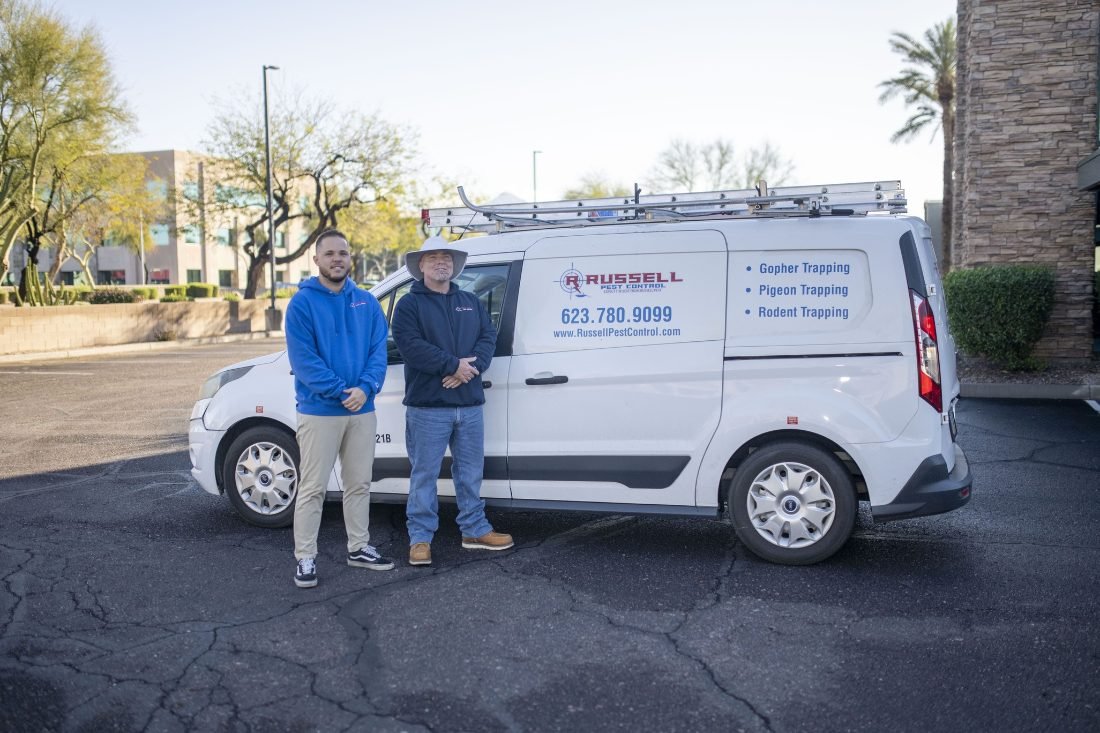
Thirty years of Arizona desert work, with a second generation on the routes. One call gets Steve, Steven Jr., or the office. Never a call center.
We survey the lot you actually have. On these streets that means opening the gate before drawing any conclusion from the front of the house.
No contracts and no initial fees on residential service, and a 15-day re-treat warranty if something comes back inside the window.
We tell you which animal you have before we quote anything, because the two programs barely overlap.
Arizona OPM License #I5321B, and a family company that's been answering its own phone in the Valley since 1996.
What Else We Run in Ahwatukee
Rodent Exclusion and Home Seal
Roofline screening and whole-house sealing, each scoped and priced as its own job.
Scorpion Control and Black Light Search
An after-dark pass that maps what's on the surface and the routes it travels.
General Pest Control Plans
Monthly, bi-monthly, or quarterly, with no contracts and a 15-day re-treat warranty.
View Fence and Snake Screening
For the yards where an Ahwatukee lot meets open ground or a channel bank.
Mosquito, Bee and Weed
Station-based mosquito work, live bee relocation where a beekeeper can take the colony, and pre-emergent timed to both desert weed seasons.
Commercial and Property Management
Documented programs for buildings, food service, and association common areas.
All Ahwatukee services: /ahwatukee
What You Get on the First Visit
A first visit is an identification, a walk-through of everything the street cannot see, and a written list stating which animal you have, where it is living, and what removal and sealing would involve. The identification determines everything that follows, and getting it wrong is how a household ends up paying for the wrong program for a season. The walk and the written list are free either way, whoever ends up doing the work.
Expect the best from Russell Pest, and have a bug-free day.
Hours
- Monday–Friday: 8:00 AM – 5:00 PM
- Same-day & emergency service available — after hours and weekends, owner-answered
(623) 780-9099 · Call or text · 6750 N 7th Ave, Phoenix, AZ 85013