
Home Seal in Ahwatukee — Some Holes Are Supposed to Be There
Go and look along the bottom of your back wall, the golf-course side if you have one. On plenty of Ahwatukee lots, there's a course of open decorative block down there, or a set of square holes at grade. It looks like damage, and it doesn't behave like damage: yards along there drain out through those openings onto the ground beyond, which means the wall you assumed was solid is doing a job you didn't know about. Which is also why filling it in, the instinct everybody has, is the one thing you must not do.
Find It, Clear It, Screen It
Walk the base of every wall
Not the top, not the caps. The bottom four inches, all the way round, with the planting pulled back where it needs to be. Openings at grade are the ones that matter, and they're the ones nothing ever gets trimmed away from.
Work out what each opening is for
A drainage opening, a weep hole, a gap where the wall meets a slab, or a hole with nothing left to do. Those four get four different answers, and the mistake we spend most of our time undoing is somebody who gave all of them the same one.
Clear what has been packed
Where an opening's been filled with dirt, decomposed granite, or root mass, it gets cleared, because a blocked drainage opening is a water problem waiting for a wet August. This is the part that surprises people: on this page, the first job is sometimes to open something up.
Screen it, and only then
Weep holes get screened rather than plugged, because they ventilate the wall cavity. The same applies to a drainage course on a larger scale. It gets a screen sized to the gap that matters, fixed so it can be cleared again, and it carries on doing the job it was built for. That principle runs through the whole job: an opening with a function keeps it and gets screened or detailed, and an opening with no remaining purpose gets closed properly.
Then everything else
The ground line all the way round, the garage, the roofline terminations and every penetration between them, closed or screened and written down. We seal to a sixteenth of an inch, because that's the gap a bark scorpion gets through. Rodent work uses a wider threshold and bee work is different again, so a scope should tell you which standard applies where. If somebody quotes you sealing without naming a gap size, ask.
The Wall Somebody Already Fixed
A household calls about scorpions on the patio and mentions, almost as an aside, that they had the back wall sorted a few years ago. What that turns out to mean is that somebody mortared the openings shut, or packed them with rock and pushed a bed of granite up against the outside so it looked tidy.
It was done with the right intention, and it does two things at once. The water that used to leave the yard now sits in it, which is a problem that only shows up during a monsoon and that nobody can trace back to the wall. And it doesn't even keep anything out. Mortar shrinks away from block over a few desert years, and rock packed into an opening is a run of voids, which is closer to a scorpion's idea of a good address than the open hole was.
The Openings at Ground Level
The ones with a job
- Decorative or pierced block courses set at grade to pass yard drainage through the wall
- Weep holes in a block wall, which ventilate the cavity and are never plugged
- Weep screed at the base of the stucco, which is a drainage detail and not a gap
- Scuppers and through-wall pipes where a yard drains to a channel bank
The ones with nothing left to do
- Old irrigation sleeves through the wall from a system that was replaced
- Conduit stubs from a low-voltage run nobody has used in fifteen years
- The gap where a patio slab has pulled away from the house
- Openings under a gate post or where a wall meets an older wall at a different height
And the rest of the building
Everything above ground level is the ordinary whole-house list, and it is the same list here as anywhere in the Valley: the roofline terminations, the vent screens, the garage door seal and track, the utility penetrations, and the ground line all the way round. None of that is Ahwatukee-specific. The wall base is.
The Wall Was Never the Barrier
Ahwatukee sits on ground that moves a lot of water when it rains, and the drainage was incorporated into the plan here rather than added afterward. One piece of it is small and easy to miss: along lots backing the golf course, yards drain out through open decorative block at the base of the perimeter wall. If your back wall faces a channel or association drainage ground rather than the course, it is worth checking the same way, because the situation there may be different.
Which is sound drainage and a permanent opening
Water leaving a walled yard has to go somewhere, and a wall that stops it just moves the problem to your side. So the opening earns its place. It is also, from a pest point of view, a doorway at ground level, in shade, on the side of the property facing planted ground. Nothing about it is a mistake. It's just a fact about the building that a standard sealing checklist has no line for.
And a lot of them are packed solid now
Beds get raised, granite gets topped up, roots find the openings. A blocked one is a drainage question first and a pest question second, and it's worth knowing which of yours are open and which are packed before anybody decides anything. Finding out takes ten minutes and a hand trowel. Clearing one that has been packed for years is a different job. Gloves and closed shoes, and never reach into a pile you can't see into. The same harborage holds bark scorpions, and near open ground it holds snakes. If something has sat undisturbed for months, don't move it by hand. For a snake, that's a call to a licensed wildlife removal service or Arizona Game and Fish, and a bite is a 911 call. For anything else, leave it for us. A shaded wall base with an opening in it is also where a black widow would choose to be, so light it before a hand goes near it.
Two lots on the same street can be different lots
Open block at the base means the situation this page describes. Solid block all the way to the ground means you have an ordinary sealing job that starts at the house. Which one you have is not something anybody can tell from an address, and it changes the shape of the quote as well as the number on it.
What Home Seal Costs in Ahwatukee
One clarification on the badge above and the terms below: the 15-day re-treat warranty covers treatment service. Home Seal carries its own one to two year warranty, and the two are separate things.
Square footage, roof access, how much perimeter wall you have, and how many openings the survey finds are what move the number. Clearing packed drainage openings is hand work, and it is quoted as its own line, because it is a job somebody could reasonably do themselves
The standing Russell terms apply here: no initial fees, no contracts, and a 15-day re-treat warranty
Black Light Scorpion Search: $125 per hour, after dark. We'll tell you what we expect your property to take before we start
Home Seal is quoted as its own job, typically $600 to $2,500 with a one to two year warranty, depending on the work
Estimates are free. Attic and hive searches can carry a charge, waived if you hire us
What Ahwatukee Homeowners Ask Us
Can't we just fill the drainage openings in?
Please don't. That water has to leave your yard, and a filled opening sends it back toward the house, which is a far bigger problem than the one you were solving. Screened, the opening keeps working and stops being a doorway.
How do I know whether mine are open or blocked?
Open block reads as a row of square or patterned holes at grade, usually a single course. A blocked one looks like nothing at all, which is exactly why nobody has ever noticed it.
We don't back the course or a channel. Does this page apply?
The drainage-block part may not, and plenty of Ahwatukee lots don't have it. Everything else does: the weep screed, the garage, the roofline, the penetrations and the ground line are the same job on any lot in the village, and that is most of what a whole-house seal consists of.
What does a screen on something that size actually look like?
Stainless or galvanized mesh sized to the gap that matters, cut to the opening and fixed so it can be taken off and cleared later. It has to be removable, and it has to actually get cleared: a screen collects the leaf litter and granite that used to wash straight through, and one nobody looks at silts up and becomes the blocked opening you were trying to avoid in the first place. Check it after the first few storms of each monsoon and pull whatever has gathered against it.
Is our association going to have an opinion about this?
Probably, since perimeter walls are usually covered by design rules and a golf course counts as somewhere the wall is visible from. Some associations here want a written submission before any work on a wall starts, even a repair, so ask yours first. It is a short conversation, and it is easier than undoing something, but check before you commit to anything visible from common area.
Will sealing replace our pest service?
No. Sealing reduces how much gets in, which is what makes a treatment program hold. It doesn't replace treatment, and a quote implying otherwise is selling you something. Where a property needs both, we price them separately so you can see what you're buying.
Can you do same-day service in Ahwatukee?
Often, yes. Call or text before noon, and same-day is realistic more often than not, and an indoor sighting is the kind of call we try hardest to fit in. After hours, the phone reaches Steve's cell for triage.
Do you treat termites in Ahwatukee?
No, and we're straight about it. We'll identify termite signs honestly and refer you to a licensed termite specialist, then handle everything else on the property. Straight lanes, straight answers.
What Else We Run in Ahwatukee
Scorpion Control and Black Light Search
An after-dark pass that maps what's on the surface and the routes it travels, plus sealing to the scorpion standard.
General Pest Control Plans
Monthly, bi-monthly, or quarterly, with no contracts and a 15-day re-treat warranty.
Rodent Control and Exclusion
Removal before anything gets sealed, then screening at the roofline and the ground line.
View Fence and Snake Screening
For the yards where an Ahwatukee lot meets open ground or a channel bank.
Mosquito, Bee and Weed
Station-based mosquito work, live bee relocation where a beekeeper can take the colony, and pre-emergent timed to both desert weed seasons.
Commercial and Property Management
Documented programs for buildings, food service, and association common areas.
All Ahwatukee services: /ahwatukee
Why Ahwatukee Homeowners Choose Us for Sealing
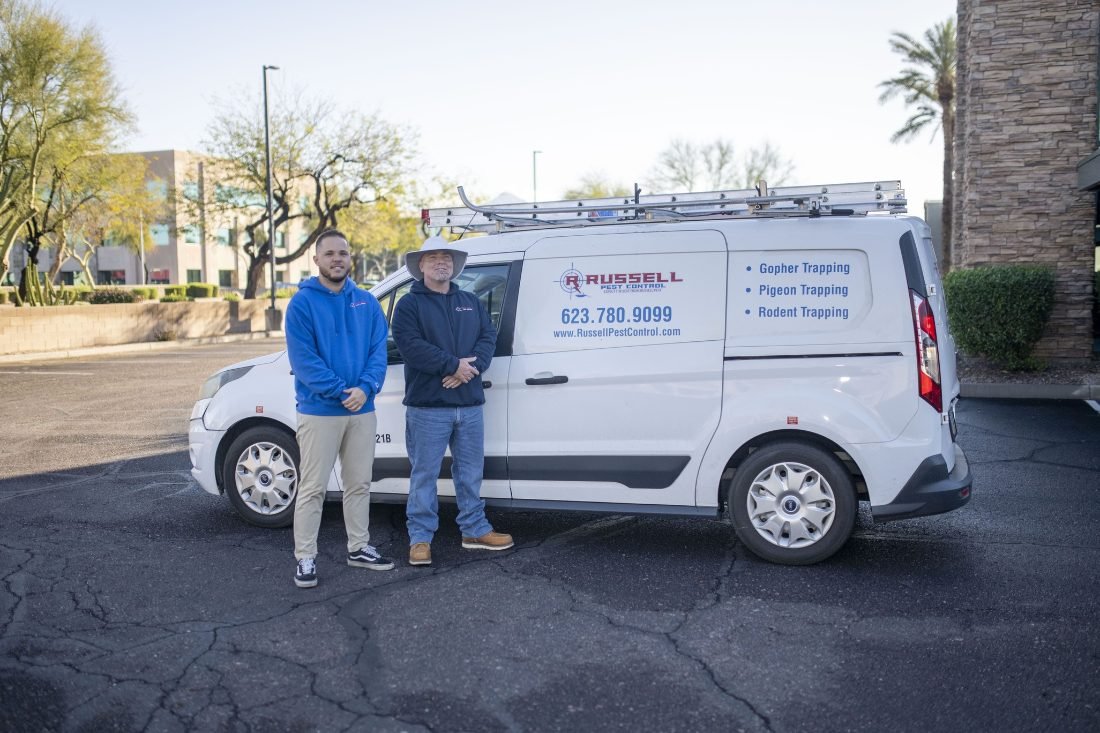
Thirty years of Arizona desert work, with a second generation on the routes. One call gets Steve, Steven Jr., or the office. Never a call center.
We work out what each opening is for before deciding what to do with it, and we clear a packed one before we screen it, because screening over a blockage locks the blockage in.
Arizona OPM License #I5321B, and a family company that's been answering its own phone in the Valley since 1996.
Ten Minutes and a Hand Trowel
Pull the planting back from the bottom of your back wall and see what is there. If there is open block, don't fill it. That is the one instruction on this page that matters more than anything we would sell you. Call us, and we will screen it properly and survey the rest of the building while we are out. If there isn't, say so on the phone, and we will price the ordinary version. The walk and the written list are free either way, whoever ends up doing the work.
Expect the best from Russell Pest, and have a bug-free day.
Hours
- Monday–Friday: 8:00 AM – 5:00 PM
- Same-day & emergency service available — after hours and weekends, owner-answered
(623) 780-9099 · Call or text · 6750 N 7th Ave, Phoenix, AZ 85013