
DIY Tips for Weed Control in Your Phoenix, AZ, Yard
Your gravel looks clean in the morning and by afternoon there are weeds pushing through it again. In Phoenix, AZ, that cycle is not a sign you are doing something wrong. It is a sign that desert weeds are exceptionally good at exploiting the Valley's climate in ways most homeowners do not expect.
Arizona weed control is not a once-a-season project. The combination of year-round warmth, sandy soil packed with dormant seeds, and a monsoon season that triggers mass germination means staying ahead of weeds requires understanding how and when they grow, not just how to pull them out.
Know What You Are Actually Fighting Out There
Not all Phoenix, AZ, weeds behave the same way, and treating them without knowing which type you have is one of the most common reasons weed problems keep returning. Annual weeds like puncturevine, spotted spurge, and Russian thistle complete their full life cycle in a single season, germinate fast, and produce seeds that remain viable in the soil for years after the parent plant is removed.
Perennial weeds are the harder problem. Species like Bermuda grass, silverleaf nightshade, and field bindweed develop deep, aggressive root systems that regrow from even small root fragments left behind after pulling. A Bermuda grass plant that appears removed at the surface is often still fully alive several inches down, ready to regenerate within days under Valley heat.
Grassy weeds like crabgrass and Bermuda grass are particularly frustrating for Phoenix, AZ, homeowners because they blend visually into desirable turf until they have already established enough to be difficult to remove cleanly. Broadleaf weeds like spurge and puncturevine are easier to identify early but spread deceptively fast in Arizona's sandy, well-drained soil once monsoon moisture arrives.
The Monsoon Does More Damage to Your Yard Than You Realize
Monsoon season in Phoenix, AZ, runs from June through September, and the surge of warm moisture it brings to desert soil is exactly what thousands of dormant weed seeds have been waiting for. Spurge, crabgrass, pigweed, and puncturevine are among the fastest responders, capable of germinating and establishing visible growth within days of the first significant rain.
The pattern catches many Valley homeowners off guard because the yard looked fine in May. What appears to be an overnight weed explosion is actually the result of seeds that have been sitting in the soil for months or even years, waiting for the right combination of moisture and heat. Monsoon conditions deliver both simultaneously, which is why post-monsoon weed surges across Chandler, Gilbert, and Mesa, AZ, feel so sudden and so overwhelming.
The window between germination and seed production is narrow with annual desert weeds. Spurge, for example, can go from a small seedling to a seed-producing plant within a few weeks under Phoenix summer conditions. Every weed that reaches maturity during monsoon season deposits a new generation of seeds into the soil, compounding the problem for the following year. Acting during the germination window rather than waiting for full growth is always significantly more effective.
Why Timing Your Treatments Changes Everything
Pre-emergent herbicides are one of the most misunderstood and underused tools available to Phoenix, AZ, homeowners. Applied correctly to the soil surface before seeds germinate, they create a barrier that prevents seedlings from establishing rather than killing weeds already growing. The distinction matters enormously because pre-emergents are far more effective and require far less effort than trying to remove established weeds after the fact.
The timing challenge in Arizona is that two separate germination windows require two separate applications. The first runs in late winter through early spring, when cool-season weeds like redstem filaree and mustard species begin germinating. The second arrives in late spring before monsoon season, targeting the summer annuals like spurge and puncturevine that dominate Valley yards from July through September.
Most homeowners apply a single treatment and assume the property is covered for the year, which leaves one germination window completely unprotected. A pre-emergent applied in February may have broken down before monsoon season arrives in July, leaving the soil wide open for the summer surge. Understanding both windows is what separates a weed management program that actually works from one that only works half the time.
Hand Pulling Works, but Only If You Do It Right
Hand weeding remains a legitimate and effective method for managing weeds in Phoenix, AZ, landscapes, particularly in gravel yards, around cacti, and in garden beds where chemical applications need to be avoided near desirable plants. The critical detail most homeowners overlook is root depth, which varies considerably between young weeds and established ones.
Young weeds pulled within the first week or two of germination typically have shallow roots that come out cleanly with a simple pull or a basic hand tool. Waiting even a few additional weeks allows roots to anchor deeply into Arizona's soil, at which point pulling the visible plant leaves enough root material behind to regenerate. Established puncturevine roots in particular require loosening the surrounding soil before attempting removal, and its sharp burs should be removed from seed heads before pulling to prevent spreading them to new areas.
The practical rule for hand weeding in Phoenix, AZ, yards is to work after rain or irrigation when soil is loose enough to extract full root systems cleanly. Dry, compacted desert soil makes complete extraction nearly impossible and dramatically increases the rate at which pulled weeds return from root fragments. Pulling weeds at the right soil moisture level makes the difference between actually removing a plant and simply pruning it.
The DIY Chemical Options and Where Each One Falls Short
Post-emergent herbicides kill weeds that have already sprouted and are the right tool for addressing visible growth that was not caught before germination. In Phoenix, AZ, gravel and rock landscapes, they are often the primary option because pre-emergents can stain decorative stone when applied incorrectly. Glyphosate-based products work on a broad range of Phoenix weeds but require direct leaf contact and will not affect seeds in the soil around the plant.
Vinegar-based solutions are a popular DIY alternative that appeal to homeowners concerned about chemical exposure around children and pets. The catch in Arizona is that standard household vinegar at five percent acidity is not sufficient for most desert weeds. Effective results require acetic acid concentrations of at least ten to twenty percent, which are stronger than what most stores carry, and even those concentrations affect only the plant tissue they directly contact rather than the root system.
Salt-based applications will kill surface growth but progressively damage soil structure when used repeatedly in the same area, reducing the ability of desirable plants to grow in those spots over time. Cornmeal gluten, sometimes suggested as a natural pre-emergent, requires large quantities to show any weed suppression in outdoor desert conditions and breaks down quickly in Arizona's heat. Each DIY chemical option has a narrow effective range, which is why most Phoenix, AZ, homeowners cycling through them see inconsistent results across seasons.
The Goathead Problem Deserves Its Own Conversation
Puncturevine, known colloquially as goatheads across the Phoenix Valley, deserves special attention because it is one of the most damaging and most painful weeds Arizona homeowners deal with. The mature plant produces hard, spined seed capsules that separate from the plant and embed in shoes, pet paws, bicycle tires, and bare feet with a sharpness that causes immediate and memorable pain.
A single mature puncturevine plant can produce thousands of seed capsules in a season, and those capsules remain viable in the soil for up to five years. Walking through an infested area unknowingly carries seeds to new locations, which is how puncturevine spreads from one part of a yard to another or from a neighbor's property into yours over the course of a single season without any obvious explanation.
Managing puncturevine in Phoenix, AZ, landscapes requires removing plants before the burs form, which means acting early in the growing season when plants are still small and soft. Once burs are present, disturbing the plant spreads them further rather than containing the problem. Pre-emergent application in spring specifically targeting puncturevine's germination window, combined with careful early-season hand removal, is the approach that produces results that actually hold through the summer.
What Gravel Yards Get Wrong About Weed Prevention
Many Phoenix, AZ, homeowners install decomposed granite or decorative rock specifically to reduce weed maintenance, and most discover within a season or two that gravel landscapes are not as weed-resistant as expected. Windblown seeds settle between rocks easily, organic debris accumulates over time creating a thin layer of soil above the barrier, and any gaps or deterioration in landscape fabric beneath the gravel quickly becomes a germination zone.
Landscape fabric installed under gravel does suppress weed growth when it is new and intact, but it deteriorates over time under Arizona's intense UV exposure. Torn or compressed sections allow roots to penetrate, and weeds that establish through those gaps are often harder to remove cleanly than those growing in open soil because the roots tangle in the fabric below the rock surface.
The practical maintenance approach for gravel landscapes in Phoenix, AZ, is applying a pre-emergent over the rock surface before each germination season, which creates a soil-level barrier even where fabric has degraded. Post-emergent spot treatments applied carefully to individual plants before they seed prevent the next generation from adding to the soil seed bank. Neither step alone is sufficient long term, but combining both consistently is what keeps Valley gravel yards genuinely low maintenance rather than just low maintenance in theory.
Ready to Stop Chasing Weeds Every Season? Call Russell Pest Control
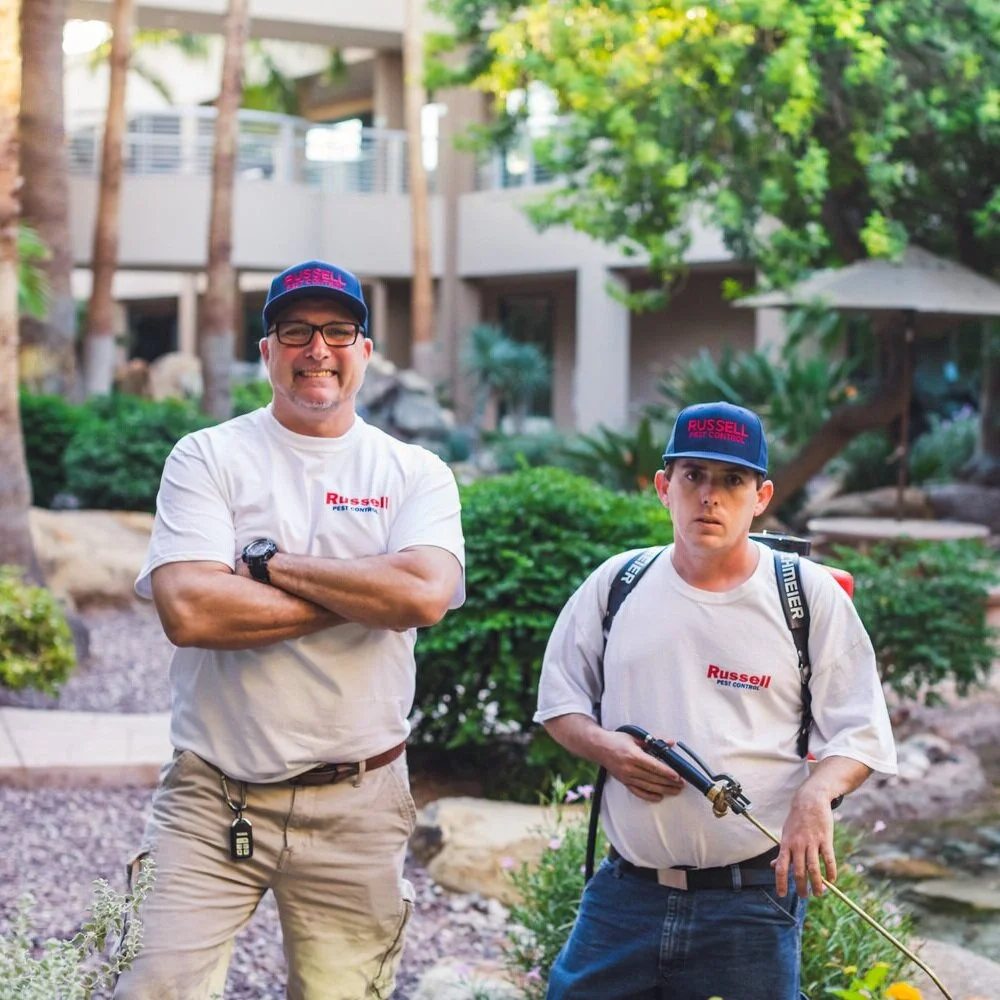
If you've been pulling, spraying, and treating the same weeds every season without getting ahead of them, the issue is almost certainly timing, species identification, or the seed bank already built up in your soil. Russell Pest Control has been serving Phoenix Valley homeowners with professional weed control since 1996, and our licensed technicians understand Arizona's weed cycles, monsoon timing, and the specific species that make Valley properties so difficult to keep clean.
We offer monthly, bi-monthly, quarterly, bi-annual, and seasonal weed control programs tailored to your property's specific needs across Phoenix, Scottsdale, Mesa, Chandler, Gilbert, Glendale, Tempe, Peoria, and Surprise, AZ. Our environmentally responsible applications target the right weeds at the right time, using pre-emergent and post-emergent strategies built around Arizona's dual germination windows rather than a one-size-fits-all approach.
No hidden fees, no gimmicks, and no contracts you did not ask for. Russell Pest Control provides free estimates and honest service recommendations built around what your property actually needs. Contact us today and let us put together a weed control program that works with the Phoenix climate rather than constantly reacting to it.
